The Hour of Pearl

“It is the hour of pearl — the interval between day and night when time stops and examines itself.” This quote from Cannery Row is one of John Steinbeck’s most famous lines. You will make your own interpretation of its meaning, but I find it especially relevant to our world today. We could use a pause, a time-out to examine where we are heading ourselves.

An equally poignant but less-known quote from Cannery Row (published in 1945), delineates dilemmas that remain in American culture almost 80 years later: “The things we admire in men, kindness and generosity, openness, honesty, understanding and feeling, are the concomitants of failure in our system. And those traits we detest, sharpness, greed, acquisitiveness, meanness, egotism, and self-interest, are the traits of success. And while men admire the quality of the first, they love the produce of the second.”   

Steinbeck’s Cannery Row did not dwell on the lives of factory workers or managers who narrow their interactions by sheltering-in-place in offices; instead, the novel shed light on people who occupy life’s stage at the end of the workday, often with little shelter in the nighttime. And guess what? Cannery Row, as a film, was banned in New York; it was considered “socialist.”  Eleanor Roosevelt is given credit for intervening and supporting the filmmaker.

We still have individuals existing on the edges of mainstream society. We still ban works of art.   

The good news? There are proactive organizations working on America’s deep-seated inequities. Illinois ACEs (Adverse Childhood Experiences) Response Collaborative recently featured IL Lieutenant Governor Juliana Stratton in a webinar. Stratton spoke on Illinois’ 5th annual Trauma-informed Awareness Day. She described the impetus to create trauma-informed and healing-centered systems change. As a first step the IL General Assembly passed Senate Bill 646: “Task Force to Create a Healing-Centered Illinois.”

Stratton outlined a healing-centered future. Addressing people’s traumas and meeting basic needs are steppingstones. For example, individuals who have served prison time come out feeling “still imprisoned” because they cannot find employment. Healing-beyond-harm restorative justice needs to be highlighted in our justice system. Food insecurity must be addressed.

Join the ACEs Response Collaborative online audience Q & A (offline):

  • What is one word that comes to mind when you think of a healing-centered state? Online: Hope, empathy, compassion, peace, justice, acceptance…
  • What would it take? Online: Dropping stigmas, having a family voice, cross-sector communication, education, funding…
  • What is happening in your community? Online: Youth harm-reduction, youth prevention education, integration of community efforts, child advocacy for physical and sexual abuse, online restorative justice programs, coaching through a trauma-informed lens, training organizations about trauma…
  • If you could make ONE thing happen overnight…Online: Free mental health services for every individual, train parents in universal programming, remove punitive charges for drug-related issues, universal healthcare….

Keep in mind, health has the word “heal” in it.

Pearls of Peace (PoP) Quiz

193.What composes a healing-centered state in your opinion?

194. What are your personal steppingstones for a healing-centered life?  

Peony Pearls

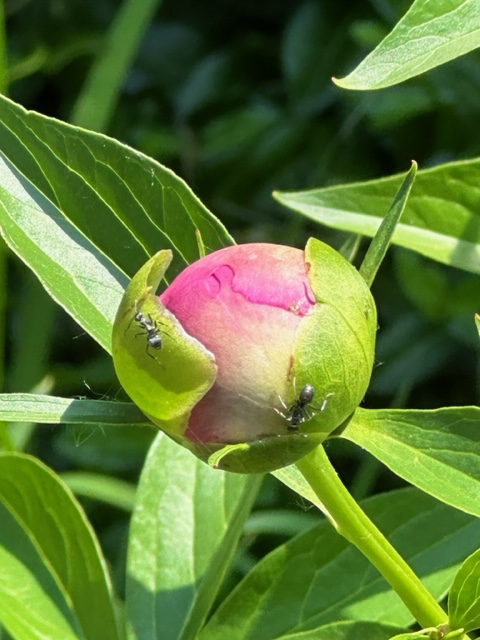
Have you ever noticed the intense action on peony buds?  My budding peonies are covered with workaholic ants. To be honest, I don’t know how many hours a single ant puts in – yes, they all look alike – but ants certainly are busy at dawn and keep working until dusk. Do some ants work harder than others? Do ants have work shifts? Yes, dear reader, I ask a lot of questions. It is because I am forever curious.

With the help of Ryan Pankau, University of Illinois Extension Horticulture Educator, I can share a few answers about this topic:

  • Ants have an interdependent relationship with peonies.
  • Peonies provide food for the foraging ants – a sweet and sticky coating on their sepals, the greenery covering the flower bud. 
  • A scout ant leaves a pheromone map for others in the ant colony to also locate this food source.
  • The benefit to peonies is that ants defend their commissary! Ant active duty includes removal of other insects who may damage the flower bud.

We often do not recognize (or misinterpret) interdependence in human culture. This brings to my mind the banning of books in several states. While there are different interpretations of what a comprehensive education for children might look like, removing certain books from school libraries and classrooms certainly does not deliver an interdependent (i.e., survival) education. True learning takes a comprehensive understanding of historical legacies as well as current issues. Book-banishing stems from peoples’ fears.   

According to PEN America, a 2022 poll suggests that over 70% of parents believe that book banning is wrong. The PEN Charter was formed in 1948 and is committed to challenging disinformation because it threatens democracy. One of their recent reports highlights our current mis/disinformation and polarization of issues in our country: Communicating During Contentious Times. This interdependent topic applies to school classrooms as well as school board meetings. However, nonviolent communication skills seem lacking in some settings.

I recently called my only remaining aunt on the phone. She had shared some email details about her parents’ (my maternal grandparents’) interdependent love story on the occasion of the 102nd anniversary date of their marriage. Grandpa told his beloved that he would choose the month of their marriage – June – and she could choose the day. Grandma, apparently without missing a beat, said June 1st. While a century ago it was an era when men often were the deciders in a marriage, this tidbit of collaboration is fascinating. It does take two to tango (in their own ways) for any relationship.

Peony pearls seem to communicate to their ants, “You have my back! Dance on! Let me feed you.” If peonies and ants have interdependence figured out, what’s the problem with people?

Pearls of Peace (PoP) Quiz

191. Where do you see interdependence working well in our culture? 192. When are times that you are challenged by interdependence?  

The Armor of Wisdom

As May’s Mental Health Awareness Month comes to a close, can we say that the U.S. is more “aware” of the precious bodymind health of all citizens? It has been another challenging month with an average of about one mass killing weekly and little movement in the halls of government to address meaningful gun control measures.

On this Memorial Day there is plenty of grief welling up in our collective atmosphere. The evening news brings graphic pictures and heartbreaking stories from Ukraine; mass killing is likely a daily occurrence in this unfortunate war. Among surviving soldiers, how many will join the considerable ranks of veterans from other wars in battling dissociation and PTSD? Combat armor may save one’s physical life but it cannot protect one’s mental health.

Some believe that protective armoring is needed after death. Chinese Emperor Qin Shi Huang was buried in 210 BCE among a massive troop of clay warriors closely lined up to protect him for eternity. The buried clay army of 7000 soldiers with terracotta chariots, horses, and wagons standing “at the ready” is an impressive picture book about the desire for protection.

Initially discovered by farmers who were digging a well in 1974, an additional 200 terracotta figures were unearthed in 2020. These amazingly intact clay soldiers each have unique features; different stances, facial features, helmets or weapons distinguish their warrior personalities. But how did ancient people care for their mental health?

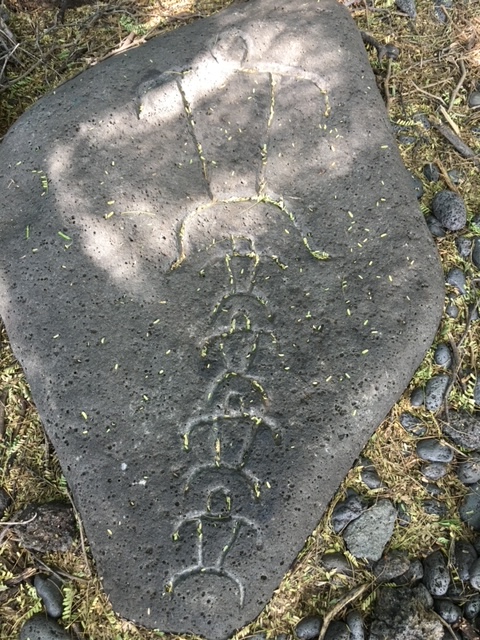
I am a huge fan of petroglyphs, not because I can interpret them, but because I admire these early “writers” who published their “stories” on rocks. My guess for the above Hawaiian petroglyph is that it tells the story of family in some sense. Is it one parent giving birth to several children? Or is it intergenerational? Is this an early version of LinkedIn? You will make your own interpretation, but there is some belonging connection among the figures. Is their purpose to stay close to one another for protection? 

Feeling safe and protected is key for one’s mental health. Too many individuals in the U.S. feel like they have a target on their back.

American Buddhist nun Pema Chödrön writes with wisdom (When Things Fall Apart — Heart Advice for Difficult Times): “When we protect ourselves so we won’t feel pain, that protection becomes like armor…We do everything we can think of not to feel anything threatening…[however] breathe in pain…[to] penetrate that armor…With the in-breath the armor begins to fall apart, and we find that we can breathe deeply and relax. A kindness and a tenderness begin to emerge. We don’t have to tense up as if our whole life were being spent in the dentist’s chair.”

Together, we must find ways to integrate inner peace within day-to-day activities to function as our best selves. Let’s arm ourselves with wisdom.

Pearls of Peace (PoP) Quiz

189. What words of wisdom speak to you about mental health awareness?

190. How might we learn lessons from the ancient ones?

Nature’s Balancing Act

If you ever doubted the interdependent web of all existence, the orange daylight sun in Chicago — after wildfires went on a rampage in Canada — was an eerie reminder that what affects one part of the planet affects us all. This interdependence is apparent everywhere. In giving garden tours recently in Lurie Garden in Chicago’s Millennium Park, I met people from Peru, Australia, and a botanist from Switzerland. Discussing shared international interests in plants is one step toward a peaceful planet.

Meanwhile in Lurie Garden, a bushy-tailed red fox nurtures 6 kits in the romper rooms of several tree surrounds along a garden sidewalk. With many mouths to feed, the garden is agitated with activity under the foliage past twilight. Bunnies and birds beware! The Fox clan is a relentless and voracious hunting party, yet very affectionate with their cute kits.           

Consider baby fox facts:

  • Fox kits have such acute hearing that they can hear mouse squeaks from 100 meters. They detect rodents when they dig underground.
  • Scent also is keen. Baby fox odor is comparable to skunk spray! It is fox fragrance for identification, marking territory, and later mating. 
  • This acute sense of smell detects threats, communicates within the fox family, as well as finds fox food favorites (mice and birds).

Food-finding is interdependent and a balancing act for all critters, including humankind. One suggestion for families to better feed themselves comes from Cara Rockwell, a professor at Florida International University. After her initial Peace Corps volunteer work in agroforesty in Paraguay, she is dedicated to natural resource management research. She studies “food forests.”

In her own yard in Miami, Rockwell created a “forest” of 10 edible species in a six-square-foot patch. She grows taro in the ground, spinach above ground, and has passion fruit vines climb a trellis: a mulberry tree, a star fruit, and a dwarf mango flutter overhead. She claims that her food forest is more resilient with its tight planting in the high temperatures and long dry spells of Floridian summers.  

Elaine Fiore is another Florida food forest enthusiast. She helped create 24 food forests for schools in Broward County. School children are taught microclimate knowledge. Some kids enhance their “forest” with toy dinosaurs. In one enterprising garden, iguana families devoured a third of the garden, especially the young sweet potato vines. Beware of iguanas! Fiore’s future plans include using any produce in school cafeterias for better nutrition for kids. This has amazing possibilities.

Primatologist Jane Goddall advises, “Only if we understand, will we care.”

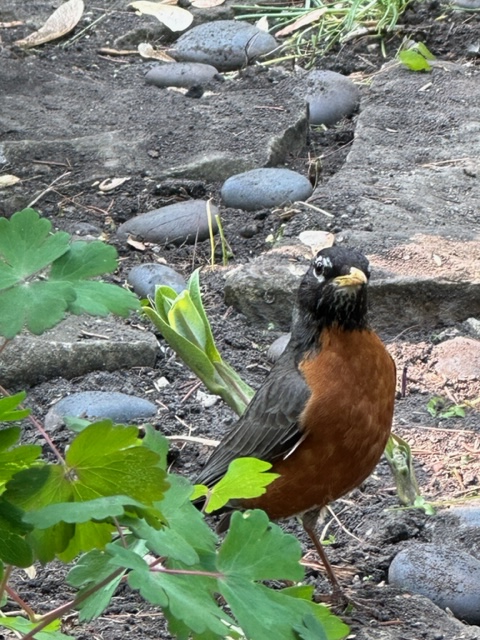
In my backyard forest I watched a foraging robin tip-toe closer to me while I was seated in soil, digging up chickweed from overtaking my stepping-stones. When I did not seem threatening, Robin kept hopping a few inches closer until we were 2 feet apart. Interdependently, s/he seemed to ask, “Where’s the worm?”

Pearls of Peace (PoP) Quiz

187. What bit of land do you have access to for food-forest produce? 188. How might our planet feed people better with interdependence in mind?        

Mothers: An Endangered Species?

Ancestor (2022) by Bharti Kher, New York City Central Park

Every day is Mother’s Day. All of us owe thanks to mothers for bringing us through 9 months of magical transformation, labor and delivery. All of us are children of mothers and fathers, whether we know our biological parents or not. Some give birth while still kids. Some want to give birth and for one reason or another are thwarted. Others decide, for many possible reasons, that they cannot continue a pregnancy.

According to 2022 United Nations Population Fund research, nearly 50% of all pregnancies are unintended; between 2015 and 2019 there were about 121 million unintended pregnancies each year world-wide. Over 60% of unintended pregnancies and nearly 30% of all pregnancies result in abortion. However, 45% of all abortions globally are considered medically unsafe. These staggering findings include references to the war in Ukraine and other sexual violence crisis situations where birth control is not a viable option. For example, the prevalence of refugee women and girls who are victims of sexual violence is estimated to be 20% of them.

Additionally, the unwanted pandemic threw people into confusion about family planning. In 2020-2021 research involving 5000 women, 51% of the women either wanted to delay pregnancy or expressed less interest in having a child. In the first year of the pandemic, it is estimated that a disruption in the contraceptive supply chain resulted in many unintended pregnancies. When motherhood is at-risk, childhood also is at-risk.

I feel enormously grateful that I planned to be a mother. With the exception of an excruciating miscarriage, I experience motherhood as a tremendous honor to have given birth and be Mom to my children. I wonder how other mammal moms feel. Many appear truly dedicated. I watched a pride of female lions interacting with playful cubs in India; the mothers seemed watchful and “contented.” I imagined contentment, as the regal female lions lounged alongside a swimming pool of water. They lived in a game reserve where antelope picnics were plentiful. However, if one lives in poverty and/or war conditions, it is challenging to find food to feed oneself and any kids.

Australian scientists have a plan to grow plants on the Moon by 2025. The goal of Lunaria One is to grow plants for food, medicine and oxygen on the lunar surface to sustain human life on the Moon. Will this be like a lion’s game reserve?  

According to Lunaria One director Linda Fell, “We have to find species that will be able to tolerate a wide range of temperatures that can go from freezing to maybe up to 40 or 50 degrees centigrade…there’s radiation…we still have a lot to learn about how that will affect plants…we will need to grow plants for eating but also for wellbeing.”

This sounds like a grand adventure, but what about unintended pregnancy? Will contraception be readily available on the Moon?

Pearls of Peace (PoP) Quiz

185. What thoughts entered your mind this Mother’s Day?

186. Do animals make better parents than some humans?              

Ageism Pearl

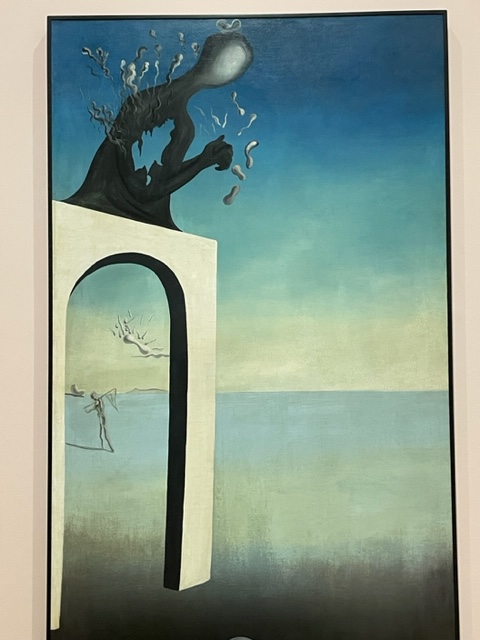
Dali: Dream of Venus (Visions of Eternity)

Recognize Your Own Ageism

Do you want to live in a place of your choosing? Nearly everyone, regardless of their age or disability, has reported in surveys that they prefer living in a community rather than an institution. The Administration for Community Living (ACL) was established to maximize the independence and well-being of people with disabilities across the lifespan as well as older adults. May is named “Older Americans Month” with a theme this year of Aging Unbound. One aspect of this theme addresses ageism in our culture.  

Other organizations also focus on ageism – AARP and American Society on Aging come to mind. According to research, 93.4 % of adults ages 50-80 experience one or more forms of ageism EVERY DAY.

While often negative, sometimes ageism takes a positive twist. I experienced a positive bit of ageism at my public library this week. After parking in the underground garage, I approached the stairwell leading to the first floor. I held the door open for a young woman right behind me, in case she also was stair-climbing. She turned to go to the elevator, gave me a once-over look, and then reconsidered, saying, “Well, if you are going to take the stairs, I can take the stairs too!” I gave her a serene smile.

Yes, all ages, take the stairs if it is possible for you! I am especially grateful for stair-climbing after months of slow healing from a sprained ankle that made stairs challenging. 

  • Gerontologists Lakelyn Eichenberger and Molly Carpenter recently presented an excellent webinar on ageism. Here are takeaways:
  • Ageism has many flavors — assumptions, stereotypes, and discrimination.
  • Benevolent ageism may view older adults as warm, friendly, but incompetent.
  • Functional age, or what a person can do, is overlooked regularly.
  • Even children’s books may depict older adults as “limited” rather than savvy about life.
  • Marketing tends to denigrate aging. (Greeting cards are notorious for bad jokes; “over-the-hill” party packs feature words such as “wrinkles” and “sagging.”)
  • An AARP study found older adults are under-represented in ads or are pictured in wheelchairs by themselves, not integrated with the world.  

While these takeaways may not surprise you, the most meaningful aspect of this webinar was when the presenters aimed their Powerpoint slides toward participants, asking us to recognize ageism in ourselves:

  • Do you equate looking old with looking “bad?” Are you ashamed of the physical signs of aging (wrinkles)?
  • Do you ever feel “too old” or “out of place?”
  • Do you embrace the aging experiences of older colleagues, neighbors or family members?
  • Do you discuss ageism with anyone?

One presenter admitted that she uses make-up to “cover” wrinkles, but she admires those who have given up make-up. It is a stereotype that women are acculturated to believe we need “foundation” facial products. What about concerning ourselves with the foundation of ageism and working on transforming U.S. cultural perceptions of aging?  

Pearls of Peace (PoP) Quiz

183. When do you need “cover-up” from your aging? 184. What does ageism mean to you?                                             

Pearls and Perils of Writing (and Life)

What are the parallels of writing and everyday life? Here are a few nuggets.

I was invited to illuminate book publishing and blogging for the Illinois Women’s Press Association this past weekend. Synchronicity smiled upon me as hot-off-the-press copies of my new book, Transforming Retirement: Rewire and Grow Your Legacy, reached my doorstep 24 hours before the talk! I opened my box of books and felt a flurry of emotions.                                          

This may sound overblown but trust me on this – writing a dissertation or a book is filled with synchronicities and is like a mini-birth. It in no way compares with the intensity of real birthing emotions but there is a certain gravitas in cradling a bit of one’s creativity in your arms; both events call for deep breathing.

 I felt the weight of 5 years of work in holding this new book – recalling both moments of joy (writing watersheds) and suffering (publishing perils). I flashed upon the last leg of this writing journey – composing the index. I had indexed two previous books, but I somehow forgot how tedious this process was. (Parts of life are tedious too.) Frequent deep breaths were required to rewire my focus. Now discerning readers can condense the entire book concepts in the 12 pages of index. Aren’t there days when we need an index to navigate everyday life?

How can one condense meaningful ideas into pertinent words? Once Hemingway was asked to write a full story using only 6 words. His mysterious version suggests peril: “For sale: baby shoes, never worn.” I challenge you to write your 6-word life story. Here is mine: “Country gardener, city psychologist, lifelong learner.” Activist Gloria Steinem condensed: “Life is one big editorial meeting.” Author Frank McCourt was tongue-in-cheek: “The miserable childhood leads to royalties.” Thankfully, I did not endure a miserable childhood, but I also have not reaped many royalties in writing non-fiction books.

If your writing does not produce monetary sustenance, why write? There are as many different answers to this question as there are writers. Here is my take: writing, whether fiction or non-fiction, is one attempt to edit your own life story. Writers’ everyday life stories end up in their writing. Writer Natalie Goldberg admits that her only novel is a thinly disguised version of her ex-husband.

Author Joyce Carol Oates realized her basic need for connections: “Writing is like a dream that you are controlling…a wish to communicate your vision to other people…writing is communal…we see that we have some of the same experiences…you are not so isolated.” Yes, people do share many of the same experiences. This is everyday life!

Writing more than 60 works, Madeleine L’Engle offers this gem: “Inspiration usually comes during work, rather than before it.” Writing is work. Writing also gathers inspiring pearls. Who does not enjoy a daily dose of inspiration?

  Pearls of Peace (PoP) Quiz

181. What do you write? Emails? Texts? _______? 182. How does your writing relate to your everyday life?                  

Pandemic Pearls II

What, if anything, came into fruition for you during pandemic times?

My third book, Transforming Retirement: Rewire and Grow Your Legacy is my fruit of many years’ growth, both before and during the pandemic. When I lost the publisher of my first two books (my editor was furloughed in the pandemic), I had to search for a new publisher. This disappointment evolved into a blessing; I worked on the manuscript that I thought was “finished.” I reached out to my retirement survey participants to discover how the pandemic may have affected their retirement attitudes and plans. Their responses were a concoction of both angst and coping skills. Here is a sample:

  • 71, male: ““I actually had more contact with out-of-town relatives since I started using Zoom…[I] learned that I can still adapt at age 71.                                                              
  • 72, male: “[I] provided e-learning support and childcare for my grandchildren full-time…[it was] an all-encompassing commitment…[an] intense time with one set of grandkids was a gift, but the rest was severely compromising.” 
  • 73, female: “I’m totally responsible for my physical, cognitive, and social health…[I] need to push myself every day to improve every area…resilience is vital to well-being…[I’m] relishing unhurried days and spending more time contemplating nature.”                                                                                   
  • 77, female: Sometimes [I’m] feeling like in a twilight zone. At other times I feel very good and normal because of my work; both consulting and volunteer work continue to engage me, anchor me in qualitative ways with others.”

Transitioning into new territory is not easy, especially when your very survival depends upon staying physically well. Staying emotionally well during the pandemic also was a challenge for most people.

Well-lived years require ongoing rewiring. You edit your life story more than once! Actually, you rewire your bodymind through “rough cut” editing of daily changes. Initial transitioning involves saying good-bye to what you are losing. Was the transitioning your choice or did someone else (due to the pandemic) initiate the ending? Either way, belonging and ability needs may go unmet initially. Grieving often accompanies our endings.

A muddling-middle stage of transitioning is where confusion and angst may pile up. Your body may feel tense. Fearful and insecure parts of your personality can surface. You experience vulnerability when you are lost-in-a-maze of feelings and unmet needs. Your energy may plummet. This is a clue for you to tend to yourself with great care.

In transitioning well from any big change in your life, tend-and-befriend yourself with resilience that is larger than your grieving. For example, you might focus on the resilience of gratitude. Calling upon a grateful part of your personality coaxes a sense of calmness and clarity. Name and frame gratitudes in your mind.

I am grateful that I finally found a publisher for Transforming Retirement (available for online pre-order on Amazon or Barnes & Noble).   

Pearls of Peace (PoP) Quiz

179. What is one upside to your pandemic “time-off” from the way you usually did things?

180. How do you generally cope with transitions in your life?                             

Biodiversity Pearls

Cell biologist Bruce Lipton suggests that Charles Darwin may have been wrong about evolutionary gradualism. In a 1972 controversial paper, paleontologists Niles Eldredge and Steven Jay Gould proposed that evolution occurs in spurts (“sudden jumps”) and introduced their Punctuated Equilibrium theory. Eldredge/Gould argued that species have relative equilibrium until their development is “punctuated” by rapid change. Since I am not qualified to argue one way or the other, I wonder if there is any middle ground here. After all, we are addressing grounded fossil “facts.”

What is fascinating about Punctuated Equilibrium is that some “spurts” certainly affected evolution; they are labeled Mass Extinction Events. The most recent Event occurring 66 million years ago. Believed to be caused by an asteroid terrifying the Yucatan Peninsula, reportedly 75% of life forms disappeared, including exciting dinosaurs who had dominated every continent (including Antarctica) for 200 million years. Perhaps you gave up your fascination with dinosaurs after childhood, but I remain keenly interested, especially about their disappearance. Does anyone (other than 8-year-olds and me) care about losing dinosaurs? I have many unanswered questions. Did dinosaurs get Alzheimer’s?

Nicklas Brendborg, a Ph.D. student of molecular biology at the University of Copenhagen (Jellyfish Age Backwards: Nature’s Secrets to Longevity), writes about species who defy expectations. Mice get cancer but not Alzheimer’s disease. A tiny jellyfish, Turritopsis, has the uncanny ability when stressed–by hunger or sudden water temperature changes–to become a younger version of itself! It ages backwards. Mysteriously, this jellyfish evolves to adulthood once again. Such immortality moves are rare, but they occur in the wee ones — another jellyfish, Hydra, and a flatworm, Planaria. Brendborg suggests that longevity favors smaller people (and smaller dogs).

I am fascinated by how many large animals traveled the extinction path in the post-dinosaur age—the woolly rhinoceros, mammoth, 3-ton wombat, and an Australian 10-foot thunderbird weighing 1300 pounds (living 7 million years ago). Were these incredible giants doomed because of humans? Currently, humans seem intent on dooming other humans. Is this because they do not have a mammoth to conquer? Unfortunately, the mammoth’s relatives, elephants, are on the chopping block today for their ivory tusks. Will people take down the largest brain of any land animal?  

Elephants form close bonds. When two circus elephants were separated for 20 years and reunited, they recognized each other immediately with much affection. Elephants comfort one another in distress and grieve their dead. The seeds of many plant species rely on passage through elephant digestive tracts to germinate effectively. Why drive elephants into extinction? Is a peaceful planet just impossible?

Returning to Brendborg’s youthful wisdom, “There is so much in this world that drives us apart. We’ve learned the hard way that one of the best ways to unite people is through a common enemy.” What if the enemy is us?

We need a “sudden jump” in compassion to sustain biodiversity.

Pearls of Peace (PoP) Quiz

177. What nature “facts” fascinate you?

178. What might you do to sustain biodiversity?        

SuperAging Pearls

SuperAgers are social butterflies according to research; they flutter between family members and/or friends, often flitting off to join volunteer possibilities in their communities where they make new acquaintances. Does this sound like you? Perhaps you are more introverted and such fluttering around drives you a bit crazy. As Carl Jung wrote in Modern Man in Search of a Soul, “The shoe that fits one person pinches another; there is no recipe for living that suits all cases. Each of us carries his [her, or their] own life-form….”

First some bad news: brains shrink during one’s life-forming aging process. Next, some good news: brains thrive with novelty in one’s day-to-day fly-by activities and many of these actions can be solitary. A simple novel action for me is to dress with different combinations of clothes from my closet with different accessories EVERY day. Yes, I have too many colorful scarves and earrings, but different daily combos deliver an early-AM pep talk for more serious novelty-thinking during my day. You will choose your own brain-tickling novelties.

You may ask, “What exactly defines a SuperAger?”

  • SuperAgers have superior memories for the ability to recall everyday events and past personal experiences. Northwestern University SuperAging Research Program has studied this exciting group of folks (over the magic age of 80) for 14 years. To qualify, one’s memory had to test to be as good (or better) than healthy memories of those in their 50’s or 60’s. If your memory seems a tad rusty, read my Pearls of Peace blog, “Bodymind Pearls for Aging,” for memory exercises.
  • SuperAgers possess healthier cells in the entorhinal cortex, a critical area of the brain for memory functioning. According to neuropsychologist Tamar Gefen, Assistant Director of the Clinical Core of the NIA-funded Alzheimer’s Disease Research Center at Northwestern (within the Mesulam Center for Cognitive Neurology and Alzheimer’s Disease), the entorhinal cortex is “one of the first areas of the brain to get ‘hit’ by Alzheimer’s disease.” New memories rely upon entorhinal-hippocampal connectivity.   
  • SuperAgers have many more “von economo neurons” — located in the anterior cingulate cortex and believed to foster rapid communication across the brain, linking cognitive processing with emotional reactions. Humans are not alone in their potential to have these cells; great apes, elephants, whales, dolphins and songbirds also have them.
  • One theory considers that “von economo neurons” deliver humans an intuitive advantage in social situations.
  • You might guess that SuperAgers are active physically and lean toward positivity. They believe in challenging their brains every day, reading or learning something new; many continue working into their 80s.

Here is one summary of a SuperAging life (by Canadian writer Robin S. Sharma): “A great life is nothing more than a series of days well lived strung together like a string of pearls.”

Pearls of Peace (PoP) Quiz

175. Who are the SuperAgers among the people that you know?   

176. What novelties, both simple and more engaging, can you add to your days?