Growth Pains and Pearls

Growth has a variety of timetables. Growth through life’s Big-T and Small-T traumas is more difficult for some than others. All do not ripen at the same time or in similar circumstances.

Miriam Alarcón Avila, a visual, multimedia and storytelling artist, was born in Mexico City. She was 14-years-old when an 8.1-magnitude earthquake killed 10,000 people, including some of her friends. At 16 she ran away from home with a journalist ten years older with his promise of giving her a pawnshop camera and Fujifilm. Taking hundreds of pictures but never developing the black-and-white photos, Miriam dropped her love of photography to study science, marry a scientist, and emigrate with her family to Iowa.

Both her husband and children found dream educational possibilities. Miriam won a scholarship for a university course in black-and-white photography. By assisting her professor in his photography lab, she harvested her old photos and rediscovered parts of her legacy. Miriam’s dream was to work for National Geographic magazine; instead, her ripening took longer than she wanted.

Her husband completed doctoral studies in Iowa and planned a return to Mexico. Miriam and her two children did not want to let go of their own educational possibilities, so the family unit separated. Miriam and her children became “undocumented,” as her ex-husband’s visa as a foreign student no longer sheltered them. Years of stress-filled work allowed her to pay the bills, but it was a last-minute decision to attend a photography symposium one day that ripened her dream.

Miriam recalls crying at seeing the work of others. Warm encouragement was offered by a symposium speaker, Jonathan Woods, a photojournalist and producer at Time magazine. He told Miriam that she could pursue her dream when her children were in college in 4 years; he advised a 4-year plan. Miriam attributes this pearl of permission as a turning point: “In that moment, my brain just exploded.”

With a grant from the Iowa Arts Council in 2017 Miriam created her photo documentary project, Luchadores Immigrants in Iowa, with portraits of heroic Latino immigrants wearing masks (that she made herself) to protect identities. Miriam recalled a childhood hero, El Santo, a Mexican professional masked wrestler. A luchador is a person who fights or struggles to achieve goals. When her luchador subjects wear their custom-made masks, they feel empowered.

Harvesting hidden voices, Miriam interviews her photographic subjects and writes their history in poems. Her admirable goal is an effort to fight the false narratives of Latino immigrants to the U.S. She describes her work as fostering “…people from different cultures to see that in essence, we are all the same.” For other poignant immigrant stories, read Somewhere We Are Human, edited by Reyna Grande and Sonia Guiñansaca.

The time may be ripe for you to harvest some old dreams.

Pearls of Peace (PoP) Quiz:

133. When in your life did you drop a dream?

134. Is there a possibility to harvest some aspect of that dream today?

A Full Head

Queen Elizabeth I (reigning 1558-1603 in England) was fluent in 6 languages, studied the Classics and history for 2-3 hours daily, and wrote poetry. She was a skilled musician as well as dancer; for exercise every morning she practiced demanding dances, The Galliard or The Volta (which requires leaping ladies). The scholarly and athletic queen also loved being outside and taking long walks. She was a skilled huntress and enjoyed daily horseback rides. When her horses were not fast enough, her Master of Horse found fresh mounts from Ireland.

When Elizabeth was a tender 2 ½-year-old princess, her 35-year-old mother was beheaded at the Tower of London — Anne Boleyn’s grave error was in giving birth to a daughter instead of a son. Likewise, an 18-year-old step-mother, Catherine Howard, was executed at the Tower when Elizabeth was only 8-years-old. Before casting criticism, we might address why hammer-attacks to Paul Pelosi’s head occurred in 2022.  

Due to crass political scheming, Princess Elizabeth also became a prisoner of the dreaded Tower of London and narrowly escaped losing her 21-year-old head. She ascended to a 45-year throne as the Elizabethan Queen at age 25 when her half-sister, Queen Mary I, died.

It is no wonder that one of Queen Elizabeth I’s surviving poems (On Monsieur’s Departure) dwells on opposing states of mind: “…I seem stark mute but inwardly do prate. / I am and not, I freeze and yet am burned, / Since from myself another self I turned….”

Poets have understood throughout the ages that one’s mind is a concoction of cognitions and emotions that shift. Consider these lines from Stanley Kunitz’s The Layers: I have walked through many lives, some of them my own, / and I am not who I was, / though some principle of being / abides, from which I struggle / not to stray….”

Stanley Kunitz became Poet Laureate of the U.S. in 1974 and was appointed a second time in 2000 at the age of 95 when he was still publishing and promoting poetry! The last line of The Layers sets his intention to keep growing: “…I am not done with my changes.” Kunitz died at age 100, but at 98-years-young he kept growing, even in his dreams! One remembered dream embraced change: “…there seems to be a transformation going on in which I have a sense of a new life that I’m possessing…I feel I have found myself, my strength.”

This finding of strength acknowledges an inner self, soul or spirit in each of us that can hold onto a peaceful centering regardless of life’s traumas and transformations. We might think of this grounded calmness as an opening to access a full heart and a “full head” capable of growth.

Pearls of Peace (PoP) Quiz:

131. How often do you stop to notice that your thoughts and emotions about a given topic shift in opposing directions?

132. What are some times when you experience a full heart and full head?  

Pearls of Change

“…Change / Says the fields to the grass, / Seed-time and harvest, / Chaff and grain….” These words come from British poet, critic and scholar, Kathleen Jessie Raine (1908-2003). Her Scottish Mom, Jessie, wrote Kathleen’s poems for her when she was too young to hold a pencil! Raine’s love of poetry kept on giving through the seasons of her 95 years. She often captured the awe of nature, while also detailing how change is our constant companion, wanted or not.

Raine met the Prince of Wales (now King Charles III) and reportedly said, “…that poor young man – anything I can do for him, I will do, because he is very lonely.” A connection was made between poet and Prince as he later gave her much needed support through his patronage of her Temenos Academy of Integral Studies which she founded in 1990 as a “school of wisdom.” Just 2 years later Raine harvested more royal recognition as Queen Elizabeth II blessed her with a gold medal for her poetry. Did Queen Elizabeth II want to write poetry like Queen Elizabeth I?

There are harvest burdens and blessings.

Today begins a Celtic harvest holiday called Samhain (beginning at nightfall and lasting until sunset on November 1st). The ancient festival celebrated the ending of summer with a need to gather the harvest by Samhain to avoid having it damaged by mischievous spirits. The Celts handled their fears of ravished crops by believing Samhain was a liminal time when communication was possible with a spirit world. They dressed up in elaborate costumes with animal heads and skins to make-believe any spirits would perceive people as supernatural companions. Animal sacrifice was practiced in huge bonfires as token offerings to spirits.

Ancient customs change but persist. Candy tokens are offered to children who dress up as animals and more. Masked paraders prowl festive-decorated neighborhoods today. Romans prowled and conquered the Celts. In the 7th century Pope Boniface IV declared a Christian substitute for Samhain, changing the name to All Saints Day. A later name change, All Hallows Eve, morphed into today’s Halloween.

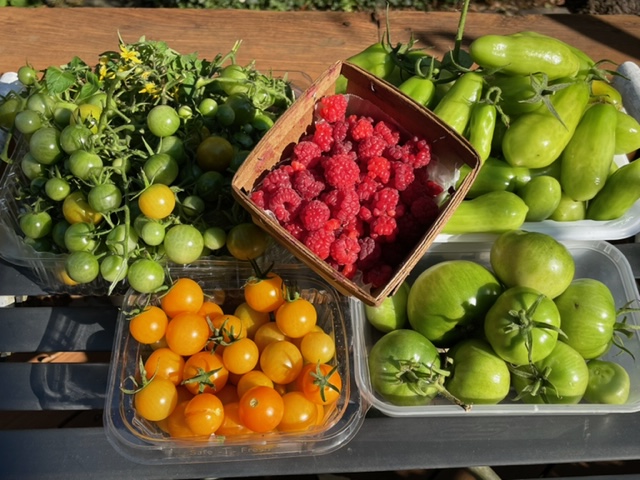
Consider reasons for hanging onto this hallow-day. I am grateful for my harvest of Roma tomatoes, but Jeremy Adam Smith, editor of an online magazine (The Greater Good, University of CA, Berkeley) offers these treats:

  • Rituals connect us to other people. Halloween visits may help us get to know some neighbors.
  • “We need candy.” Smith’s 9-year-old son was credited with this notion, although I agree with Smith on eating a bit of dark chocolate every day!
  • Pretending is helpful behavior. Research suggests that pretending helps children play through their fears.
  • Ultimately, the playfulness of Halloween helps to prepare us “…for things that are genuinely scary, like climate change.”

Aren’t we the mischievous ones when it comes to climate change?     

Much impermanence is in the air.               

Pearls of Peace (PoP) Quiz:

129. How do you view seasonal changes from autumn to winter?

130. When do you use pretending to cope with your fears?                     

An Open Mind for Peace

At the heart of happiness lies peace. It is the last and the highest attainment of the soul, according to  Hugh Black (1868-1953), Scottish-American theologian and author of the classic book, Happiness. 

You may wonder what makes a book a classic. My answer: it is in the eye of the beholder — what is classic to one individual, is not even close to classic to another. But happiness is a classic mood. And peace is a classic, although often elusive, topic.

Here is a deeper dive into Black’s Happiness:

  • “The 18th century was inclined to make a gospel of what it called the rights of [woman and] man and assumed that nature endowed [women and] men with certain abstract rights…but it is more accurate to say that nature endows [woman and] man with desires and capacities. Rights are the creation of society, of law.”
  • “In our deepest thinking we usually underestimate the place and value of joy in life.”

We need “our deepest thinking” to handle a plethora of issues in today’s world. We need to consider peoples’ rights in our laws. And we need to hold a space for happiness, joy and peace.

Here is one open-minded-happiness approach: “Happiness is not the absence of problems. It’s the ability to deal with them.” Steve Maraboli is the author of this twist on classic happiness definitions. He is a military veteran and philanthropist who has worked with 40 countries in empowerment programs. He elaborates on defining happiness as a choice; we simply cannot allow ourselves to be defined by our problems. We have happiness capacity!

Another happiness mentor is a British potter who believes that happiness is embedded within one’s awareness of an inner self identity. Observing that the source of lasting peace and happiness comes from within each person, spiritual teacher and philosopher Rupert Spira began reading the poetry of Rumi when he was a teenager. Later, Rupert opened his possibility passport by abandoning a scientific career after visiting a mind-changing pottery exhibition in London. Spira now creates pottery that holds poems incised in clay. Some embedded poetry is his, while other poems are by British poet, Kathleen Raine (find her next week).

Spira carves his pottery philosophy as messages of awareness. Some bowls can be “read,” while others cannot be deciphered. A white Deep Bowl has this incised awareness carved into clay; “…I know no lack and am thus happiness itself.” One in his black Open Bowl series contains these lines: “I am peaceful like the sky. I am open like the sea.”

We have serious divisions in our country as well as in the world. Countries banter and battle in dangerous military shows of force or in actual military maneuvers that kill people, along with children’s choices for happiness. When will peace be our perennial choice? Is war “classic” too?

Pearls of Peace (PoP) Quiz:

127. What choices for happiness do you make?

128. When are you aware of having an open mind about some topic?  

Lighten Trauma in Families


Bright Endeavors’ grand opening celebration in the East Garfield Park neighborhood in Chicago this weekend left me feeling brighter about our interdependent future! Funding through Chicago’s Justice Advisory Council enabled this fledgling candle-making enterprise to find generous space for increased production and shipping of their soy-based candles with fragrances such as Rose & Vanilla, Sandalwood & Patchouli, and Holiday Citrus.

The brainchild of 2 female social entrepreneurs, in 2010 Bright Endeavors merged with New Moms, a non-profit located in the Austin community. New Moms (acquiring former Parenthesis Family Center of Oak Park in 2016) provides housing and family support to young women and their precious babes who cope with poverty and/or homelessness. Nearly 50 % of the moms are high school dropouts; 100% are trauma survivors.

The new spacious warehouse of Bright Endeavors includes loft offices to expand an Academic Coaching Program. Only 8% of single-mother students in Illinois finish an Associate degree within 6 years, compared to 60% of non-parenting students (according to Institute for Women’s Policy Research). Furthermore, 1 in 3 black women in college are single parents.

New Moms guides young women in finding economic mobility by teaching them basic job skills in the comprehensive program at Bright Endeavors. The 16-week paid program trains young mothers in positive work values while also helping them set personal and professional goals for sustainable employment. Each hand-poured candle comes with space for its candle-maker to sign her name under the words, “Created with pride.”

Maybe it was thinking of all the youngsters who will benefit from their moms’ ability to model both work and educational skillsets, but I recalled the children’s book, The Little Engine That Could by Watty Piper. I read this book to my children over and over, probably needing the message myself as a working mom with two precious babes. Chug, chug, chug…I THINK I CAN, I THINK I CAN, I THINK I CAN. Aside from dolls depicted as “white” and the ageist reference to the “old, rusty engine” who is “too tired,” there is a timeless quality to Piper’s classic tale. Yes, I think I can __________. Each one of us needs goal setting, whether burned by trauma or not.

Each one of us is a pearl…what if we string our unique pearls together? What might we accomplish when we pull together?

Each child deserves possibilities to fulfill their ability potential. To realize this, kids need illuminating support from parents, teachers, and other co-regulators in their tender years. Kids (and parents) need others who believe in them, and model “I-know-you-can” attitudes.

100% of Bright Endeavors candle proceeds support the mission of empowerment for young families. These fragrant candles are sold at Whole Foods Market, but you might order some directly from www.brightendeavors.org. Help some moms receive “I-know-I-can” skills for job markets this holiday season!

Pearls of Peace (PoP) Quiz:

125. What new goals are you setting for yourself?

126. How do you finish this sentence? Yes, I think I can ___________.   

Harvesting Pearls

Harvest time is a reminder that another growing season is winding down and winter is waiting in the winds. Autumn presents a wistful time for avid gardeners. As I savor the second crop of my ever-bearing red raspberry pearls and hunt zucchini hiding under giant leaves, I realize that these pickings are precious due to their limited timeframe.

My aging garden is a reminder of our human life cycle. John O’Donohue, Irish theologian and philosopher, acknowledged both the fears and gifts of aging. Few speak as passionately about the gifts of aging as O’Donohue. Ironically, he wrote about autumn as a favorite season; he died suddenly and unexpectedly at age 52 before reaching the winter of his life.

O’Donohue’s old-soul understanding of aging inspires many: “…when it is autumn in your life, the things that happened in the past…almost unknown to you, now yield their fruit…you are able to gather lost moments and experiences, bring them together, and hold them as one…[you] see aging not as the demise of your body but as the harvest of your soul…aging can be a time of great strength, poise, and confidence.”

Much of American culture dwells on the spring and summer of one’s life as our times of strength and confidence. Productivity and optimal progress are most esteemed in the U.S. more-is-better attitude. Losses are sidestepped and sometimes denied because of “move-on” thinking. However, writer Joyce Carol Oates maintains that our losses make us more human. Near the end of her memoir, she consoles herself in her widow-status with these thoughts: “I kept myself alive…being older is this kinship of losing people. I have gained a sense of proportion…many things do not matter to me anymore…almost everything is trivial. People complain about the weather.”

Yes, people constantly complain about trivial weather conditions, although the devastating hurricane in Florida, frightening wildfires in California, and massive flooding in Pakistan (affecting 33 million) link people to interdependent losses. We might ask ourselves if we are in the autumn season of our planet. According to NASA, climate change (especially drought) has been the culprit for the rise and fall of past civilizations. Current NASA research documents the rapid changes in Earth’s ice sheets, along with rising global sea levels since 1992. NASA is one of 13 federal government agencies that make up the U.S. Global Change Research Program.

Climate change can no longer be denied.  

Solutions to climate change include every world citizen: making biofuels from organic waste, increasing wind and solar power, protecting forests and green spaces, switching to sustainable transportation, encouraging more vegetarian meals, recycling, reducing energy usage, and cutting back on consumption and waste (as in using less plastic).

As we are gardeners of our planet’s bounty, let’s harvest some confidence that we can pull together for the benefit of our interdependent global climate.

Pearls of Peace (PoP) Quiz:

123. What solutions can you think of for reducing climate change?

124. How can you harvest confidence for taking action steps toward a green recovery?

Pearl Needs

“I need____________.” How do you fill in the blank?

Deviating from Abraham Maslow’s famous ideas on needs, I developed a list of 5 basic needs from my many years as a family therapist. I worked with clients who were languishing in basic survival energy; they reported eating and sleeping problems along with feelings of depression.  Some lacked enough discipline to complete their career-work or homework. And many of my clients, both adolescents and adults, expressed a scarcity of creativity, belonging, and/or ability to meet the potential they wished for in their life.

Often my clients expressed an assumption that “someone” owed them something; their assumption was that IF that “someone” gave them what they desired, THEN their needs would be met. These perceived inadequacies (in oneself and others) relate to one’s lack of perceiving a core self, a calm present-moment consciousness, amidst clamoring desires for needs-in-waiting.

Consider 5 basic needs: Energy, Discipline, Creativity, Belonging, and Ability–EDCBA  (ABCDE’s backwards). Meeting basic needs takes daily attention. It also takes a strength-filled and peace-filled approach.

What does a pearl need to become lustrous and grow in stature? 

Pearls exude strength. Pearls may look peaceful, but it must be challenging to be peaceful amidst immigrant upbringing. A natural pearl is born in trauma, in a disturbance to the parent oyster, mussel, or clam shell. When a foreign irritant, perhaps a parasite, lodges itself into the lining of the mollusk shell, a sac covers the invader and a fluid called nacre coats the intruding irritant. It is the layering of this protective mother-of-pearl (or shell material called nacre) that forms pearls. Nacre is made from a mineral, aragonite; how marine invertebrates secrete aragonite is a mystery.

What does it take for immigrant children to become resilient and grow up with incredible strength?

Children exude strength. Immigrant children may appear peaceful in pictures we see on the evening news, but it challenges anyone in leaving homes and friends for an unknowable destination and outcome. Immigrant mothers and fathers face many irritants and are pearl-makers. They desire a lustrous life for their offspring where they have possibilities to meet basic needs. When we recognize this, perhaps we can address immigration policies in humane ways.

How many years has it been since your ancestors floated to the shorelines of America? Mine came in the 1600’s-1700’s. An English Quaker ancestor sailed in the ship Brittania in 1699 for reasons of religious freedom. While over 200 braved the trip, the crossing was referred to later as “the sick ship from Liverpool;” 75 passengers died enroute or shortly upon arrival in Philadelphia. Other immigrant ancestor reasons for crossings are unknown, but likely all wanted better lives for their offspring. I am grateful for their sacrifices to provide an accepting haven for me and my family to meet our basic needs.  

Pearls of Peace (PoP) Quiz:

121. When and under what circumstances did your ancestors arrive in America?

122. How might you honor your immigrant ancestors?        

Take-a-stand Pearls

Malala Yousafzai is a queen without pearls on her neck. She does not represent any monarchy or have any subjects; instead, she has the entire planet’s girl population as her subject. She did not inherit her position but is a stick-your-neck-out person. Malala is like a queen chess piece. Her influence spans far corners of the global chessboard, as she is capable of moving on the diagonal.     

Malala suffered a bullet to her head when she was 15 years old and on a bus riding to school. Her injuries were extensive, including the lacerating of facial nerves, shattering of her eardrum, and breaking her jaw joints. Physicians in London inserted a titanium plate where a skull bone had existed. Initially Malala could not speak, but she could write. She wrote the word, “mirror” on paper and her nurses understood her. As she gazed at herself, Malala reflected, “I only recognized half of my face. The other half was unfamiliar. But I believed in my strength. I believed I would get out of the hospital and run like a wolf, fly like an eagle.” Most would have retreated.

However, passion-and-positivity actions led to Malala’s shared 2014 Nobel Peace Prize at the tender age of 17. Her co-recipient was 60-year-old Kailash Satyarthi; along with his team, he was responsible for more than 86,000 children’s liberation from child labor, slavery and trafficking in India.

Not only has Malala brought attention to girls’ education in her homeland of Pakistan, but her diagonal travels have stretched out to Afghanistan, Bangladesh, Brazil, India, Lebanon, Nigeria, and Tanzania. Her non-profit Malala Fund has a mission of providing 12 years of safe, quality education for girls. After graduating from Oxford University with honors (in philosophy, politics and economics), Malala is documenting her legacy. She became a producer of documentaries to teach us about women’s and children’s issues world-wide.

A legacy requires learning from the past while living in the present moment. At age 25Malala already has a blossoming legacy that is far-reaching–from speaking to ambassadors to the United Nations to young girls in almost-forgotten villages. Her take-a-stand compassion for the plight of girls and women is an inspiration. When compassion is shared, we experience what Brazilian novelist Paulo Coelho describes as “…a precious moment. It is a little parenthesis in eternity.”

Unfortunately, everyone does not understand and/or embrace the importance of education for every child in every part of the planet. U.S. culture is highly individualistic; we need to raise consciousness for the interdependent nature of meeting every person’s basic rights. Receiving a minimum of 12 years of education must be considered a basic right.

We might consider that every child is a pearl waiting to evolve.

Pearls of Peace (PoP) Quiz:

119. Where might you move on the diagonal to take action for women and child rights?

120. In what ways can you share your compassion for some take-a-stand cause?

Royal Pearls

Would YOU like to be Queen or King for a day? Do you remember there was a radio (1945-1957) and TV (1956-1964) game show, Queen for a Day? Dramatic stories of women spilling their guts about financial hardship and stressed-out lives riveted audiences. With an applause meter, a TV “winner” was selected by audiences. Pomp and Circumstance accompanied the often-crying “queen” to her velvet throne where she donned a red velvet robe and bejeweled crown. She was gifted with whatever she had asked for, along with extra perks from sponsoring businesses. The “losers” received token prizes. Ending each TV production, Jack Bailey crooned, “…wishing we could make every woman a queen, for every single day!”

I wonder if Queen Elizabeth II relished being a queen every single day. She was a queen for 70 x 365 days or 25,550 days + an additional 214 days. She was royalty for the monarchy of the United Kingdom, which turns out to be not so united. Her royal position was much tougher than it looked. We only had glimpses of her smiling gracefully at special events with her many pastel hats and matching ensembles. Queen Elizabeth was a pearl girl. Many of her pictures show her wearing pearls. Even her crown has pearls.   

Queen Elizabeth seemed to relish days without pomp and circumstance 24-7. Escaping to her mother’s homeland of Scotland for summer vacation may have helped her cope with less-than-united relationships within her own family—marriages set asunder and various other snafus. Like many mothers and grandmothers, the Queen was a matriarch surrounded by trauma and troubles. 

We honor her steadfastness, her enduring positive attitude (at least as far as we could tell) and how she loved driving her own car in Scotland as a regular kind of gal. We don’t know if pearls accompanied her on Range Rover get-aways, but she deserved privacy out of London’s limelight. Perhaps Balmoral Castle felt homier than Buckingham Palace.

We might think of Queen Elizabeth as a heroine. She was not first in line for the monarchy job, but her uncle, King Edward VIII, threw away pomp with plenty of circumstance. His abdication of duty was tied to marrying an American divorced woman, allowing the royal crown to tumble into the hands of his younger brother, Elizabeth Alexandra’s father, King George VI. Then, as oldest child, Elizabeth was crowned with a daunting yoke of duty for 7 independent Commonwealth countries at the tender age of 25.

Joseph Campbell popularized the archetypal Hero journey. His student, family therapist Maureen Murdock, moved beyond Campbell to define the heroine journey and incorporate an inclusive “we”  voice. Murdock asked what happens when women have followed male success rules. Did Queen Elizabeth have regrets? What other career path might she have chosen? I feel incredibly fortunate to have chosen my psychology career with fewer obligatory demands.

Pearls of Peace (PoP) Quiz:

117. Did you follow your bliss in your work?

118. If you could choose again, what might you choose?   

Pearls of Giving

The Raven and the First Men, Bill Reid, Canadian Haida artist

I come from two giving grandmothers. One gave constant prayers for her family and families around the world. She gave away part of the family dinners to a family less fortunate down the block. My other grandmother gave away food, flowers for her church’s Sunday services each week, and her handmade crocheted doilies or afghans to nearly everyone she encountered. There was no end to my grandmothers’ giving natures.

Today, people are more likely to give others COVID. Why are we not masking and thinking about giving others their healthiest chance to be COVID-free when we enter crowded public transportation? What are we missing in this millennium?

I wrote these lines and then re-read them. These thoughts emerged from opposite parts of my personality! Sometimes a mind feels like a seesaw with up-then-down thinking. I return now to thoughts of a giving legacy.

At Printer’s Row Lit Festival this weekend I witnessed a giving man at the book-selling space next to mine. The man looked through a lovely children’s picture book, Seeking Best Friend, written by Angela Marcotte and illustrated by British Diane Ewen. A woman stood next to him, also flipping pages of the promising pictures. She said she wanted to purchase a copy for her school’s library to support friendships among students. The man turned to her and announced that he wanted to pay the $20.00 cost for her copy! She was stunned. The author was stunned. I was captivated.

I am reminded of the giving nature of a Canadian Haida man, Bill Reid (1920-1998). A prodigious artist, Reid was a gifted jeweler, painter, sculptor, and wood carver. He wished to seek the best relationships among Indigenous and non-Indigenous people in fostering an accurate history of Canadian culture. Mentoring Indigenous youth with an interest in the arts through internships was a giving goal. 

Due to discriminatory edicts of the Canadian “Indian Act,” where women marrying a non-Indian were expected to give up their native heritage, Reid was not told about his First Nation ancestry. While his mother had Raven matrilineage of the Haida Nation, his father had Scottish-German heritage. However, in his teen years Reid noticed Haida symbols on the gold and silver jewelry worn by his aunts, sisters of his mother. He discovered his silversmithing ancestors. He later became involved with totem pole salvage and restoration.

Reid’s yellow cedar carving from one wooden block, The Raven and the First Men, tells the creation story of his mother’s people, the Haida. After flooding, a raven detects a clamshell, partially buried in sand. Inside the protective shell are cowering people. Raven coaxes them out to explore new possibilities. This magnificent work of art was unveiled by Prince Charles, now King Charles, at the Museum of Anthropology, in Vancouver in 1980.

Our planet needs our giving possibilities.

Pearls of Peace (PoP) Quiz:

115. What giving examples have you experienced in your life?

116. How might you engage in some giving legacy?