Pearls of Possibles

Plaza de Beneficencia, San Juan, Puerto Rico

A statue of Eugenio Maria de Hostos (with children dancing overhead) stands in the Plaza de Beneficencia (Charity Square) in San Juan, Puerto Rico. Sculptor Jose Buscaglia Guillermety honored Hostos’ extensive influence in the region by naming the monument, “The Great Citizen of the Americas.” Hostos believed that independence in Puerto Rico and Cuba was a possibility and worked tirelessly to accomplish his goal. He was disappointed when the U.S. rejected his proposals. Not all possibles make it to the finish line.

And yet, Hostos was successful in other possibilities. He traveled extensively and reorganized educational systems in the Dominican Republic (establishing a Teachers College despite local opposition of churches), in Peru (advocating for Chinese people living there) and in Chile. As a professor at the University of Chile he campaigned to allow women into colleges in 1873. Also, Hostos was successful in the development of a railroad system between Chile and Argentina with the first locomotive given his name!

Hostos’ essays covered sociology, psychology, literature, law, and philosophy. He earned acclaim as one of Latin America’s first systematic sociologists. He valued a growth mindset for his culture. Hostos held onto possibles despite great challenges.

In First Nation peoples there is a tradition of a “possibles bag.” Originally, these were leather pouches containing something from the plant world, animal world, mineral world as well as something from human life. For example, one’s possibles bag might hold seeds, herbs, animal teeth or claws, feathers, rocks and bones that were believed to possess some spiritual value. The meaning of a possibles bag includes the fact that plants and animals provide what one needs for life sustenance, while a feather can “smudge” with sweetgrass or sage smoke to invoke spirituality.

Later the possibles bag was adopted by frontiersmen. Their collection also was motivated by “needs”–tobacco and pipe, tin cup, jerky and other edibles, knife, black powder, powder measurer, and flint. A gun slung over the shoulder perhaps was most valued among their day-packing items. What represented their spirituality?

Today we might ask ourselves the same question about spirituality.

On daily TV grinding-down news, I cringe when I see soldier after soldier bearing heavy backpacks to hold onto sustenance. Perhaps they carry pictures of loved ones? One side carries an invisible possibles bag of hopes for independence from an aggressor. The other side must have an invisible possibles bag too. What are their values and hopes?

The war in Ukraine rages on with relentless numbers of families torn asunder–both innocent bystander families and families losing soldiers on both sides.

Surely, we can do better in packing our own invisible possibles bag. Writer Annie Dillard muses, “How we spend our days is, of course, how we spend our lives.”

Pearls of Peace (PoP) Quiz:

74. What causes, activities, or groups have you joined as an ardent supporter?

75. What part does spirituality and/or religion play in your possibilities?   

A Beginner’s Guide to Grief

Grief is not a one-size-fits-all process. Everyone grieves in their own way but if you experience unresolved grief, that process can take decades. Prince Harry was only 12 when Princess Diana died in a tragic car accident. He admitted that he could not grapple with the painful loss initially: “…shutting down all of my emotions for the last 20 years, has had a quite serious effect on not only my personal life but also my work as well,” Prince Harry said in an interview. He credits his brother, Prince William, for guiding him to seek professional help.

When you grieve, you may not meet your basic daily needs. Your energy level may flag, your previous discipline for school/work may be compromised, your creativity is on-hold, your belongingness suffers (often fearing the loss of other relationships), and you feel stymied in meeting your ability potential. Speaking from its own version of sign language, your body’s immunity may lower. Intense emotions bluster through you and/or a protective numbness can blanket any emotional expression.  

Elizabeth Kubler-Ross’ stage-theory of grief – denial, anger, bargaining, depression, and acceptance – was never meant as linear stepping-stones. You may or may not experience every stage. Thoughts flip-flop, making you feel ill-equipped for life. All of us are beginners with grieving.

A helpful model of grieving, the Pinwheel Model of Bereavement, is based upon nursing research of Susan Carter and clinical work of Ann Solari-Twadell and colleagues at Loyola University, Chicago. There is no specific resolution, or one set of stages to master in grieving.

Picture a toy pinwheel set into motion by an initiating wind of loss. To not only survive, but to thrive after loss, consider the very center of the pinwheel as your personal history. The turning and spinning of your grieving depends upon your core resilience as built up over your lifetime so far. Consider these aspects when loss blows into your life:

Being stopped or interrupted;                                                                                                    Pain and hurting emotions;

A missing or yearning for all that has been lost;

A holding desire, often holding onto what was good about someone;

A seeking of meaning, comfort, support, and

Valuing what matters most and provides meaning in life.

While a smell, place, or season of the year can trigger fresh grieving, you turn more and more toward an openness to present moments with time. My heart goes out to the people of Ukraine and the relatives/friends of Russian soldiers. The winds of war devastate countless families over millenniums.

Grieving is a whirlwind of conflicting emotion that whiplashes every aspect of life. However, consider how the whirlwind is an ancient symbol of some First Nation people. A whirlwind was believed to sweep out old crevices to allow openness to the “new.” Can that “new” be peace? Hope is possible. Alongside U.S. and German astronauts, Russian cosmonauts collaborate peacefully at the International Space Station.

Pearls of Peace (PoP) Quiz:

 72. When have you experienced a whirlwind of grief?

73. What “new” possibilities were you able to embrace?      

Weaving Trauma into Beauty

Artist: Igshaan Adams

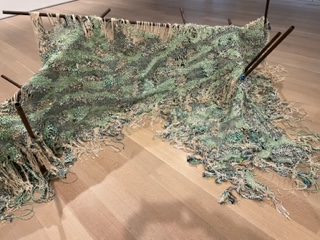
A textile artist born during forced segregation in South Africa, Igshaan Adams’ enmeshed designs may be interpreted to represent familial relationships and generational trauma amidst socio-political discrimination. His art pays tribute to “gaps,” or invisible spaces in his work. Using beads, shells, glass, rope, wire, and “found objects,” his weavings pulse with meaning. One three-dimensional installation has lead pipes piercing both the weaving and the surrounding air. Is the weaving a sheltering tent…or a flimsy cover-up for truth?

Adams’ recent exhibition is entitled “Desire Lines” which he intends as a metaphor for weaving an individual’s life roadways into a merging collective with others’ paths. Underlying Adams’ work is a poignant probe: “How would you treat someone differently if you knew everything about them? Or nothing?”

We do not know very much about other people. Perhaps we cannot grasp the meaning of another’s life because they never share their innermost angst with anyone. Is it because they deem their experiences as unacceptable? Perhaps they do not want to hear imagined criticism from others: “Really? You did what?”

What if we knew the ACE’s score of everybody? ACE’s stands for Adverse Childhood Experiences, a 10-question survey about traumatic challenges that a child may experience before age 18. The questions do not mince words: Did you…lack protection as a child (including not having enough food to eat); …lose a parent through divorce, abandonment or death; …live with anyone who was depressed, mentally ill, or attempted suicide? Did anyone in the family have a problem with drinking/drugs; did anyone go to jail or prison? Did your parents… ever hit, beat, or threaten each other; …ever swear at you or put you down; …ever hit, beat, or physically hurt you? Did you feel that no one in your family loved you? Did you experience unwanted sexual contact?

Perhaps you will take the survey: https://acestoohigh.com/got-your-ace-score/

Rob­ert Anda, M.D., from CDC, in partnership with Vincent Felitti, M.D., from Kaiser Permanente (California), conducted the Adverse Childhood Experiences study which linked childhood trauma with increased health/social problems across adulthood. The amount of personal suffering found in the initial population of 17,000 adults taking the survey surprised the co-authors, as participants were mostly middle and upper-middle class with college educations. They lived in California with good jobs and health care benefits.

Yet, 87% of the participants reported 1+ traumatizing childhood experiences. The research uncovered tragic numbers of child abuse. As one’s ACE score increases, the risk of disease, social and emotional problems can escalate. For example, ACE scores of 4+ link to a likelihood of chronic pulmonary lung disease increasing 390%; depression increasing 460%; or attempted suicide increasing 1,220%.

Poet Maya Angelou weaves trauma into beauty through words:  “…prepare yourself so you can be a rainbow in somebody else’s cloud. Somebody who may not look like you….”

Pearls of Peace (PoP) Quiz:

70. What did you endure as a child?

71. In what ways do you share your invisible stories?     

Pearls of Creative Problem-solving

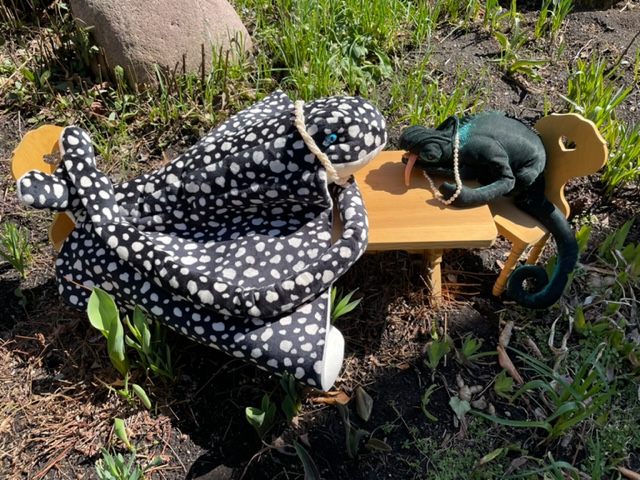
Puppet peace table

We want our children to be creative problem-solvers. U.S. preschools and kindergartens brim with creativity! Then we take most toys out of classrooms of first graders. Perhaps when we do not see much creative problem-solving in adulthood, a creativity drop-off started with misguided educational ideas that toys cannot be learning tools from ages 6-onward.

I loved using psychotherapy techniques that incorporated toys in my private practice. As a family therapist my clients ranged from ages 3-83 (many grandparents were raising grandchildren). A sand tray with tiny figurines was a favorite among all ages. It was not uncommon for an adolescent or adult to pick up one of many puppets in my office and hold it part-way through a session. Some teens took two puppets to illustrate some scene from a difficult interaction they had endured at school. Many people talk best when their hands are moving.

Some companies understand the need for toying with different moves than desk-sitting delivers. A Google office has a slide to get between floors! Employees enjoy company game rooms with a pool table and other “toys” like arcade-favorite Ms. Pac-Man. One Google office that I visited was stimulating with a variety of games present amidst vibrantly painted walls.

This brings me to question whether Mr. Putin had an enriched childhood with ample play time. My guess is no. David Hoffman (The Washington Post) claims that Putin learned, “…[to] never show weakness because the weak are always defeated.” Other writers tell of horrific times in Leningrad (now St. Petersburg) where Putin was born. During World War II most of the population of 3 million in Leningrad were killed. It was termed a genocide. This is an ominous cultural legacy for any child.

Prior to Putin’s birth, his parents lost two sons—one died in infancy and the second son died from diphtheria. The family grief must have been torturous. Both parents worked and one wonders who took care of the young Putin when his parents were at work. Reportedly, Putin was bullied in childhood. He learned judo and became an expert at sambo, a Russian sport combining judo with wrestling. In high school he played handball and worked on the school’s radio station. His fascination with spy movies may have led to a career with the Russian secret service or KGB.

We cope with tragedy and grief legacies by first acknowledging them. When unresolved grief piles up through generations, it is challenging for any person. Creative problem-solving is not the first thing on one’s mind. Filling the potholes of grieving can take on strange actions. In the movie “The Interpreter,” Nicole Kidman says, “Vengeance is a lazy form of grief.”

Is it ironic that there are mass killings (genocide?) happening in Ukraine? Does history HAVE to repeat itself?  

Pearls of Peace (PoP) Quiz:

68. What legacy in your family may have a huge effect upon your current life?

69. How do you decide to have “peace table talks” in your personal conflicts?                                    

Peace versus Polarization

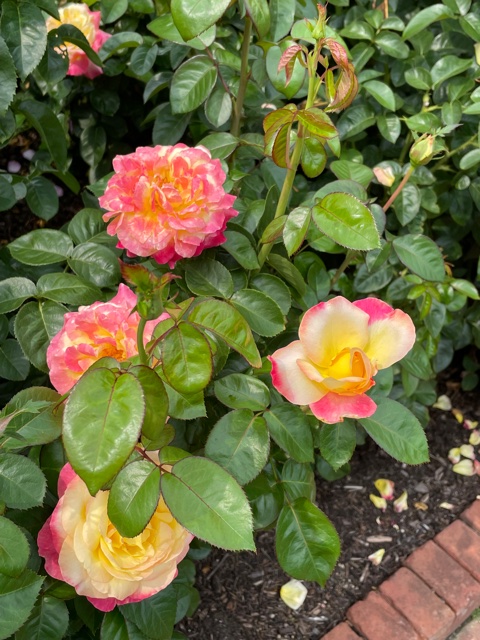
Love & Peace Hybrid Tea Rose

Polarization is undermining our planet. What will it take for the Ukrainian people to have peace in their corner? I listen to the month-long impassioned words of Volodymyr Zelensky and wonder what it will take to bring his country’s people back together again. Like the old rhyme about Humpty Dumpty, I wonder if all the king’s weapons and all the king’s men CAN bring back Ukraine’s 3.3 million scattered-to-the-four-winds refugees.

There is a story or two about Humpty Dumpty. Some tout the simple version; it is just a riddle about things breaking down. From other minds, Humpty may represent King Richard III of England. Was he humpbacked? History tells that Richard was brutally defeated at the Battle of Bosworth Field in 1485. Later dubbed the War of the Roses, battling sides spilled blood from 1455-1485. Why? The homeland was polarized between Lancaster (red-rose territory) and York (white rose-land). Never mind that the rosy-war label did not appear until the 19th century.

History reveals Richard to be a bad egg who clawed his way to power by killing his brothers, nephews, and anyone else who stood in opposition to his claim to “King-dum” rights. Richard rationalized his actions as “security” measures for his country.

The egg-enhanced story came from Lewis Carroll’s novel, Through the Looking Glass, published in 1871. However, the name, Humpty Dumpty, pre-dates the iconic pictures of a wall-climber egg-shaped Humpty.

A weapons’ version of Humpty Dumpty suggests that this was no egghead, but rather Humpty was a name given to a cannon fired by the Royalists during the English Civil War. The Civil War raged from 1642-1649. The cannon’s position was on the walls of Colchester and it did indeed suffer a fatal fall, along with King Charles I who lost the war along with his head. OK, this is grim, but you already know that war is grim.

People have fought in wars seemingly since the beginning of time, whatever timeframe that represents. When is peace possible? Artists, musicians and poets express anguish for all of us over peace possibilities. Emily Dickinson captures the essence of this angst in these lines:  

I many times thought Peace had come

When Peace was far away—

As Wrecked Man—deem they sight the Land—

At Centre of the Sea…

How many fictitious Shores—

Before the Harbor be–

Yet, we must not give up on the possibility of peace for the planet. The resilient Ukrainians believe in peace. They elevated their national flower, the sunflower, to peace-symbol status. (See Peace as Your Legacy Blog, 3-7-22.) Let’s restore the lovely rose to a peace-time image.

We need to turn a corner or two and intend to make peace possible – in our families and our communities. Start small. Handle one polarization in your life at a time. Let’s make peace in our own daily lives.

Pearls of Peace (PoP) Quiz:

66. What seems polarized in your life today?

67. How might you model peace-making for those around you

Pearls of Altruism

History matters. Tomorrow is the Ides of March. “Beware of the Ides of March” is a phrase from Shakespeare’s play, Julius Caesar. This was not frivolous theater; actually, the historical Roman dictator, Julius Caesar, was stabbed to death in the Roman senate in 44 BC on March 15th. “Barbaric!” you say. Yes, and barbaric events keep occurring both within and without senate walls.    

“I can’t watch the news. It’s just too grim.” Have you said this? I have said this some days. Yes, there is heinous behavior in the world. There is also altruistic behavior.

Our humanity task is to discover how NOT to turn our backs on world suffering, but to look for ways to initiate altruism. Contrary to what one might assume, there is evidence to show that when a natural catastrophe or some other frightful tragedy occurs, mutual helping is more often the case than pillaging or other forms of individualistic behavior. Examples of altruism are multiplying daily in extending aid to 2.6 million migrants who are fleeing Ukraine. Pearls of altruism for the wellbeing of others string together when courage trumps faint-heartedness and a sense of calm overrides fear.

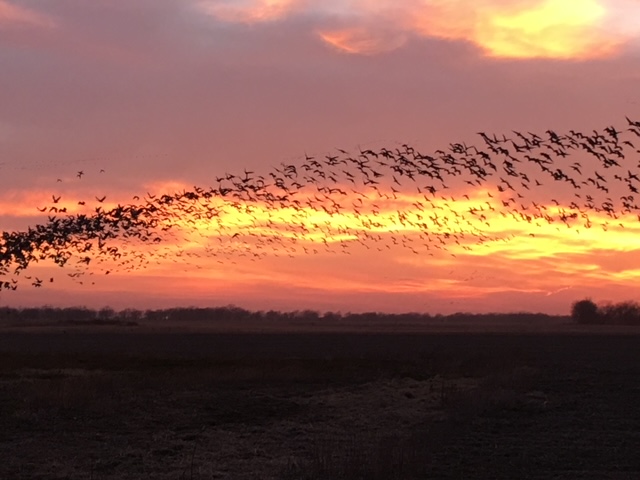
We might learn something from some of the oldest living birds on our planet. The earliest sandhill crane fossil found in Florida dates back 2.5 million years. Following the end of the last ice age, migrating sandhill cranes have gathered along the narrow Platte River in Nebraska during mid-March. The annual reunion of cranes numbers over one-half million this year. Sandhill cranes are omnivorous, but 90% of their take-out diet comes from taking out left-over grain in nearby corn fields. Every evening singing crane choirs return to the sandbars of the Platte River where the cranes protect each other from coyotes. Unrelated cranes roost together in survival groups.    

I was mesmerized one spring when I spent a week volunteering at the Iain Nicolson Audubon Center at Rowe Sanctuary along the Platte shoreline. At dawn and dusk volunteers give tours from protected blinds for tourists from all over the world. In their mass fly-aways at sunrise, crane roaring gave me goosebumps. Smaller groupings returning to sandbars offered sunset lullabies. Spectacular almost describes it! Cranes symbolize balance with beauty. Their courtship features fancy “dancing,” well, leaping into the air, while cooing their love songs. I was totally charmed one foggy morning by this sight.

Cranes model living in harmony with others. With a lifespan of 20-40 years, sandhill cranes mate for life. Both parents work together to build a nest for junior; both take turns sitting on the eggs. Resilient baby sandhill cranes, called colts, fly with their parents one day after their hatching.

We are not people of one feather, but we might expand who is in our “in-group.” Altruism is an inclusive possibility.

Pearls of Peace (PoP) Quiz:

64. When have you engaged in altruism?

65. How might you expand altruism toward others?                   

Peace as Your Legacy

Do you wish to make the world a better (and more peaceful) place?

Joan Halifax, Abbot of Upaya Institute and Zen Center in Santa Fe, writes, “We can nurture peace by transforming our own lives…we must work actively for nonviolence toward all…[nurturing] deep and true dialogue with respect for and appreciation of differences…we all live under each other’s skin.”

Yes, along with inherited legacies, we do live “under each other’s skin.” The video of a brave Ukrainian woman confronting a heavily-armed Russian soldier on a street corner in Henychesk gave my skin chills. She asked what the soldier is doing in Ukraine. He replied, “We have exercises here.” She asked, “What kind of exercises?” and then with emotion, “What the #^&* are you doing on our land with all these guns?” She commanded the Russian soldier to take her sunflower seeds and put them in his pockets so that sunflowers will grow in the soil upon his death in Ukraine.

I am (belatedly) learning Ukrainian history. It includes sunflowers, a legacy symbol of peace for Ukraine. In June, 1996, Ukraine gave up nuclear weapons. Defense ministers from U.S., Russia, and Ukraine joined in planting sunflowers at Pervomaysk missile base. This is significant as Ukraine inherited the world’s third-largest nuclear arsenal in the 1991 Soviet Union collapse.

The sunflower is Ukraine’s national flower, however sunflower history predates the country. Sunflowers were nurtured as a crop by indigenous tribes from 3000 BC. First Nation North Americans cultivated sunflowers in present-day Arizona/New Mexico to produce large flowerheads. It is possible that sunflowers were a staple domestic crop before corn! Besides milling sunflowers for flour to bake bread and cooking with sunflower oil, creative uses included turning plant pigments into “sunscreens” and clothing dyes.

Spanish sailors pocketed sunflower seeds for Europe where the seeds migrated to Russia and Ukraine. However, it was the Russian Orthodox Church that elevated sunflowers to prominence. The 18th century Church hierarchy banned foods made from a variety of oils for Lent. Sunflower oil somehow escaped this ban! The demand for sunyashniki, or sunflowers, blossomed into an important commodity. Ukraine and Russia supply 70% of the world’s sunflower oil exports. Sunflower oil ranks as the fourth most important oil crop in the world (after palm, soybean, and rapeseed oil). Who knew?

A legacy is about learning from the past while living in the present moment. A legacy of peace sometimes seems elusive, but there is peace as well as war in our past and present. A Greek proverb reminds, “A society grows great when old [women] and men plant trees whose shade they know they shall never sit in.” Who will be left in Ukraine to plant sunflowers for coming generations?

Who remembers the Ukrainian legacy of peace from 1996?

Gardeners unite. Let us plant sunflowers this spring.

Pearls of Peace (PoP) Quiz:

62. What legacy of peace can you cherish?

63. How might you leave peace as an aspect of your own legacy?   

How to Create Peace

Happily, many schools now understand that punishment is ineffective in helping students resolve fights and slights in the schoolyard and classroom. Slowly, schools are turning to “restorative practices,” a term popularized by the International Institute of Restorative Practices (IIRP). https://www.iirp.edu/

When conflicts between students occur, there is recognition that participants may share victim and offender roles, but generally not in equal proportions. Punitive suspensions of students from school are outdated and go against what child advocates know about learning “lessons” to handle future interactions.

Some schools have a “Peace Room.” Secondary schools may train “peer juries” that replace the traditional discipline of sending students to the principal for punishment. Still others create “Peace Circles.” Regardless of the restorative practice, adult facilitators offer neutrality, respect, and confidentiality. These peaceful practices acknowledge a damaged relationship, identify the harm(s) caused by specific behaviors, and may include community participants who also endured the harm in some way.

Participants are asked questions:

What happened?                      Who was harmed by your actions?                         What can be done to repair that harm?                                      What can be done to prevent a recurrence of the harm-producing behavior?

If possible, pre-conferences with each participant help to access strong emotions. It is wise to have two facilitators. The second facilitator or peer guide is trained to focus on non-verbal behaviors that otherwise might be overlooked.

Many years before I took training offered by IIRP, I was employed by a large high school in their Behavioral Disorders program. My school psychologist job was to handle student/student and student/teacher conflicts. There were lots of conflicts. I ditched suspensions, although it was not a popular move with some teachers who preferred sending a student “away” for a period of time.

My problem-solving approach had similarities to current Peace Circles. Any teacher or student could fill out a paper request for a Problem-Solving Conference (PSC). I asked students to face their teacher (or another student) when the two of them were in conflict. With practice, students learned to de-escalate quickly, sometimes earlier than their teachers! Eventually I added PSC+ forms (on red paper) for student/teacher partners to meet and acknowledge positive behavior changes.

See my Pearls-of-Peace blog (“Restorative Justice Peace,” 9-29-21). I suggest that parents and employers lead with restorative justice. My PSC model led to student/parent meet-ups when underlying conflicts in school had their roots in family interactions. Family participants wrote contracts for improved behavior on both sides of the rocky battles.  

In current warring times, we need people to create peace without the nasty scars of lost lives. It is ironic that many wars end with conflicting sides sitting at a table to negotiate belated problem-solving or peace “settlements.”

A problem-solving takeaway is to leave each opposing participant with HOPE for a better day. What do we HOPE to restore in restorative practices? Peace.  

Pearls of Peace (PoP) Quiz:

60. When have you used restorative practices to resolve a conflict?

61. Who might you coach to use restorative practices?                                               

Retirement Pearls

Start the first lesson on retirement — make time your friend. This is what I learned from surveying 125 individuals, ages 55-96.

Whenever you define what retirement age is for you, it means that you have experienced the luxury of living enough years to gather perspectives on the circle-of-life journey. Likely, you probed yourself with poignant questions:

  • When is it time to retire?
  • Where do I plan to live?
  • What delivers passion and purpose for me?
  • Who do I want to “spend” time with now?

I found that people grapple with circle-of-life issues in a colorful variety of ways. From surveying, here are some answers to the first question:

57, female (works 30 hours/week): “I have a fear of becoming irrelevant to society as my parents experienced after their retirement…I made a cognitive switch from deriving my identity from work/success to valuing living life and experiences, spending more time with family and friends. I cut-back work after my mother died.” 

59, male (works 40 hours/week, volunteers 8 hours/week): “I do not plan to retire.”                                                                                     

62, female (works 35 hours/week): “You have to have a plan before retiring so your retirement years don’t lead to depression. Do some of the grief-work before retirement.”

69, male (retired 7 years): “Retirement means a re-assessment, a retooling, a re-evaluation…I want to be more of who I was meant to be.”

70, male (retired 3 years): “Initially I had loss of prestige, identity (career), income, but now I can sleep, and dictate my schedule, exercise.”

71, female (semi-retired 6 years): “I didn’t want to totally retire…Stopping abruptly wasn’t for me. I had a career, not just a job…I missed the day-to-day interaction with colleagues…[who] were busy and I needed to email and keep in contact with them.”    

81, female (works 10-20 hours a week): “I tried to retire, but I was too bored and cranked it back up. Now I have a revived private practice of up to 20 sessions per week…people are not retiring from the university because they don’t know what to do with their time.” 

83, male (works 6 hours/week; volunteers 1 hour/week): “I’m enjoying being semi-retired perhaps more than I expected…a blessing of retirement…is greater freedom of choice about how to spend my time.

94, female (retired 29 years, volunteering varies): “Time for reading, Pilates, getting together with friends, and volunteer work.”

95, male (retired 30 years): “It seems strange to have so much free time.”                                                                              

Encore adults often are skilled workers. They are adept at making strategic choices quickly; they have the capacity for holistic or systems thinking. Releasing a job or career can be viewed as a welcome transition or a psychological deer-in-the-headlights change.

Whatever you decide to do, find meaningful ways to “spend” your precious time.

Pearls of Peace (PoP) Quiz:

58. What is your association to retirement?                                                                                                           59. What fresh start might you begin with today’s time

My Mom, a Pearl of Peace

On this Valentine’s Day, I treasure the love that parents show to children and especially the love from my mother, Lois Treasure Whitacre Clark. My 99-year-old Mom died a week ago and her Celebration of Life memorial service occurred yesterday. A 500-word blog can never capture the whole story of parental love but here are some pearls. Mom not only loved me dearly, but her love was widespread.

Mom taught the value of lifelong learning. For many of my childhood years, every week I checked out 10 books from the public library. Our home was filled with books — my home is filled with books. My brothers and I read different books, but all of us are avid readers. Throughout decades Mom often was the first person to check out new books from the library. She usually had a stack of library books at any one time, but she seldom read whole books. She told me that she always started reading at the end of a book…Mom gleaned what she needed in the last chapter and moved on to the next book. I think the Bible was an exception to her usual practice, as she quoted more from the Gospels than from Revelation.

The oldest child of 10, many of Mom’s values came down the line from her parents, Bertha and Joseph Whitacre, and countless ancestors. Each new generation takes on some of what their parents modeled…and takes a pass on some things. My 2 brothers would agree with me that we are glad that Mom took a pass on having 10 children!

My Mom taught the value of making a difference. We will never know what happened to the letter Mom sent to Nikita Khrushchev, urging him to embrace world peace, but Mom was a frequent letter-writer to her newspaper, her senators, and state/national congressional representatives. She frequently called their offices as a witness for peaceful expenditures of tax dollars. The number of peace posters that Mom created is amazing.

Her enduring symbol was the butterfly. She collected butterfly pictures and wore butterfly earrings. In ancient Greek the word for butterfly is “psyche” which means “soul,” but about a year ago, I asked Mom what the butterfly meant to her. Mom’s words were a self-description:

“…momentary brush with beauty…heart-warming…shear fragile strength…unbelievable endurance ability…capable…bonding influence…affection…attention…amaaaazing (spelled with 5 a’s).

Mom’s present-moment living is an example of how to make our world a better place. My mother worked tirelessly on her many projects, mainly world peace for the coming generations of children. In the words of poet Naomi Shihab Nye,  “… the real heroes of race and culture would always be the people who stepped out of their own line to make a larger circle.” Mom always lived her life with the larger circle in her mind’s eye.   

Pearls of Peace (PoP) Quiz:

56. When do you contact your congressional representatives?  

57. What is one thing you might do today to consider a wider circle of influence in your life?