Pearls in Petroglyphs

The desire to communicate and leave a legacy of one’s existence is ancient. The Lascaux Cave paintings in France are estimated to be 15,000-17,000 years old and feature a predominance of large animals. Horses were frequently painted, but interior cave walls also hide bison, bulls, felines, a bird, a bear, a rhinoceros, and a human figure.

At least 5000 years ago, the ancestor of writing (called proto-writing) is recorded in Egyptian hieroglyphs. The word hieroglyph means “sacred carvings.” Hieroglyphs with over 1000 distinct characters were carved and/or painted on tomb and temple walls. Additional hieroglyphs appeared on papyrus, wood and most famously, on stone. The meaning of many symbols was unclear until the 1820’s when the Rosetta Stone revealed the same message in three “scripts” – ancient Egyptian hieroglyphs, Demotic Egyptian script (writing used for 1000+ years), and finally a Greek translation.

What voices speak from the Rosetta stone? Believed to be carved post-coronation of King Ptolemy V, the Rosetta Stone is a decree announcing the divinity of the new ruler. Times were troubled in 196 BC. Ptolemy V became Egypt’s ruler at age 5 after his parents were murdered, supposedly in a power grab that involved the mistress of his father (Ptolemy IV). Conspirators ruled the country as Ptolemy V’s “guardians.” Ptolemy V was coronated at age 12 amidst war and internal conflict.

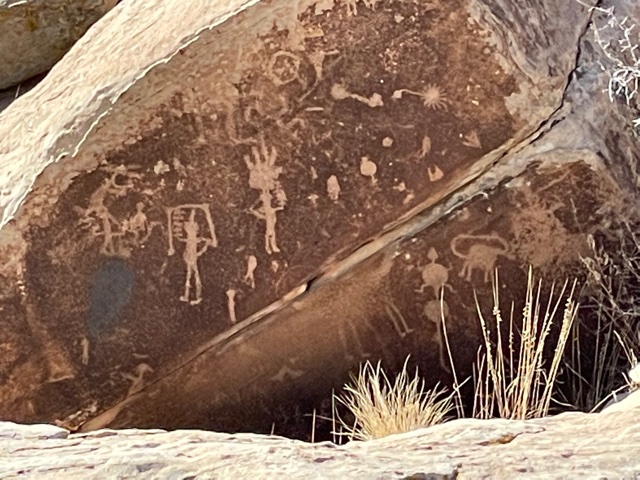
Petroglyphs offer mysterious rock-Pinterest images. The social media of the times featured many animals but a persistent petroglyph is the human handprint. Many interpretations offer important legacy messages: a holy place, a family marker, a ceremonial signature, a prayer or perhaps a map signifying, “Go this way.” Handprints with a spiral in the palm are thought to express messages of power, migration, or healing (read more about petroglyph spirals in Pearls and Swirls, 1-10-22).

Vikings recorded their voices in stone, wood and metal in often-ambiguous symbols called runes. Many runestone inscriptions were remembrances of those who died. Older runes might include the wording, “May Thor hallow these Runes.” Later runes integrated both Norse and Christian symbols on coffins, gravestones and monuments until the medieval church banned runes in the 17th century. One Norwegian runestone translation is dear: “Gunnvor, Thryrik’s daughter, built a bridge in memory of her daughter Astrid. She was the handiest girl in Hadeland.” Astrid is a Scandinavian name meaning “divinely beautiful.”

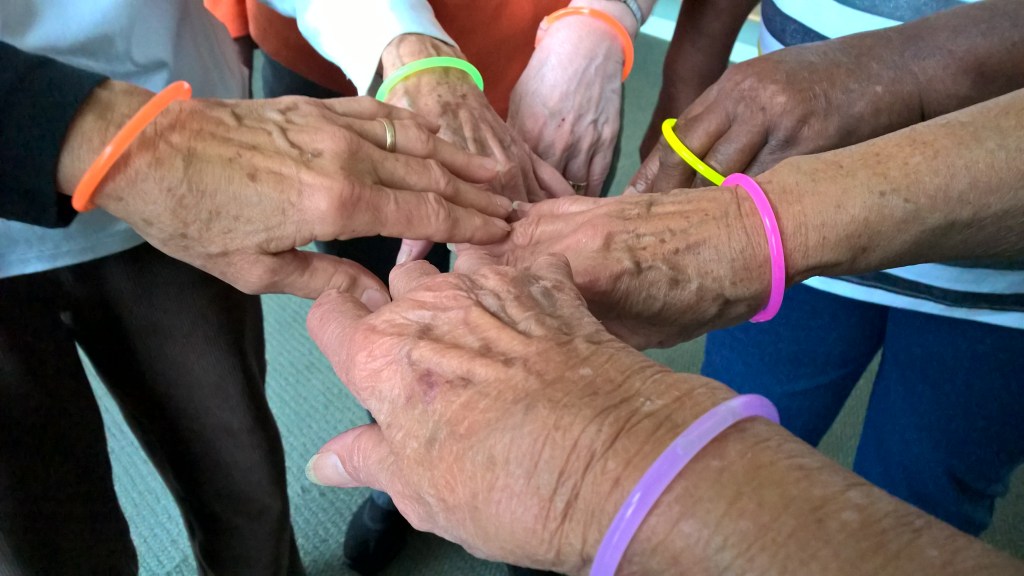
Cave and hieroglyph painters, petroglyph and rune carvers, and writers release their pearls for unknown audiences. Painters and writers of the ages reach hands across years for future observers to carry precious meaning forward. Meaning is tucked into cryptic messaging. Whether anyone deciphers such communication attempts or not, [wo]mankind is comprised of meaning-makers.

People search hidden caves, boulders, and dusty attic storage boxes for pearls of understanding the human condition.

Pearls of Peace (PoP) Quiz:

54. What meaning from your family tribe will you pass onto later generations?

55. What legacy will you leave for others?   

Seeing a Bigger Picture

Sometimes a nature picture is a whole poem, as a poem can be uplifting. As Mary Oliver wrote in A Poetry Handbook, “…poems are not words, after all, but fires for the cold, ropes let down to the lost, something as necessary as bread in the pockets of the hungry.”

Last week a bridge collapsed in Pittsburg. First responders formed a rescue “rope” — a human chain — to free people who were in a bus on the precariously collapsed bridge. We may tell ourselves that we cannot make any difference in serious life events, but when we work together we often make a huge difference. Saving someone’s life makes a monumental difference to their family, friends, and community. Even a poem can be lifesaving for some.   

John O’Donohue, Irish theologian and poet, explains the power of poetry in Eternal Echoes: “Poems are some of the amazing presences in the world. I am always amazed that poems are willing to lie down and sleep inside the flat, closed pages of books. If poems behaved according to their essence, they would be out dancing on the seashore or flying to the heavens or trying to rinse out secrets of the mountains.”

Every person likely reaches times when they question, “What’s it all about, Alfie?” This song title comes from Hal David and Burt Bacharach in the 1966 British romantic comedy Alfie. It is a phrase that my late husband and I asked each other frequently. We usually went into depths (or heights) of conversation that led us far away from the original question. Perhaps that is the point—when you want to consider the “big picture,” water, mountains, sky or planetary metaphors are within limits.

When is the last time you wrote a poem? What do you have to lose? Try writing haiku, a Japanese poetic form. After you get the hang of it, you will enjoy the elegant simplicity:

  • three lines of poetry with a total of 17 syllables,
  • 5 syllables in the first line,
  • 7 syllables in the second,
  • and 5 syllables in the third (final) line.

Here is a haiku that I wrote one day when I was frustrated with the evening news:

  • growth pains all groaning 
  • planet interdependence    
  • moves slowly and stalls

Sometimes we understand a “bigger picture” when we slow down, come into the present moment, and condense our ongoing wordiness. When we tenderly catch ourselves not paying attention to the present moment, we can pause and slow down our mind-chat. We can vow to treat our thoughts and emotions with more consciousness: “Oh, there’s anger about my job lay-off …oh, there’s loneliness. My work colleagues and I miss each other.” It is in the present moment we think about a “bigger picture.”

Pearls of Peace (PoP) Quiz:

52. When do you notice a “bigger picture” than just your own personal struggles?

53. Can you write a haiku about some “big picture” issue on your mind? (I’d love to see your haiku in the Comments section below.)

Pearls of Presence

Gentoo penguin mediator?

“We are caught in an inescapable network of mutuality, tied in a single garment of destiny,” wrote Martin Luther King, Jr. In fact, through tending-and-befriending others from different cultures (or species), we grow and figure out something important about ourselves. We make sense of our internal struggles when we acknowledge the present struggles of others.

An ally of King was the Vietnamese Buddhist monk, Thich Nhat Hanh, who died a few days ago at age 95. Both men invested in peace and nonviolence. Nhat Hanh’s attempts to promote peace through reconciliation between North/South Vietnam failed, but his actions influenced King’s opposition to the Vietnam War. Shortly before his assassination, King nominated Nhat Hanh for a Nobel Peace Prize in 1967, although the prize was not awarded that year. King’s summary of his peace buddy is striking: “Thich Nhat Hanh’s ideas for peace, if applied, would build a monument to ecumenism, to world [sister]brotherhood, to humanity.”

Ousted from his beloved country, Thich Nhat Hanh lived in exile for decades until finally granted permission to teach in Vietnam in 2005. He only returned permanently in 2018 after suffering from a stroke stealing his ability to speak. In spite of great trauma, an earlier and soft-spoken Nhat Hanh possessed a louder voice than if he spoke through a megaphone: “When another person makes you suffer, it is because [s]he suffers deeply within [her]himself, and [her]his suffering is spilling over. [S]he does not need punishment; [s]he needs help. That’s the message [s]he is sending.”

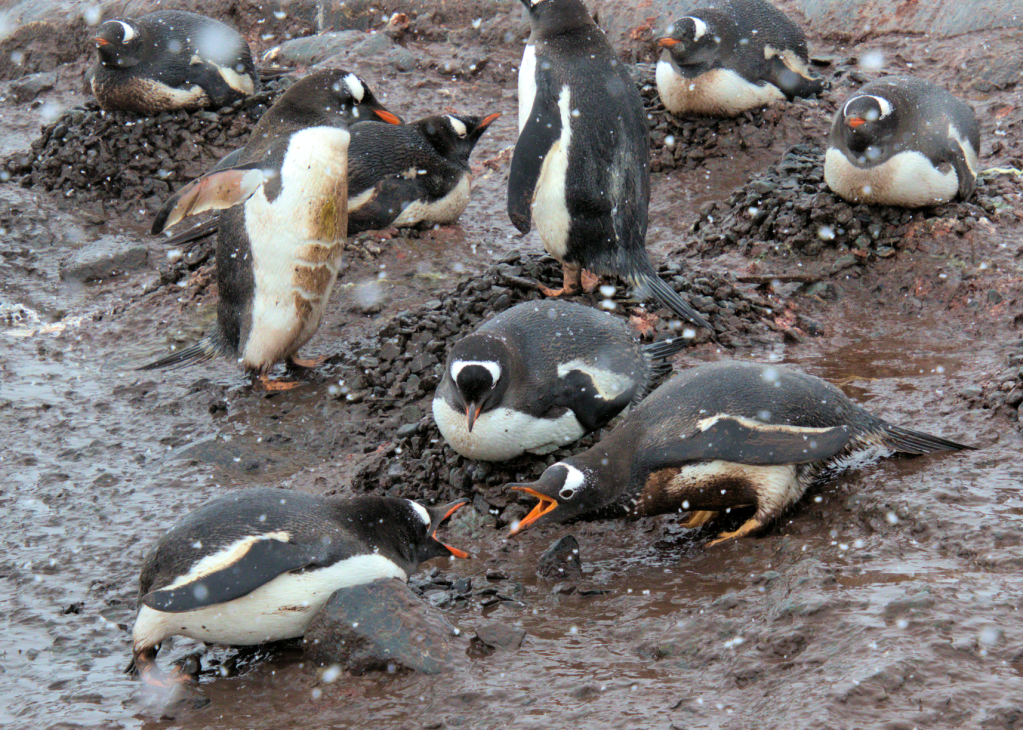
The world needs mediators like Nhat Hanh who attempted to stop his country’s feuds. However, people are not the only ones to fight over territorial “rights.” While capable of herding fish together with one of the fastest bird-swimming records of 22 miles an hour, Gentoo penguins can become aggressive in feuding over ownership of land (especially involving nesting sites). Agitated penguins open their bills, stretching their neck outward. Some protect their eyes by half-closing them. Do they expect the worst outcome?      

Actually, holding a vision of possible peace is really important. Martin Luther King, Jr. did not say he had a nightmare, but he had a dream. Are your eyes half-closed? We become so inundated with our own version of suffering that we forget about our capacities to change systemic flaws.

Name your own definition of holding a presence for peace. There are no perfect words or actions. There is no expectation that you become perfect. Life keeps challenging us with imperfect situations. The pandemic has reinforced the notion that there is no charmed life even if you win several pots of gold in lotteries.       

Embrace the wise words of the gentle mediator, Thich Nhat Hanh: “Waking up this morning, I smile. Twenty-four brand new hours are before me. I vow to live fully in each moment and to look at all beings with eyes of compassion.”      

Pearls of Peace (PoP) Quiz:

50. What is your dream for the future?

51. What peace-present actions will you take today?       

Pearl HIStory and HERstory

As far as I know, pearls are gender-free. But their adoptive-parent mollusks have sex-changing possibilities. For example, pearl oysters change from male to female as they age. Two mollusk species have this ability — Gastropoda (snails and slugs) and Bivalvia (clams and mussels) — although most mollusks are of separate sexes.

Many mollusk species have two breeding periods in a year. An octopus is in the mollusk family but these highly intelligent mothers reproduce only once before dying. The female octopus dies after releasing and protecting a clutch of up to 50,000 eggs unless she has her optic gland (similar to our pituitary gland) surgically removed. She eats little as she meticulously parents for months (or as long as a year) to keep her babes aerated and free of algae. Unbelievably, there are stark odds for her efforts. Only a few from each clutch will survive and reproduce. However, long life is granted to the oldest known animal — the ocean quahog, a bivalve mollusk that can live at least 500 years. Who knew these mollusk stories?

More mollusk minutiae: the sex of a pearl oyster appears to influence a pearl’s upbringing. Pearl oysters have a male phase for the first 2-3 years of life before changing to a female phase in later years. Male oysters are thought to produce higher-valued pearls compared to female oysters in terms of luster, smoothness and evenness. Pearls produced by the female oyster may have “scratches” or be “uneven.” Who knew that female oysters were paid less for their work?

What is an “uneven” pearl to one person may be considered a thing of beauty to another. I have both circular pearls and “uneven” ones. Actually, the “uneven” ones are captivating and cause me to look at them more closely. I never considered a pearl’s HIStory/HERstory until recently. Ralph Waldo Emerson reminds us that history is in the eye of the beholder: “There is properly no history; only biography.”

What does this bit of biology have to do with people? Draw your own conclusions (as I know you will), but the informed and misinformed stories you tell about ANY subject have meaning.

Whenever we link snippets of information, or otherwise piece together vague images and sensations from our memories, we tell narratives—even in dream stories. Psychiatrist and trauma specialist Bessel Van der Kolk emphasizes story changes: “…as soon as a story starts being told, particularly if it is told repeatedly, it changes—the act of telling itself changes the tale…the meaning we make of our lives changes how and what we remember.”     

I am curious about how people change (or never seem to change). Nature has many fascinating change-stories, including those about humans.

            Pearls of Peace (PoP) Quiz:

48. When have you told a story about some event in your life and later re-considered the meaning of your first story?

49. What biography do you want to leave for future generations?   

Pearls and Swirls

When roses arrived in a recent bouquet, I admired the swirling or twisting spiral of petals toward the mysterious center of the blooms. Each delicate petal followed neighboring petals to create an interdependent wholeness. If flower petals can spiral together for a common goodness, why are people having such difficulty? There are many reasons. Some reasons are not pretty. We need new approaches to come together in our country in this new year.

I like to think of new beginnings as evolving or spiraling. Swirling spirals are highlighted in the captivating art of Georgia O’Keefe’s flowers or seashells, suggesting some inner core vitality. Of course, Georgia took her inspiration from nature’s many swirls and spirals. When she painted White Shell with Red, she painted 5 whorls, or revolutions in the spiral growth, into center circling of the moon shell. The mollusk tribe keeps ancient company: with a 545-million-year fossil history, it predates the 230-million-year earliest dinosaurs. Remember, certain mollusks are home territory to pearls.

We might consider both pearls and swirling patterns as timeless. The curb-stone entrance to the inner chamber of the passage tomb, Newgrange in Ireland, has 3 inter-connected spirals. No one knows what message the stone carver meant to preserve, but the iconic design dating from 3000 BC is believed to represent creation, evolution, and perhaps cosmic energy. Or maybe the ancient Celts were nature artists like Georgia O’Keefe and simply observed that seashells and flower petals often grow in swirling spirals.

In Native or First People’s petroglyphs, it is suggested that the spiral petroglyph stands for the wind, or a blowing out of the old to open the way for the “new.” Another interpretation for a petroglyph spiral design is generation, or life as coiled until ready for emergence.

Distant galaxies appear as spiral nebulae. Years ago, on top of Mauna Kea on the big island of Hawaii, my family and I saw a sky densely swirled with stars. Through a telescope we were told that we were seeing distant galaxies. I only saw “dim” and “tiny” swirling masses, but I was awe-struck at witnessing the trail of what quantum mechanics scientists call the multiverse.

You will interpret your spiraling years with your own symbolism but take time to pause and follow your trailheads to an inner self. Each one of us has an inner telescope to amplify self-territory, a state of being where we experience inner beauty. Internal Family Systems (IFS) founder, Dick Swartz, lists 8 qualities of our innermost nature: calmness, compassion, creativity, courage, confidence, clarity, curiosity, and connectedness. Spiral inward and take some deep breaths.

Pearls of Peace (PoP) Quiz:

46. What inspires you in nature?

47. When do you take a pause to connect with your innermost nature?            

Pearls of Hope (2)

Happy New Year!

On New Year’s Day I was invited to attend a heart-warming Kawanzaa celebration online.  Kawanzaa was created in 1966 by American Maulana Karenga with the motivation of providing African Americans a holiday to celebrate Black heritage and culture. The week-long celebration (December 26-January 1st) incorporates African harvest traditions and derives from a Swahili phrase meaning “first fruits.” The keynote speaker was Atena Danner, a literacy learning facilitator, who read 7 of her dynamic poems to honor the 7 principles of Kwanzaa: unity, self-determination, collective work and responsibility, cooperative economics, purpose, creativity, and faith. Each poem released pearls of hope for a better future for all.

Another celebration treat was a Lion King video of the song, Circle of Life: “From the day we arrive on the planet…there’s more to see than can ever be seen / More to do than can ever be done….” Yes, but each person can do SOMETHING.

Participants were encouraged to write into the “chat” their intentions for the coming year. I was touched by the many hopes for harmony and peace for all. My intention was to increase my listening to other people’s differing opinions. What if everyone became a better listener when others said things that one considers “different?” Too often we only speak and listen to people who have similar viewpoints to our own. We protect ourselves from disagreements. We miss out on the chance to discover the pearls of others. As a Nigerian proverb reminds, “A pearl is only a pearl once it’s out of its shell.”

Is it time to break out of some shell you have constructed over time? Pick a new intention to harvest this year. Now pick a start date (and savor it). Motivational writer Daniel Pink offers a list of 86 calendar days that are auspicious for new beginnings: 12 first days of the months, 52 Mondays, the 4 days that begin each season, July 4th, your favorite holiday, a birthday, the first day back from vacation, or an anniversary date (wedding, first date, divorce). Your start-up intention can embody hope in this new year.

Chilean-American Isabel Allende was forced to leave her homeland during a military coup that resulted in the assassination of her relative, Salvador Allende, president of Chile. Traumatized and exiled in Venezuela–and wanting to keep her family memories alive– Allende began a writing habit. She wrote a series of unmailed letters when her 99-year-old grandfather was dying in Chile and she could not visit him. Allende’s letter-writing turned into a 500-page first novel, The House of the Spirits. Allende began her writing January 8th. She now waits for that day to begin each new novel.

You can set intentions on ANY day you declare as auspicious, but TODAY is another possibility.

Pearls of Peace (PoP) Quiz:

44. What is one hope-intention that you can embody?

45. How will you nurture the motivation part of you to make it happen?   

Pearls of Health

COVID: Between a rock and a hard place…

Are you a victim of your fears? The pandemic amplifies fears even if one is fortunate enough to escape the virus. Psychologist and mindfulness meditation teacher Tara Brach advises, “OK. Fear here. Forgive. Forgive.” This is a good first step: name it to tame it. Now we need to address the gems of recognizing our fears. As another saying goes, we have issues in our tissues. Our bodies ache, cramp, and pain us at times. What are these issues in our tissues?

Often, our rocky issues connect to our stories involving previous fears in a life snafu or trauma. A tornado near-escape (I had one in childhood), surviving a scary illness or accident (I had one of those too) or any other type of physical attack make up one kind of trauma. But an emotional storm in the mind is a trauma also. Have you noticed that physical and emotional trauma hang out together? However, our consciousness often escapes us when it comes to minding our bodily tissues.

In Somatic Internal Family Systems Therapy, psychotherapist Susan McConnell writes: “Our individual hurts and collective societal burdens lodged in our tissues await the light of our courage and compassion shining into the depths of our interiority, leading us to the essence of our being.” Thinking like a body-mind psychotherapist is like pearl farming. An oyster’s shell hides its essence. What nonverbal clues of people lead to hidden pearls? What subtle breathing clues are exhibited? What body tissue tensions show up in one’s posture?

When we are suffering, we just want the hurt to go away. In focusing solely on escaping our suffering, we ignore the issues in our tissues. What we might benefit from most is tuning into a compassionate self to understand and validate our fearful body-mind parts. Fear in your personality is protective. Ask yourself, “What is my fear trying to protect?”

Slow your breath to the count of 4 on the in-breath and exhale to the count of 8. Thank your fear for trying to keep you healthy. One kind of acceptance happens when we rub a painful leg when there is a cramp. As Susan points out, using physical contact helps to hold one’s attention in the present moment and even imagined physical contact releases oxytocin in the body. Oxytocin, often called the “cuddle chemical,” is just as important to your singular wellbeing as it is to social interactions with others as it reduces stress responses. Oxytocin contributes to relaxation. In turn, this relaxed response allows one to soften and find a centered self.

Touch and being “in touch” with our body-mind is key in these pandemic hard times. Our fearful personality parts deserve some cuddling.

Pearls of Peace (PoP) Quiz:

42. Where in your body might you hold some fear?

43. What happens in your thinking and behavior when you change your relationship to fear?   

Pearls of Time

Holiday time often pairs with excess—shopping, presents, food, and/or drinking. A recent revealing read, performance coach Diane Grimard Wilson’s Brain Dance book, explains that most days people just try to make their brain feel good–whether through alcohol, drugs, or any other type of addicting behavior. Brain scans on people with an alcohol addiction show major deficits of alpha waves in specific parts of their brains. Alpha waves are linked with feelings of relaxation and peacefulness. Drinking alcohol increases alpha waves initially, but at a later time the brain switches to faster beta wave frequencies that can lead to anxiety and perhaps more drinking. How tuned in are people to their brain waves at ANY TIME?

Diane admits that she learned most about her brain waves after she was catapulted into brain trauma from a car barreling into her car as she watched in disbelief. She was driving home from an exercise workout and had stopped at an intersection. The accident delivered an unwelcome package—a moderate concussion and post-concussion syndrome. Many symptoms sounded like a hangover that refused to leave. Numbing confusion with fragmentation and immobility is not a peaceful time.  

As the holiday season rolls along, I am aware that many individuals are not experiencing much peace on earth in their current life. At a recent conference, I heard presentations about incarcerated folks who have not been included on much positivity or peace any time. Due to injustices in life and compromised decision-making, they are “serving time” with limited possibilities. It reminds me of the concept of “satisficing,” a word coined by psychologist, economist, and Nobel prize winner in economics, Herbert Simon. Stemming from his years of combining psychology and economics, Simon explained “satisficing” (a combination of “satisfy” plus “suffice”) as the behavior of decision-makers in situations where an optimal solution is not immediately available: a “good enough” solution is accepted. However, what is “satisficing” to one person does not meet up with another’s expectations.

Fortunately for Diane, she opened the gift of a second chance in life with the assistance of neurofeedback, Eye Movement and Desensitizing Reprocessing (EMDR) psychotherapy, and the support of a very loving spouse. Her story is one of “satisficing” in ways that model how to make good use of your time in a crisis. Diane became a board-certified neurofeedback clinician! She studied the very training protocols that helped her cope with her brain trauma. No one wishes for bad things to happen to them but when they do, there are possibilities in responding. Diane’s perseverance in finding how to make her brain rewire, as well as helping to heal the brains of her clients, is truly inspiring.

How you choose to spend time matters. Consider your own ways of improving your precious brain to have more peace in your life.

Pearls of Peace (PoP) Quiz:

40. What do you do on a regular basis to enjoy peaceful times in your life?

41. How might you share the gift of peace this holiday season?                                         

Pearls of Strength

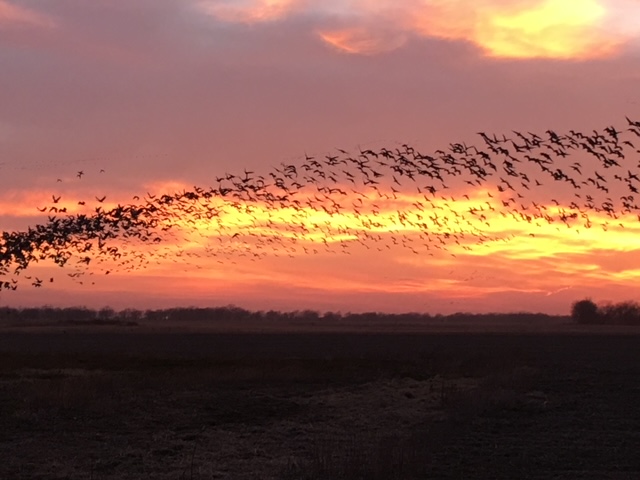
Have you ever been in awe of a swirling mass of starlings that flow in a myriad of shapes as they perform an airborne ballet together? It is called a murmuration of starlings. Some other birds fly together in V-shaped formations, but starlings dance in a spinning and swirling flow together in the sky. Murmuration, meaning low and continuous sounds, comes from starling-wing music when as many as 10,000 birds synchronize their moves.

Traveling through the Great Plains—Nebraska, Kansas, Oklahoma—in one day I saw 9 different starling murmuration configurations. Each one was captivating in its beauty. Starlings fly in close relationship with their flock mates for protection from predators and for warming. What our world needs today is people murmuration–a flock of folks who get vaccines together to protect ourselves from the pandemic predator. Peaceful bodies, free from viruses, are not about politics; peaceful bodies are about survival.

Norwegian Johan Galtung is considered to be the father of peace and conflict studies. The 91 year-old sociologist has Ph.D. degrees in both mathematics and sociology. He founded the Peace Research Institute Oslo in 1959 and the Journal of Peace Research in 1964. What is Galtung’s idea of peace? Peace means there is a relation between 2 or more entities which includes people, nations, regions, or civilizations.

If you think about it, relational interactions are everywhere you may look. Some relational interactions are peaceful; others are conflictual. Galtung considers how our social interactions have evolved from “primitive” times (hunters and gatherers) to agricultural societies to the modern industrial world. Relations shifted, becoming more hierarchical and even impersonal, as these changes occurred.

We are missing out if we do not care about the personal best from each person. We need each person’s  flow in the flock. “Flow” is a concept proposed by Hungarian-American psychologist Mihaly Csikszentmihalyi. In his book, Flow: The Psychology of Optimal Experience, a sense of flow is defined as a presence, a state in which you are so involved in some activity that you are entirely focused. One might assume that health and survival would be good focus options. Flow activities do not have to involve a competition or a masterful piece of art, although these experiences do involve a flow mentality. Csikszentmihalyi’s research found that a person’s skill can develop best when they reach an intersection between their skill level and challenge. A sense of flow can be a struggle, as challenges often are difficult.

What might happen to the strength of countries if we engaged in peaceful dialogues about our conflicts? Is your flow tank full? It is a possibility that we could be a people of murmuration, flowing together to resolve the weighty issues of life.

Pearls of Peace (PoP) Quiz:

38. When have you felt a sense of flow in your life?

39. What dialogues might you have with another that could move both of you in positive directions?

Pearls of Hope

Winter sunset…

Emily Dickinson identified hope as withstanding the “chillest land” in her stalwart poem, “Hope is the thing with feathers.” In other words, the sun never sets on hope because hope has possibilities for a new day.  

Environmentalist Jane Goodall and co-author Douglas Abrams wrote The Book of Hope: A Survival Guide for Trying Times (NY: Celadon Books, 2021). Jane does not wear rose-colored glasses (or pearls) but she does deliver pearls of hope. There are 4 reasons for hope outlined: the amazing human intellect, nature’s resiliency, the power of young people, and an indomitable human spirit.

Goodall emphasizes that “real hope” requires action! Think of hope this way–when you take on hopeful actions, you create a domino effect because hope has contagious possibilities. When you choose your domino, you set up possibilities for another’s domino. We actually need a healthy contagion of positive domino action with yet another COVID variant circling the planet. Hope activities come in many forms.

Here is part of a much larger conversation between Jane Goodall and Doug Abrams:

Jane: “Hope is what enables us to keep going in the face of adversity. It is what we desire to happen, but we must be prepared to work hard to make it so…You won’t be active unless you hope that your action is going to do some good. So you need hope to get you going, but then by taking action, you generate more hope. It’s a circular thing.”

Doug: “Do animals have hope?” 

Jane: “Chimps will often throw a tantrum when they don’t get what they want. That is some form of frustrated hope.”

Doug: “Is hope an emotion?”

Jane: “No…it’s an aspect of our survival…it’s not a skill. It’s something more innate, more profound. It’s almost a gift…it is a human survival trait and without it we perish.”

You might guess that Jane’s “gift” metaphor might make me think of pearls. A pearl is a gift from the sea, parented by an oyster or mussel shell due to an irritant (or parasite) entering the innocent shell. Like the COVID irritant, the shell may be “taken” by surprise, but it immediately gets down to business–layering a fluid on top of the irritant. People have the ability to layer on protective measures when irritants appear too. Vincent Van Gogh explains a version of hope: “The heart of man [or woman or child] is very much like the sea, it has its storms, it has its tides and in its depths, it has its pearls too.”

Not every shell produces a pearl. But pearls-of-hope actions are a possibility. Whether we are battling COVID or any other life-storm, if we realize our indomitable human talents together as the human race, we can find pearls of hope.

 Pearls of Peace (PoP) Quiz:

36. What life irritants are you dealing with today?

37. How do you find hope in the depths of your challenges?