Memorial Pearls

Over the book of time, Memorial Day changed. Did you know that originally it was known as Decoration Day? The day was set aside on May 30, 1868, to honor sacrifices of Civil War soldiers according to a proclamation by General John A. Logan who represented Union soldiers.

When World War I took over public consciousness, the focus shifted from commemorating those killed on Civil War battlefields to all men and women who died while fighting for the United States. In 1971 the day became a national holiday and the date switched to the last Monday in May.

But I find the earlier switching from the original “Declaration Day” to be the stories worth noting. It turns out that General Logan was aware of an annual memorial time in the South that began in 1866 by the Ladies Memorial Association. Four women in Columbus, Mississippi (a burial site for both Union and Confederate soldiers) decorated the graves of the dead. “…one of the women spontaneously suggested that they decorate the graves of the Union as well as the Confederate dead, as each grave contained someone’s father, brother or son. A lawyer in Ithaca, New York, Francis Miles Finch, read about this reconciliatory gesture and wrote a poem about the ceremony in Columbus, ‘The Blue and the Gray,’ which The Atlantic Monthly published in 1867…From the silence of sorrowful hours / The desolate mourners go / Lovingly laden with flowers / Alike for the friend and the foe….”  

A more poignant story predates the dear Ladies. A friend corrected my first version of this post. Actually, the earliest tribute was held May 1, 1965, by thousands of freed slaves in Charleston, South Carolina. Adults and children paid tribute to 257 deceased Union soldiers who were buried in a mass grave. The fact that this story is not a part of our collective knowledge about Memorial Day is troubling.  

Yes, every life represents someone’s grandfather, father, brother, son–or someone’s grandmother, mother, sister, daughter. We are family, all of us on the planet, including those who support Russian or Ukrainian soldiers. Sorrowful hours accompany far too many of us these days.

Reconciliation is what we need more of in these turbulent times. Today, Confederate soldiers in Arlington Cemetery are given respect just like the Union soldiers. All 228,000 graves receive an American flag on Memorial (Decoration) Day in the tradition known as “Flags In.”

Let’s use the inclusive “Flags In” as a rallying call for our country. It is time that we come together. When we have to decorate commemorative killing sites at grocery stores, churches, and elementary schools for innocent victims of war-style weapons, it is time to make big changes in our beloved country.

We all must take a stand this time. I applaud Steve Kerr, NBA coach and gun-violence survivor, as well as Fred Guttenberg, father of a slain high school student in Parkland Fl, for using their national platforms to make a difference. I have joined Kerr and Guttenberg in supporting the non-profit Brady: United Against Gun Violence.

Our bodymind health is on the line, yours and mine. If we do not promote gun safety this time, whose family will be next in line to decorate a grave?

Pearls of Peace (PoP) Quiz:

86. Whose grave site(s) do you commemorate this Memorial Day?

87. What will you do to foster change in America?   
Peacemaking Politics

Cat Walk

In Peacemaking Among Primates, Dutch-American primatologist Frans de Waal labels aggression a “social fire.” When ignited, it can be lethal. And yet, de Waal found peacemaking activities are common in the animal kingdom. Ruthless competition is not more prevalent than sharing and peacemaking among our relatives, the primates. There are territorial squabbles, but many primates are talented in reconciliation efforts. It is daunting to consider de Waal’s observations about monkeys versus humans: “…whereas monkeys generally make-up within minutes, humans can take days, years, even generations to do the same.”

Chimpanzee colonies have developed checks and balances on aggression with peacemaking occurring through a hug and a kiss. Rhesus monkeys groom the fur of their former enemies. The bonobo version of reconciliation is engagement in more overt make-up and make-out sexual behaviors. Other species appear to have make-up behaviors also – wolves, domestic goats, bottlenose dolphins and captive ravens are found to “reconcile” differences.

Only domestic cats have failed to show behavior that reconciles relationships after conflict! Those independent cats are reminders that peacemaking is NOT universally present. 

In de Waal’s book titled Chimpanzee Politics: Power and Sex Among Apes, he cites a definition of politics as a social process containing three ingredients: “who gets what, when, and how.” He compares aspects of chimp life to Machiavelli! However, monkey leaders, the alpha males, do not impose leadership by themselves; they have accomplices.

Monkey business gained new interest this year. For the first time in 70 years, a female Japanese macaque named Yakei (who lives in a nature reserve) violently overthrew three high-ranking males and her own mother to become the first female leader! Yakei’s alpha status is stunning to watch according to reserve workers. “Social smarts are more important than physical strength for Japanese Macaques,” reports Katherine Cronin of Chicago’s Lincoln Park Zoo.

It was imagined that Yakei would lose her reign in mating season, however the plucky Yakei waltzed her wiggle successfully and mated with Maruo, rated 15th in the troop. Staff members call him “quite the catch” as he is very calm and kind to baby monkeys. Yakei gave a rare birth to twins in 2019, but one of her babies disappeared. Meanwhile, Yakei is a loving mom to her remaining twin in spite of fighting her own mother to rise in rank.

Do animal behaviors remind you of any humans?

How did I come to write about monkeys this week? Maybe the latest news on monkeypox was an influence. The idea of yet another animal infecting us — when we cannot get a grip on handling the bat virus — is disturbing.

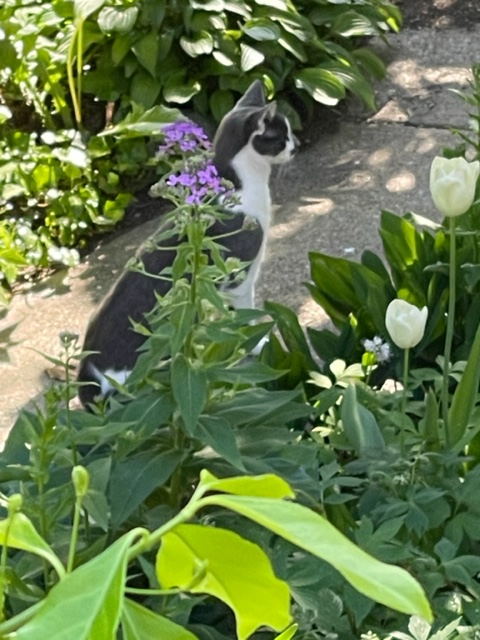
Is our current culture raising people to be like cool cats, independent creatures who are not adept at reconciling differences? Cat walking in a swaggering sway, as if to say, “Nobody better mess with me,” describes quite a few people.                                                          

Pearls of Peace (PoP) Quiz:

84. What peacemaking skills did you learn in your family?

85. Where do you place yourself on an independent-interdependent continuum?

Veterans of Pandemic Time

A 74-year-old woman summed up pandemic time: “It limited and slowed down face-to-face interactions while speeding up progress on some projects that had lain dormant…time is precious. Using it wisely is harder when your activities are limited and your schedule falls apart.” T. S. Eliot captured such time distortions with these words: “For most of us, there is only the unattended Moment, the moment in and out of time.” You may ask, “What was Eliot trying to say?”

My take on Eliot’s message is that time feels slippery. What feels like a “long” time to one person may feel like a “short” timeframe for another. And to make matters complicated, people are not good at attending to present moments. Our nearly constant mind chit-chat ties up so much of our time that we may feel we run “out” of time on a given day.

A 71-year old man offered these timely reflections: “[The pandemic offered]…me more time for contemplation and strategic thought…I did not feel that I lost time…[lessons included] some patience, some resilience…like a repeat when I was drafted in the service, like something you were compelled to do, [it was] better to accept that than to bemoan it…the greater your gratitude, the greater your happiness.” All of us are veterans of the pandemic invisible war with its ongoing deadly strikes. The veteran make-it-through toughness with a nod to gratitude makes me think about Father Time. 

Consider the grandfatherly image of archetypal Father Time who holds a farm-harvest tool, a scythe. Greek mythology’s Cronos was a god of time, harvest, justice and fate. This pandemic season is challenging economic harvesting and our sense of justice; it is fateful for many. Father Time represents veteran journeying through life seasons and enduring whatever befalls him. In some art Father Time holds Baby New Year, a hope-filled rejuvenation possibility. However, Father Time did not have to worry about running out of baby formula for his protégé.

British detective novelist Agatha Christie explained time this way: “I have been on a journey. Not so much a journey back through the past as a journey forward—a starting again at the beginning of it all—going back to Me who was to embark on that journey forward through time.” This optimistic time-travel is another way of suggesting that we trust and embrace our essence, a core self, to lead us onward.

The essence of a pearl is embracing “what is” and growing forward. If there is a pearl to harvest in any shell, it comes out of a trauma ancestry. Pearl conception begins as a natural defense against an intruder – an irritant entering an innocent “parent” oyster or mussel shell. Today’s pandemic is an invisible irritant.   

Is there a pandemic space-time continuum? Harvest your interpretation about the meaning of time, pandemic time or otherwise. Your thoughts matter.

Pearls of Peace (PoP) Quiz:

82. What has pandemic time meant for you?

83. How might you find some pandemic pearls?    

Desert Pearls

Is peace hard to find in ANY culture?

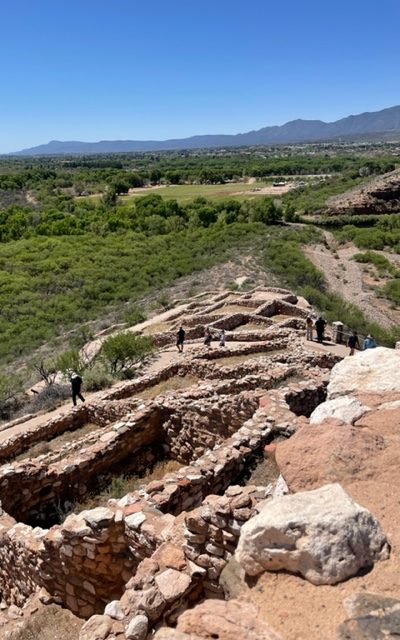
I may have stumbled onto a peaceful culture last week. While on a birthday trip with a dear gal friend, we visited Tuzigoot National Monument in Arizona. Tuzigoot, a First Nation word for “crooked water,” is a description of the nearby Verde River snaking its path through the Verde Valley.

Stone-by-stone the Hisatsinom, meaning “ancient people,” built a layered condo (or ridge-top pueblo) with 87 ground-floor rooms between 600-1400 AD. There were few exterior doors, as entry was by ladder through roof openings. It is estimated that by1200 the tribe had doubled and continued to thrive until abandoning the desert valley around 1450. Why did they leave their homeland? Did violence play a role? It is believed that some from the tribe migrated north. Violence often is the reason for migrations.

According to a National Park ranger, the later-named Sinagua burial discoveries tell the story of a hunting-gathering peaceful people – no evidence of warrior-style deaths were found. The tribe lived similarly to earlier Hohokam culture in southern and central Arizona. Farming efforts produced maize, squash, and cotton. These game hunters added deer, antelope, bear, muskrat, rabbit, and duck to their diet. A nearby salt deposit was mined, and salt became useful for trading purposes.    

Hisatsinom artisans made pottery and axes for daily use. Some pieces of woven cotton clothing appeared to be tie-dyed! Turquoise ornamentation was common, as turquoise is found where copper and other minerals proliferate. The Verde Valley is a major source of copper. Turquoise is a hydrated phosphate formed through a chemical reaction. Water containing copper and aluminum leaks through rocks to create veins where turquoise appears.

Today we locate leaks in our government.   

Organizational psychologist Adam Grant distinguishes “performance cultures” from “learning cultures.” In the former category, people want to prove themselves; disagreement is viewed as a threat to the managing parts of one’s personality. Learning-culture folks focus on improving themselves; every interaction is viewed as a possibility for learning.

In his book, Think Again, Grant suggests the difficulty in reconsidering any belief that one holds deeply. Making a shift in one’s thinking can feel like a loss of a part of one’s personality. However, re-thinking any topic is what leads to creativity and new possibilities for old problems. In Adams’ view, “We laugh at people who still use Windows 95, yet we still cling to opinions that we formed in 1995.”

 Investigating one’s thoughts can free up ass-umptions (some thoughts that are not one’s best attempts).

Is peace hard to find in your personality? It is no wonder that we do not have peace in our world when we have difficulty finding peace in our own personalities. Was it easier to live peacefully in the desert? There were rattlesnakes around the crooked Verde River. Today we are more challenged by crooked thinking.

Pearls of Peace (PoP) Quiz:

80. When have you challenged your thinking about some previous belief?

81. What new possibilities arose from your reconsideration?  

PTSD Pearls

We often focus on the down-side. There is a reason. According to research, a negativity bias starts showing up in your baby brain. While infants initially pay attention to positive facial expression and tone of voice, this changes with the approach of a first birthday. Brain responses to negative stimuli begin showing a surge in activity in information processing, as if some gagging voice in one’s cranial theater sputters, “Fire!”

People consistently overemphasize negative aspects of an event rather than positives. Survival for our ancestors depended upon being on high alert and we carry a defensive negativity bias forward. We constantly tinker with imagined “what if” scenarios. This ancient survival part of our personality keeps kicking up dust storms. What if _________________? Fill in the blank. Your “what ifs” may be different from mine.

The purpose of “what if-ing” is to preempt disaster from delivering us into Neverland. Remember Peter Pan, leader of the “Lost Boys?” His band of boys were lost from parents, living independently in Neverland. What was Peter’s disaster? Peter looked through a window and saw his parents with a new baby; he assumed his parents did not want him. To make matters worse, in the book version Peter Pan killed the “lost” boys to prevent them from aging!

This drama may represent Scottish author J. M. Barrie’s real-life issues. His early history shows a tragic legacy. When he was 6, his 13-year-old brother died while ice-skating. This brother was his mother’s favorite child. The dear 6-year-old tried, as children often do, to comfort his Mum to no avail. Barrie never grew taller than 5 feet and had a notion that leaving childhood was disastrous.

Whatever your child-speak connotation to Neverland might be, a catch in your throat from feeling “on the outside” of some “window” can linger in your body for a long time. Today we might label such lingering malaise PTSD or post-traumatic stress disorder.

Instead of calling PTSD a “disorder,” I’d label it post-traumatic stress development. When you encounter a developmental phase in your life there is a hope for growth. PTSD is rampant in war times, but I see PTSD as a developmental possibility. We sometimes grow most when we are seriously challenged. However, with a focus primarily on negatives (like disorders and pathology), it can seem like a lengthy search to locate positive outcomes.

This reframing in no way takes away from the reality of PTSD as frequently mind-numbing and a difficult staging in any person’s growth efforts. Calling something developmental implies that eventually one has a strong possibility of progressing beyond the initial trauma. Israeli psychologist Amos Tversky warned, “When you are a pessimist and the bad thing happens, you live it twice.”

 Become aware of your negativity searchlights. Rediscover inner lightness in thinking, relating, and overall wellbeing. No rose-colored glasses are needed, but you might smell more roses in your life.

Pearls of Peace (PoP) Quiz:

78. When have you experienced PTSD?

79.  How did you grow from that experience?                

Pearls of Resilience

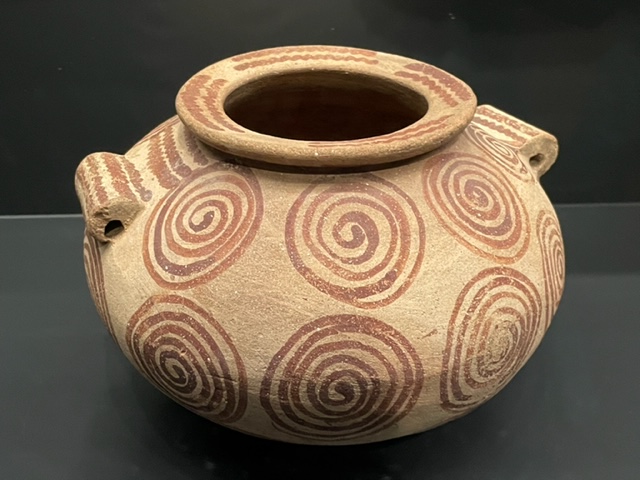
Egyptian pottery, 3500-3200 BCE

Resilience conveys staying-power in the ability to withstand stressors. What supports resilience? A social support system undergirds resilience. What supportive network kept a piece of pottery intact for 5000+ years? Resilience also has links to having a meaning or purpose. The purpose of pottery sealed into inner protective chambers of Egyptian tombs was to help the deceased transport necessities for an afterlife.

If humans can preserve fragile artifacts for safe-keeping, why not treasure human life itself?

What purposes underlie the excruciating stressors of war?

Evolutionary psychologists Martin Daly and Margo Wilson of McMaster University in Ontario, Canada studied 60 different cultures around the world. While 95% of these groupings of people had some form of blood revenge, 93% of them also included forgiveness or reconciliation. The researchers did not believe that killing was so much an evolutionary edict as it was meant to fulfill some goal. Afterlife was not a consideration, but higher social status placed high on the goal list.

It turns out that humans are not alone in seeking higher status. Chimpanzees have been followed closely since their behavior was highlighted at the Jane Goodall research center in Gombe, Tanzania. Chimps sometimes engage in gang violence and kill their neighbors. Chimpanzee wars result in the winning side gaining members from a losing tribe. Through domination of another community of chimps, the aggressors also expand their territorial range and possible food supply chains. Does this  sound familiar?

The noun resilience comes from Latin resiliens, meaning “to rebound, to recoil.” I picture a slinky when I think of recoiling after being stretched to the max. Slinky resilience occurs over and over, each time reshaping a semblance of “holding together.” Ukrainian mothers are “holding together” as they stand in long lines to get on trains, get off trains, obtain food, find shelter, and most importantly, tend to their precious children. Many women are forced to leave their homeland without partners. Courageous Ukrainian parents and grandparents are today’s pearls of resilience. They deal with the unfolding tragedy in Ukraine with passion and persistence.

One thing we must not hold onto is hatred. The resilient words of Volodymyr Zelensky are for everyone: “Don’t let rage destroy us from the inside.”

Look carefully at the spiraling circles holding onto Egyptian pottery. It is curious to find in another part of the planet that similar swirls were carved into stone at the Newgrange Stone Age passage tomb in Ireland around 3200 BCE (blog post, Pearls and Swirls, 1-10-22). I wrote then about an “interdependent wholeness.” I did not imagine a war-ravaging crack about to shatter our coming months.       

Resilience is a possibility for all of us. It works best when we are “holding together” with passion and persistence, the definition of “grit.” Remember, pearls are born from grit.  

Pearls of Peace (PoP) Quiz:

76. When do you use a resilient part of your personality?

77. What can you do today that shows passion and persistence?     

Pearls of Possibles

Plaza de Beneficencia, San Juan, Puerto Rico

A statue of Eugenio Maria de Hostos (with children dancing overhead) stands in the Plaza de Beneficencia (Charity Square) in San Juan, Puerto Rico. Sculptor Jose Buscaglia Guillermety honored Hostos’ extensive influence in the region by naming the monument, “The Great Citizen of the Americas.” Hostos believed that independence in Puerto Rico and Cuba was a possibility and worked tirelessly to accomplish his goal. He was disappointed when the U.S. rejected his proposals. Not all possibles make it to the finish line.

And yet, Hostos was successful in other possibilities. He traveled extensively and reorganized educational systems in the Dominican Republic (establishing a Teachers College despite local opposition of churches), in Peru (advocating for Chinese people living there) and in Chile. As a professor at the University of Chile he campaigned to allow women into colleges in 1873. Also, Hostos was successful in the development of a railroad system between Chile and Argentina with the first locomotive given his name!

Hostos’ essays covered sociology, psychology, literature, law, and philosophy. He earned acclaim as one of Latin America’s first systematic sociologists. He valued a growth mindset for his culture. Hostos held onto possibles despite great challenges.

In First Nation peoples there is a tradition of a “possibles bag.” Originally, these were leather pouches containing something from the plant world, animal world, mineral world as well as something from human life. For example, one’s possibles bag might hold seeds, herbs, animal teeth or claws, feathers, rocks and bones that were believed to possess some spiritual value. The meaning of a possibles bag includes the fact that plants and animals provide what one needs for life sustenance, while a feather can “smudge” with sweetgrass or sage smoke to invoke spirituality.

Later the possibles bag was adopted by frontiersmen. Their collection also was motivated by “needs”–tobacco and pipe, tin cup, jerky and other edibles, knife, black powder, powder measurer, and flint. A gun slung over the shoulder perhaps was most valued among their day-packing items. What represented their spirituality?

Today we might ask ourselves the same question about spirituality.

On daily TV grinding-down news, I cringe when I see soldier after soldier bearing heavy backpacks to hold onto sustenance. Perhaps they carry pictures of loved ones? One side carries an invisible possibles bag of hopes for independence from an aggressor. The other side must have an invisible possibles bag too. What are their values and hopes?

The war in Ukraine rages on with relentless numbers of families torn asunder–both innocent bystander families and families losing soldiers on both sides.

Surely, we can do better in packing our own invisible possibles bag. Writer Annie Dillard muses, “How we spend our days is, of course, how we spend our lives.”

Pearls of Peace (PoP) Quiz:

74. What causes, activities, or groups have you joined as an ardent supporter?

75. What part does spirituality and/or religion play in your possibilities?   

A Beginner’s Guide to Grief

Grief is not a one-size-fits-all process. Everyone grieves in their own way but if you experience unresolved grief, that process can take decades. Prince Harry was only 12 when Princess Diana died in a tragic car accident. He admitted that he could not grapple with the painful loss initially: “…shutting down all of my emotions for the last 20 years, has had a quite serious effect on not only my personal life but also my work as well,” Prince Harry said in an interview. He credits his brother, Prince William, for guiding him to seek professional help.

When you grieve, you may not meet your basic daily needs. Your energy level may flag, your previous discipline for school/work may be compromised, your creativity is on-hold, your belongingness suffers (often fearing the loss of other relationships), and you feel stymied in meeting your ability potential. Speaking from its own version of sign language, your body’s immunity may lower. Intense emotions bluster through you and/or a protective numbness can blanket any emotional expression.  

Elizabeth Kubler-Ross’ stage-theory of grief – denial, anger, bargaining, depression, and acceptance – was never meant as linear stepping-stones. You may or may not experience every stage. Thoughts flip-flop, making you feel ill-equipped for life. All of us are beginners with grieving.

A helpful model of grieving, the Pinwheel Model of Bereavement, is based upon nursing research of Susan Carter and clinical work of Ann Solari-Twadell and colleagues at Loyola University, Chicago. There is no specific resolution, or one set of stages to master in grieving.

Picture a toy pinwheel set into motion by an initiating wind of loss. To not only survive, but to thrive after loss, consider the very center of the pinwheel as your personal history. The turning and spinning of your grieving depends upon your core resilience as built up over your lifetime so far. Consider these aspects when loss blows into your life:

Being stopped or interrupted;                                                                                                    Pain and hurting emotions;

A missing or yearning for all that has been lost;

A holding desire, often holding onto what was good about someone;

A seeking of meaning, comfort, support, and

Valuing what matters most and provides meaning in life.

While a smell, place, or season of the year can trigger fresh grieving, you turn more and more toward an openness to present moments with time. My heart goes out to the people of Ukraine and the relatives/friends of Russian soldiers. The winds of war devastate countless families over millenniums.

Grieving is a whirlwind of conflicting emotion that whiplashes every aspect of life. However, consider how the whirlwind is an ancient symbol of some First Nation people. A whirlwind was believed to sweep out old crevices to allow openness to the “new.” Can that “new” be peace? Hope is possible. Alongside U.S. and German astronauts, Russian cosmonauts collaborate peacefully at the International Space Station.

Pearls of Peace (PoP) Quiz:

 72. When have you experienced a whirlwind of grief?

73. What “new” possibilities were you able to embrace?      

Weaving Trauma into Beauty

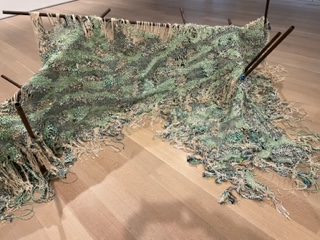
Artist: Igshaan Adams

A textile artist born during forced segregation in South Africa, Igshaan Adams’ enmeshed designs may be interpreted to represent familial relationships and generational trauma amidst socio-political discrimination. His art pays tribute to “gaps,” or invisible spaces in his work. Using beads, shells, glass, rope, wire, and “found objects,” his weavings pulse with meaning. One three-dimensional installation has lead pipes piercing both the weaving and the surrounding air. Is the weaving a sheltering tent…or a flimsy cover-up for truth?

Adams’ recent exhibition is entitled “Desire Lines” which he intends as a metaphor for weaving an individual’s life roadways into a merging collective with others’ paths. Underlying Adams’ work is a poignant probe: “How would you treat someone differently if you knew everything about them? Or nothing?”

We do not know very much about other people. Perhaps we cannot grasp the meaning of another’s life because they never share their innermost angst with anyone. Is it because they deem their experiences as unacceptable? Perhaps they do not want to hear imagined criticism from others: “Really? You did what?”

What if we knew the ACE’s score of everybody? ACE’s stands for Adverse Childhood Experiences, a 10-question survey about traumatic challenges that a child may experience before age 18. The questions do not mince words: Did you…lack protection as a child (including not having enough food to eat); …lose a parent through divorce, abandonment or death; …live with anyone who was depressed, mentally ill, or attempted suicide? Did anyone in the family have a problem with drinking/drugs; did anyone go to jail or prison? Did your parents… ever hit, beat, or threaten each other; …ever swear at you or put you down; …ever hit, beat, or physically hurt you? Did you feel that no one in your family loved you? Did you experience unwanted sexual contact?

Perhaps you will take the survey: https://acestoohigh.com/got-your-ace-score/

Rob­ert Anda, M.D., from CDC, in partnership with Vincent Felitti, M.D., from Kaiser Permanente (California), conducted the Adverse Childhood Experiences study which linked childhood trauma with increased health/social problems across adulthood. The amount of personal suffering found in the initial population of 17,000 adults taking the survey surprised the co-authors, as participants were mostly middle and upper-middle class with college educations. They lived in California with good jobs and health care benefits.

Yet, 87% of the participants reported 1+ traumatizing childhood experiences. The research uncovered tragic numbers of child abuse. As one’s ACE score increases, the risk of disease, social and emotional problems can escalate. For example, ACE scores of 4+ link to a likelihood of chronic pulmonary lung disease increasing 390%; depression increasing 460%; or attempted suicide increasing 1,220%.

Poet Maya Angelou weaves trauma into beauty through words:  “…prepare yourself so you can be a rainbow in somebody else’s cloud. Somebody who may not look like you….”

Pearls of Peace (PoP) Quiz:

70. What did you endure as a child?

71. In what ways do you share your invisible stories?     

Pearls of Creative Problem-solving

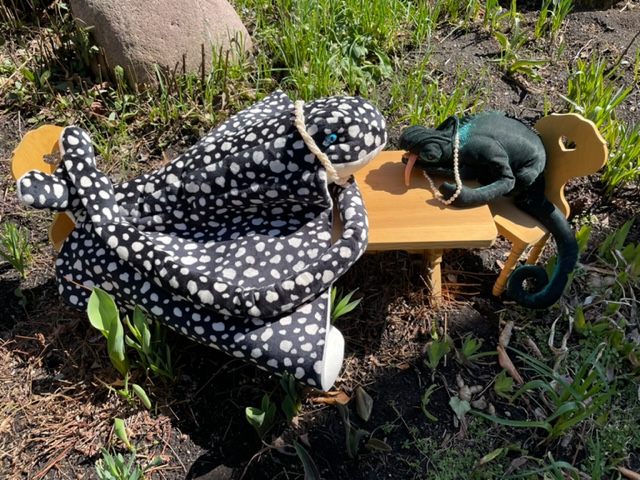
Puppet peace table

We want our children to be creative problem-solvers. U.S. preschools and kindergartens brim with creativity! Then we take most toys out of classrooms of first graders. Perhaps when we do not see much creative problem-solving in adulthood, a creativity drop-off started with misguided educational ideas that toys cannot be learning tools from ages 6-onward.

I loved using psychotherapy techniques that incorporated toys in my private practice. As a family therapist my clients ranged from ages 3-83 (many grandparents were raising grandchildren). A sand tray with tiny figurines was a favorite among all ages. It was not uncommon for an adolescent or adult to pick up one of many puppets in my office and hold it part-way through a session. Some teens took two puppets to illustrate some scene from a difficult interaction they had endured at school. Many people talk best when their hands are moving.

Some companies understand the need for toying with different moves than desk-sitting delivers. A Google office has a slide to get between floors! Employees enjoy company game rooms with a pool table and other “toys” like arcade-favorite Ms. Pac-Man. One Google office that I visited was stimulating with a variety of games present amidst vibrantly painted walls.

This brings me to question whether Mr. Putin had an enriched childhood with ample play time. My guess is no. David Hoffman (The Washington Post) claims that Putin learned, “…[to] never show weakness because the weak are always defeated.” Other writers tell of horrific times in Leningrad (now St. Petersburg) where Putin was born. During World War II most of the population of 3 million in Leningrad were killed. It was termed a genocide. This is an ominous cultural legacy for any child.

Prior to Putin’s birth, his parents lost two sons—one died in infancy and the second son died from diphtheria. The family grief must have been torturous. Both parents worked and one wonders who took care of the young Putin when his parents were at work. Reportedly, Putin was bullied in childhood. He learned judo and became an expert at sambo, a Russian sport combining judo with wrestling. In high school he played handball and worked on the school’s radio station. His fascination with spy movies may have led to a career with the Russian secret service or KGB.

We cope with tragedy and grief legacies by first acknowledging them. When unresolved grief piles up through generations, it is challenging for any person. Creative problem-solving is not the first thing on one’s mind. Filling the potholes of grieving can take on strange actions. In the movie “The Interpreter,” Nicole Kidman says, “Vengeance is a lazy form of grief.”

Is it ironic that there are mass killings (genocide?) happening in Ukraine? Does history HAVE to repeat itself?  

Pearls of Peace (PoP) Quiz:

68. What legacy in your family may have a huge effect upon your current life?

69. How do you decide to have “peace table talks” in your personal conflicts?