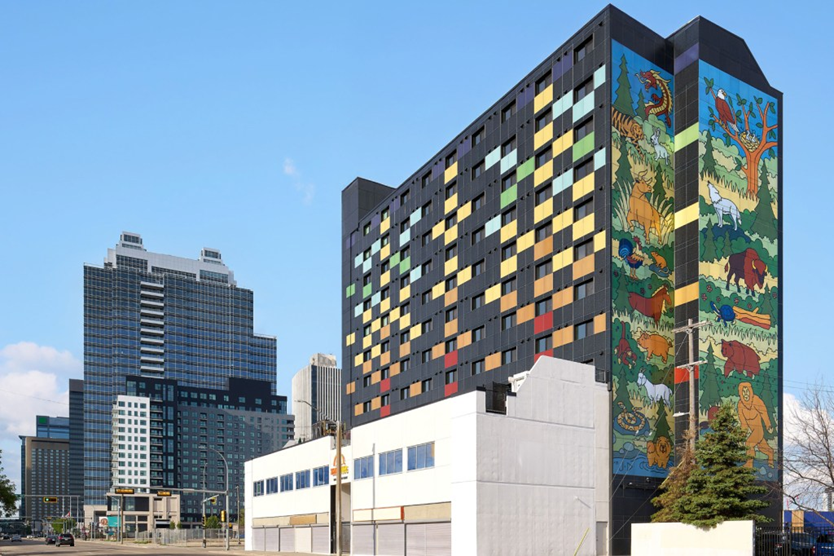
In Edmonton, Canada, a 12-story residential building is retrofitted with photovoltaic solar panels that promise a reduction of nearly 150 tons of carbon emissions annually. Projected savings for both owners and residents is estimated at $80,00 per year beginning with year five.
The 1970’s building, once named Capital Towers, needed renovation. The eco-friendly makeover with a solar focus has a new name, SunRise Residential, and combines sustainable architecture along with the world’s largest solar-panel mural, a current Guinness World Record holder. “This integration provided a dual-purpose solution, allowing the building to generate solar energy while showcasing meaningful artwork,” according to the solar panel company Mitrex. Danial Hadizadeh, CEO of Mitrex, further states, “…building-integrated photovoltaics can produce clean energy, cut emissions, and inspire communities with culturally resonant designs.”
The solar-panel art is a cultural integration of two communities. Indigenous artist Lance Cardinal named his artistic rendering, “The Land We Share.” The color-filled mural panels depict both First Nations and Chinese culture: 7 animals symbolize Cree sacred grandfather philosophy while 12 animals of the Chinese zodiac align vertically. The Cree significant animals are muskox, wolf, bear, eagle, moose, otter, and raven. The Chinese 12-year cycle of animal signs includes rat, ox, tiger, rabbit, dragon, snake, horse, sheep, monkey, rooster, dog, and pig. I wondered if the muskox and ox were the same animal. Online info suggests that the shaggy-haired muskox adapted to cold environments and relates more to sheep; domestic oxen belong to a different family. While the two have similarities, they have distinct physical and behavioral traits (like people it seems to me). However, these species shared a common ancestor millions of years ago.
Artist Cardinal views his paired animal lore in a collaborative manner: “The different teachings and ideals represented by these 19 animals help us see the world in a better way, to be respectful of each other and to understand each other’s differences, and of course, to take care of Mother Earth.”
In fascinating research of indigenous First Nation individuals, scientists have discovered several migrations that originated in China. Originally, it was thought that all indigenous Americans were descendants of a Siberian population; some are, however, earlier migrations began between 19,000 and 26,000 years ago when ice sheet glaciers covered northern China and the harsh climate began a melting of the ice. Some early adventurous Chinese settled in Japan. Some pushed onward to the Americas. There are similarities in prehistoric arrowheads and spears that existed in China, Japan and the Americas.
When we go back far enough to the ancestry of various groups of people, we become more astute in our understanding that we are indeed brothers and sisters with one another. The surprising genetic links between certain Native Americans, Chinese, and Japanese people brings our understanding of one planet, one people to a deeper place.
Pearls of Peace (PoP) Quiz
421. When you consider your ancestry, how many generations can you trace?
422. What meaning does another culture’s folklore have for you?
 Pearls of Peace: A Family Psychologist’s Circle-of-Life Blog