Is Women’s History a Secret?

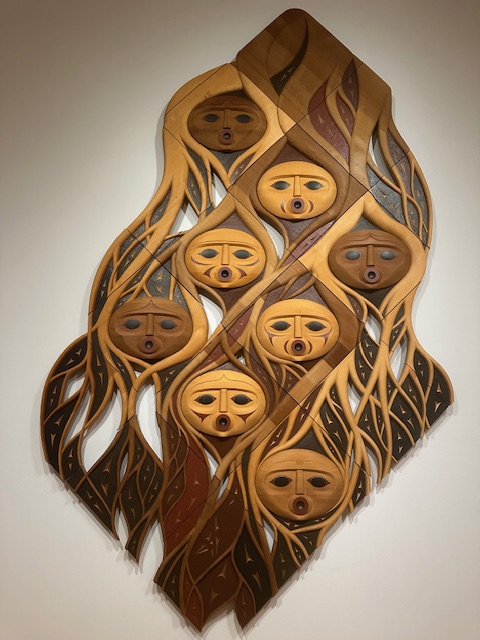
The First People. Susan Point, Musqueam, Canadian

International Women’s Day (IWD), March 8th, has a comprehensive theme – “Rights. Justice. Action. For All Women and Girls.” Despite the day’s U.S. origin, IWD is not uplifted enough in our culture, perhaps due to ongoing discrimination. Trace events to March 8, 1857, when hundreds of New York City’s women – mostly immigrants from garment and textile employment — protested sweatshop conditions. Many were school-aged girls who worked 12-hour days in cramped space with pennies for pay. Strict rules limited the use of a restroom or eating a meal. Their union, International Ladies Garment Workers Union, was male-only and named for the work setting; no women could participate at the bargaining table. Male immigrants also were overworked; they managed to receive concessions and a 10-hour workday through their trade unions.

Fifty years later in 1908, women protested in the streets of New York. Their ongoing issues were child labor practices, harsh work settings, and voting rights. They were met by police carrying hoses with ice water to cool down peaceful protesters. After ongoing attempts of women seeking justice in the work world, in 1980 President Carter proclaimed a national week in March to celebrate women’s sacrifices and contributions. In 1987 Congress expanded the honoring of women’s resilient leadership to the entire month of March. But where is equity hiding?

The National Women’s History Alliance set their 2026 theme as “Leading the Change: Women Shaping a Sustainable Future.” While pay progress occurred in the 1980’s/1990’s, glaring gaps continue in how women’s earnings stack up to men’s earnings. Women’s median earnings today are 80.9% of men’s median earnings for full-time, year-round workers (ages 15+). In 2023 this ratio was 84.6%. Why is this gender gap going in reverse?

Sustainability goes beyond one’s paycheck. Women often lead the forefront in systemic sustainability. They work and/or volunteer in community organizations that are inclusive in creating equitable chances for children’s futures. Many women invest volunteer time in building stronger communities. Women often lead environmental initiatives and work tirelessly on justice issues. These actions primarily are a labor of love with no pay.  

Data from the Pew Research Center finds that 48% of women feel the need to focus on home responsibilities (compared to 35% of men). Caregiving is a huge factor in the gender maze. Taking time away from careers to devote precious hours to caregiving often translates to fewer raises, fewer bonuses, and an overall slow-down in earnings over time.

Many women work in caregiving careers. According to the U.S. Census Bureau, 80% of elementary and middle school teachers are women. While teachers are among the country’s more educated employees, their earnings are far less on average than others with similar education. Earnings have declined for teachers since 2010.

Women’s rights keep getting sidelined. It must be a secret about who cares for caretakers.

Pearls of Peace (PoP) Quiz

478. Have you ever experienced discrimination in your employment pay?

479. How might you engage time and resources to build a more equitable society?

Pearls of Purpose

“Another world is not only possible, she is on her way. On a quiet day, I can hear her breathing.” Writer Arundhati Roy

It is easier to believe this hopeful thought when one is surrounded by Mother Nature’s beauty — especially in a fertile atmosphere like Hawaii where my nephew and fiancée live and married this weekend. The wedding took place on a working ranch under a canopy of banana trees with a rocky mountain peak for a chapel steeple. As part of the ceremony, a tree sapling was placed between the couple as they held a pot of soil with a trowel. They jointly scooped soil into the tree. They will plant it at one of their ecological volunteer sites.

Earlier in Wedding Week the bridal party of 14 attendants joined family members for a volunteer activity at a non-profit 405-acre farm near the Ko’olau Mountains. Forming a long line across a trough of watery planting area, we stomped in thick mud to even the planting bed for the next taro crop. With mud halfway up to our knees, we encountered a few rocks underfoot. It was a literal slippery slope when leaning over to pull weeds growing in rich mud. Taro grows on a rotating basis to produce a constant food source. Much  produce from this farm goes to the local community living outside of tourist areas. If one does not visit rural Hawaii with its dirt roads, an opportunity for cultural understanding is lost. However, most tourists may taste taro at any luau or buffet meal as taro (karo) is a staple food in O’ahu.

The newlyweds are regular volunteers at Kako’o Oiwi, along with some of their friends who were wedding guests. These young adults feel a strong commitment to both helping sustainable food efforts and partnering with Hawaiian people preserving their culture. They find a dedicated purpose in volunteerism alongside their careers. Psychologist William Damon, professor at Stanford, defines the power of purpose (The Path to Purpose). When one’s skills meet the needs of the world, purpose becomes like a chemical reaction. In identifying something in one’s environment where improvement is necessary, the volunteer also identifies aspects of their skillset that make a contribution, such as leadership or creativity. A synergy develops as a win-win opportunity for both recipient and volunteer.

Damon finds that individuals begin their pursuit of purpose in their 20’s and 30’s. While career and family often are at the center, he adds volunteerism as bringing purpose to many individuals. Making a difference in the world is good for people! However, in one survey only 30% of individuals ages 50-92 reported feeling purposeful. Older adults may feel a loss of identity when they leave their careers without cultivating other purposes in life.

In an earlier book, Greater Expectations: Overcoming the Culture of Indulgence in Our Homes and Schools, Damon suggests that child-rearing that is predominantly focused on a child-centered philosophy does not prepare youth for moral maturity and competence: “Less is expected of the young, and in turn less is received.” I find that the same thing might be said of older adults. When we do not expect that seasoned citizens have skills and new purposes to be further developed, we all miss out.

Taking care of the environment is critical. It takes many feet in muddy and rocky places. What if we start to live with Roy’s quote in our own backyards?

Pearls of Peace (PoP) Quiz

285. Where do you find purpose in your life?

286. How many of your friends might join you in some common purpose?