Is peace hard to find in ANY culture?
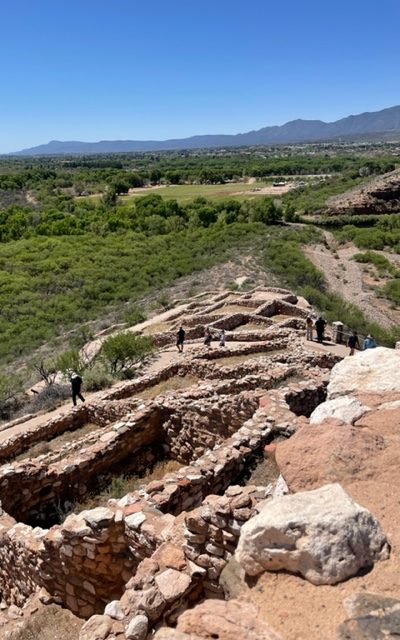
I may have stumbled onto a peaceful culture last week. While on a birthday trip with a dear gal friend, we visited Tuzigoot National Monument in Arizona. Tuzigoot, a First Nation word for “crooked water,” is a description of the nearby Verde River snaking its path through the Verde Valley.
Stone-by-stone the Hisatsinom, meaning “ancient people,” built a layered condo (or ridge-top pueblo) with 87 ground-floor rooms between 600-1400 AD. There were few exterior doors, as entry was by ladder through roof openings. It is estimated that by1200 the tribe had doubled and continued to thrive until abandoning the desert valley around 1450. Why did they leave their homeland? Did violence play a role? It is believed that some from the tribe migrated north. Violence often is the reason for migrations.
According to a National Park ranger, the later-named Sinagua burial discoveries tell the story of a hunting-gathering peaceful people – no evidence of warrior-style deaths were found. The tribe lived similarly to earlier Hohokam culture in southern and central Arizona. Farming efforts produced maize, squash, and cotton. These game hunters added deer, antelope, bear, muskrat, rabbit, and duck to their diet. A nearby salt deposit was mined, and salt became useful for trading purposes.
Hisatsinom artisans made pottery and axes for daily use. Some pieces of woven cotton clothing appeared to be tie-dyed! Turquoise ornamentation was common, as turquoise is found where copper and other minerals proliferate. The Verde Valley is a major source of copper. Turquoise is a hydrated phosphate formed through a chemical reaction. Water containing copper and aluminum leaks through rocks to create veins where turquoise appears.
Today we locate leaks in our government.
Organizational psychologist Adam Grant distinguishes “performance cultures” from “learning cultures.” In the former category, people want to prove themselves; disagreement is viewed as a threat to the managing parts of one’s personality. Learning-culture folks focus on improving themselves; every interaction is viewed as a possibility for learning.
In his book, Think Again, Grant suggests the difficulty in reconsidering any belief that one holds deeply. Making a shift in one’s thinking can feel like a loss of a part of one’s personality. However, re-thinking any topic is what leads to creativity and new possibilities for old problems. In Adams’ view, “We laugh at people who still use Windows 95, yet we still cling to opinions that we formed in 1995.”
Investigating one’s thoughts can free up ass-umptions (some thoughts that are not one’s best attempts).
Is peace hard to find in your personality? It is no wonder that we do not have peace in our world when we have difficulty finding peace in our own personalities. Was it easier to live peacefully in the desert? There were rattlesnakes around the crooked Verde River. Today we are more challenged by crooked thinking.
Pearls of Peace (PoP) Quiz:
80. When have you challenged your thinking about some previous belief?
81. What new possibilities arose from your reconsideration?

 Pearls of Peace: A Family Psychologist’s Circle-of-Life Blog
Interesting information and good thoughts for self-examination.
LikeLike
Hi Jan,
I’m off to get Adam Grants book Think Again! I’m so looking forward to reading it. At a high school/ neighbor meeting recently I was trying to articulate Grants very idea and did not have the words👏
Thanks for your blog! Hugs, Mary Rose
Sent from my iPhone
>
LikeLike
All of us have a “performance” part of our personalities as well as a “learning” part. Recognizing which of our parts speaks for us in any interaction is important.
LikeLike
When you can apply Grant’s ideas to your own personality, your perspective on many topics may change!
LikeLike