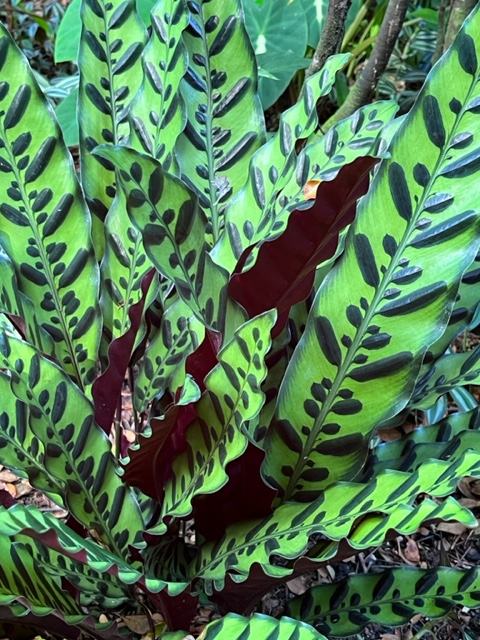
Rattlesnake Plant enfolds its brilliant leaves together at night but unfurls beauty every morning. The leaves-within-leaves plant reminds me of the hardy Hawaiian people. Although foreign takeover of their islands in 1983 attempted to separate Hawaiians from their sacred culture, there has been an ongoing momentum to unfurl genealogy stories and traditions orally. Ancestral land is revered in Hawaiʻi.
The U.S. government (who “annexed” their islands in 1898) wrote this description of Hawaiians: “…the Native Hawaiian people lived in a highly organized, self-sufficient subsistence social system based on a communal land tenure system with a sophisticated language, culture, and religion.” The communal, or ahupuaʻa system, featured land demarcations cascading from mountainous uplands to the ocean. Each section was enfolded into the next interdependent land division. Everyone had a definitive role — to farm, fish, irrigate, heal, teach – and community bonding was strong.
Annabelle Le Jeune, an Asian American program outreach specialist for the Hawaiʻi nonprofit, Partners in Development Foundation, reports on current community bonding. With a tribute to local community leaders, the State of Hawaiʻi has reduced the state’s youth incarceration rate by 82%. In a similar disproportionate categorization of incarcerated individuals along racial/ethnic identities on the U.S. mainland, Native Hawaiians and Pacific Islanders are overrepresented in the Hawaiian juvenile justice system.
Keeping youth closed up and locked down does little to help them cope with issues of substance abuse, mental illness, family and generational trauma, and/or poverty. “Due to historical trauma that predates the illegal overthrow of the Hawaiian Kingdom, Indigenous people are more likely to experience poverty than their nonindigenous neighbors–and in their own homelands,” writes Le Jeune. “The island colonizers gained economic power through private land ownership, disrupting the connection and communal land system that the native people had with their ʻāina (land). Missionaries were also sent to Hawaiʻi to open boarding schools for children to reduce the Native Hawaiian language (‘Ōlelo Hawai‘i)…and promote Christian conversion.”
Hawaiian language and sacred cultural practices were forbidden both in schools and communities for nearly a century. Recently a cultural renaissance is opening and allowing the revival of the Native Hawaiian language. Passed by Congress and signed by President Bill Clinton in 1993, the U.S. apologized to Native Hawaiians for the overthrow of the Kingdom of Hawaiʻi (Public Law 103-15).
Systemic trauma is not reduced immediately with laws, but it is a good first step. We can address mistakes in our collective history. Politicians often are not given credit for righting seriously wrong behavior, however there is still much work ahead.
To reverse the ills of juvenile incarceration in Hawaiʻi, youth are returning to the land for work when released from the Hawai’i Youth Correctional Facility. After nearly 100 years, this facility has been rebranded as Kawailoa Youth and Family Wellness Center with a focus on pu‘uhonua (a place of healing).
Pearls of Peace (PoP) Quiz
155. When you consider your own schooling, what did you miss out on?
156. How might you address issues of our precious at-risk youth?


Thanks for sharing!
Sent from my iPhone
LikeLike
In our local school we did not have students of different color or different racial backgrounds. We need to have others that are different in many ways and hear their stories. What we would have learned is that they also are a lot like ourselves! Also I don’t recall leaning much about native Americans and very little about slavery in our country! It is shocking to learn how people were and are treated in such cruel ways. Hope schools are doing better with those discussions today.
LikeLike
Yes, it is best to embrace diversity at a young age. While our early public schooling was not proactive in this endeavor, remember the song we learned in Sunday School…”love the little children, all the children of the world…red and yellow, black and white, they are precious….” This has stayed with me over the decades.
LikeLike
Nice Jan. A beautiful tribute and worthy reminder of how to live!
LikeLike