As May’s Mental Health Awareness Month comes to a close, can we say that the U.S. is more “aware” of the precious bodymind health of all citizens? It has been another challenging month with an average of about one mass killing weekly and little movement in the halls of government to address meaningful gun control measures.
On this Memorial Day there is plenty of grief welling up in our collective atmosphere. The evening news brings graphic pictures and heartbreaking stories from Ukraine; mass killing is likely a daily occurrence in this unfortunate war. Among surviving soldiers, how many will join the considerable ranks of veterans from other wars in battling dissociation and PTSD? Combat armor may save one’s physical life but it cannot protect one’s mental health.
Some believe that protective armoring is needed after death. Chinese Emperor Qin Shi Huang was buried in 210 BCE among a massive troop of clay warriors closely lined up to protect him for eternity. The buried clay army of 7000 soldiers with terracotta chariots, horses, and wagons standing “at the ready” is an impressive picture book about the desire for protection.
Initially discovered by farmers who were digging a well in 1974, an additional 200 terracotta figures were unearthed in 2020. These amazingly intact clay soldiers each have unique features; different stances, facial features, helmets or weapons distinguish their warrior personalities. But how did ancient people care for their mental health?
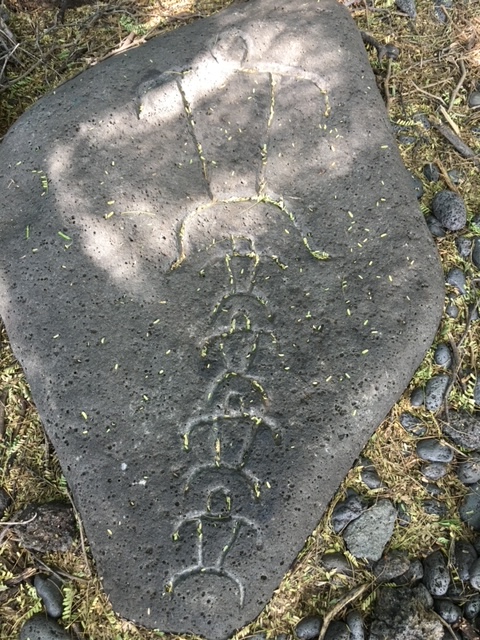
I am a huge fan of petroglyphs, not because I can interpret them, but because I admire these early “writers” who published their “stories” on rocks. My guess for the above Hawaiian petroglyph is that it tells the story of family in some sense. Is it one parent giving birth to several children? Or is it intergenerational? Is this an early version of LinkedIn? You will make your own interpretation, but there is some belonging connection among the figures. Is their purpose to stay close to one another for protection?
Feeling safe and protected is key for one’s mental health. Too many individuals in the U.S. feel like they have a target on their back.
American Buddhist nun Pema Chödrön writes with wisdom (When Things Fall Apart — Heart Advice for Difficult Times): “When we protect ourselves so we won’t feel pain, that protection becomes like armor…We do everything we can think of not to feel anything threatening…[however] breathe in pain…[to] penetrate that armor…With the in-breath the armor begins to fall apart, and we find that we can breathe deeply and relax. A kindness and a tenderness begin to emerge. We don’t have to tense up as if our whole life were being spent in the dentist’s chair.”
Together, we must find ways to integrate inner peace within day-to-day activities to function as our best selves. Let’s arm ourselves with wisdom.
Pearls of Peace (PoP) Quiz
189. What words of wisdom speak to you about mental health awareness?
190. How might we learn lessons from the ancient ones?

 Pearls of Peace: A Family Psychologist’s Circle-of-Life Blog