My community library has a book sale every summer. People donate books that they no longer want. A volunteer army attacks bags and boxes of books piling up in sections of the library; they sort books into categories for ease of purchase. You drive to the library loading dock for a big stash of giveaways. No less than 5 individuals (of every decade past age 10) swarmed my last truckload. The ensuing sale draws a huge crowd. One can enlarge their home library for very little money.
Meanwhile, individuals transform their former book stacks and bookshelves for a variety of reasons: making space for new books (wink), using cleared-out space for something totally new, or needing to reduce “stuff” from a family’s estate hand-me-down books.
As an author I have mixed feelings about all of this. What if the precious books that I donate to the book sale are not purchased? Where do they go? Several years ago I was told that there are simply too many books left over from the sale; they go to the equivalent of book cemeteries. I was aghast. Knowing how much time, deliberation, and energy it takes to write a book, I could not imagine this fate.
Another part of my mind put a philosophical and transformative spin on the life span of a book. What if each book had served its purpose at a particular time in a culture? With paper coming from trees, and trees rising out of the dusty earth, was the return of paper to a landfill just another example of “dust to dust?” After all, my college paperback copy of War and Peace by Russian Leo Tolstoy was on the tattered (and quite dusty) side already. I confess that I never read every fictional war portion. Today we ponder horrors of a current Russian war.
Tolstoy penned these 1867 lines, as if written today: “He recalled his mother’s last letter. ‘What would she feel,’ he wondered, ‘if she saw me here now, on this field, with cannon aimed at me?’” We can answer this, whether we gave birth or not. Clearly, we are a people in need of transformation.
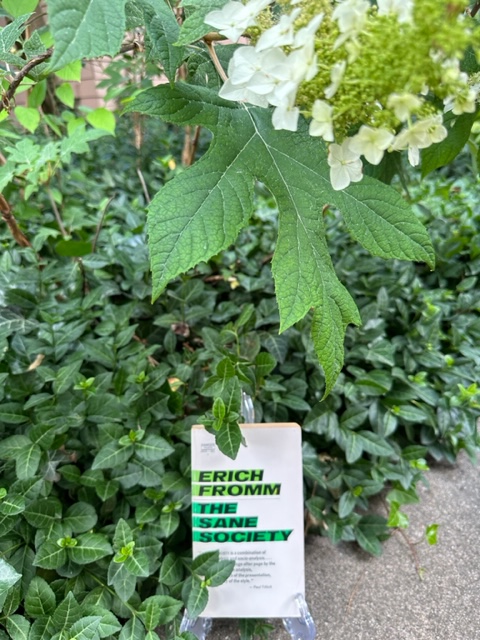
While War and Peace immigrated to the library book sale, I held back another college-era book, psychiatrist Erich Fromm’s The Sane Society (1955). Fromm is described on the back cover as “…counter[ing] the profound pessimism for our future that Freud expressed in his Civilization and its Discontents” (another donation). I am struck by this Fromm quote: “The danger of the past was that men became slaves. The danger of the future is that men may become robots.”
Again, Tolstoy’s deliberations are timeless: “There is no greatness where there is not simplicity, goodness, and truth…” and “If everyone fought for their own convictions there would be no war.”
Transformation is primarily an inside job.
Pearls of Peace (PoP) Quiz
197. What books from college resonate with you?
198. How do you decide to let go of a book?

 Pearls of Peace: A Family Psychologist’s Circle-of-Life Blog
Janis, I still have my Donald J. Grout book, “A History of Western Music”, from my Music History classes at Elizabethtown College. I am not done with it yet! Even though I haven’t picked it up in years, I am not done with it yet. 🙂 Also, I still feel the blood, sweat and tears of poring through that book taking notes so I could be prepared for class discussions. Turns out, this is one of my fondest memories of my college classes experiences. So, I guess that is my criterion for donating a book. Am I done with it? 🙂 Ellen
LikeLike
Some books reach us in new ways — decades after first reading them — because we keep growing! And yes, memories of where we were when we first encountered a book are important. My college memories are precious too!
LikeLike