Last weekend I was with an amazing group of therapists at a retreat center in Northern Michigan, a lovely hideaway with no TV availability. I enjoyed the break from heart-breaking catastrophes in Ukrainian families plus the lack of political civility and problem-solving in U.S. Congress. Listening to music stations on my car radio while driving home, I was unaware of the devastating attacks upon Israeli families.
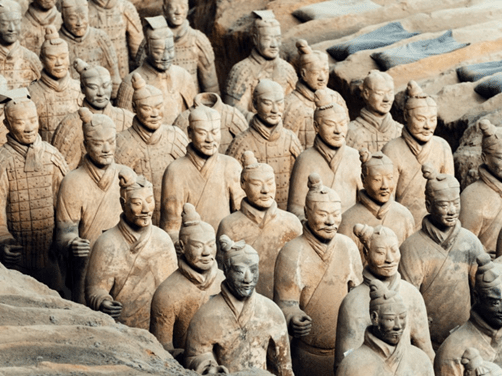
My mind is a wandering journeyer as you know if you have read any of these Monday blogs. While my home TV screen flashed one terrorist trauma after another, I recalled the Terracotta Warriors in Xi’an, China. On a trip over 20 years ago, I grasped an eyeful of the tenacious and long-standing nature of war.
Close to the unexcavated tomb of Qin Shi Huangdi, the 13-year-old self-proclaimed first emperor of China in 221 B.C.E., lies a mammoth burial of an estimated 7000 warrior army of life-size terracotta soldiers. Standing strong with near-life-size horses (plus a few chariots), row- upon-row warriors seem formidable even in clay. Assembly-line production of Qin’s terracotta army shows modern technology; bodies were mass typecast, but separate head molds for warriors were individualized to reflect different soldiers.
Qin reportedly did not embrace Confucianism (common elsewhere in China) where the belief was that well-run governments might follow similar tenets of well-run families – mutual obligation and respect. Instead, Qin’s version of ruling was “legalism” where punitive laws were the norm. Conquering a vast frontier through massacre and destruction, Qin built fortifications which became the basis for the Great Wall. Not only did this dominant Chinese leader plan for his immortality, but he is accredited with many innovations. Qin standardized currency and writing, as well as built advanced roadways and canals to connect regions of China. Were these roads built so soldiers could more easily reach distant lands?
War is horror, both for soldiers as well as the slayed or traumatized survivors. The 22-square-acre Terracotta Warrior site delivers harsh realities: war is ancient and often humankind’s go-to version of political problem-solving. What have we learned from wars about problem-solving possibilities? The unfolding Israeli-Hamas tragedy seems destined to deliver yet another sad example of how war is not situated in any solution camp.
John O’Donohue (1956-2008), Irish theologian, philosopher and poet, had an uncanny wisdom: “… for so many of us…we have to be in trouble before we remember what’s essential.” How much trouble do people have to endure before acknowledging our essential connection with one another?
I often turn to John’s gift of words when grieving some loss. The loss of peace and justice for so many people around the globe seems overwhelming. Fortunately, John’s philosophy survives him. He asked good questions. I am recalling John’s words from a therapist workshop with him in 2006: “Where do unrealized possibilities hang out?”
Pearls of Peace (PoP) Quiz
229. What lessons do you take away from our planet’s perpetual wars?
230. Where do your unrealized possibilities hang out?

 Pearls of Peace: A Family Psychologist’s Circle-of-Life Blog