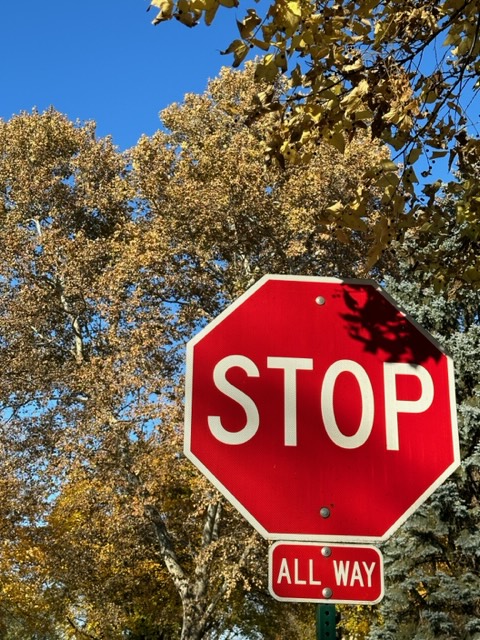
Could you use a few personal stop signs for a more peaceful life? Our planet could use a few global stop signs to curb all ways of violence.
William Phelps Eno, referred to as “Father of Traffic Safety” is given credit for inventing and promoting usage of stop signs. Born in New York City in 1858, he experienced an indelible memory as a 9-year-old child with his mother in Manhattan when they were entangled in a horse-and-carriage traffic jam. Later Eno quipped, “There were only about a dozen horses and carriages involved, and all that was needed was a little order to keep the traffic moving. Yet nobody knew exactly what to do; neither the drivers nor the police knew anything about the control of traffic.”
In 1900, Eno wrote his essay, Reform in Our Street Traffic Urgently Needed. Three years later Eno created the first known traffic code for New York City. Following up, he developed traffic plans for Paris and London.
Recipient of a hefty inheritance when his father died, Eno had freedom to create a brand-new career — traffic management. In addition to realizing a desperate need for stop signs, Eno also designed the pedestrian crosswalk, the one-way street, the taxi stand, and pedestrian safety islands. He is perhaps most famous for his “traffic circles.” There were almost daily accidents at Columbus Circle (Manhattan) where his rotary planning coalesced in 1905. Eno specified that traffic must keep to the right and circle the driving pattern in one direction, not two different directions. With safety as his muse, Eno continued his rotary plans at the Arc de Triomphe (Paris, 1907), and Piccadilly Circus (London, 1926).
Eno established the Eno Center for Transportation (Washington, D.C.), a think tank for improving transportation that continues today. He espoused 3 ingredients for accomplishing any worthwhile project:
1. “We must have concise, simple and just rules, easily understood, obeyed and enforced under legal enactment.
2. These rules must be so placed and circulated that there can be no excuse for not knowing them.
3. The police must be empowered and ordered to enforce them…men [and women] should be trained for that purpose.”
With Eno’s law-and-order legacy, it is curious that he never drove a car — he never learned to drive, despite being given an honorary driver’s license in France in 1912. Were traffic accidents unresolved trauma for him? He lived a long (and presumably safe) life, dying at age 87 from pneumonia. Perhaps Eno felt safer on water than on city streets; he was the first owner of the steam yacht named Aquilo, meaning “the ancient Roman personification of the north wind.”
Our planet could benefit from less long-winded rhetoric and more “urgently needed” agreement on “simple-and-just” rules for safe living, both on roads and elsewhere. Stop signs are reminders that everyone’s safety counts.
Pearls of Peace (PoP) Quiz
237. Where do you need a stop sign in your personal life?
238. What rules might you suggest for the safety of everyone?

 Pearls of Peace: A Family Psychologist’s Circle-of-Life Blog