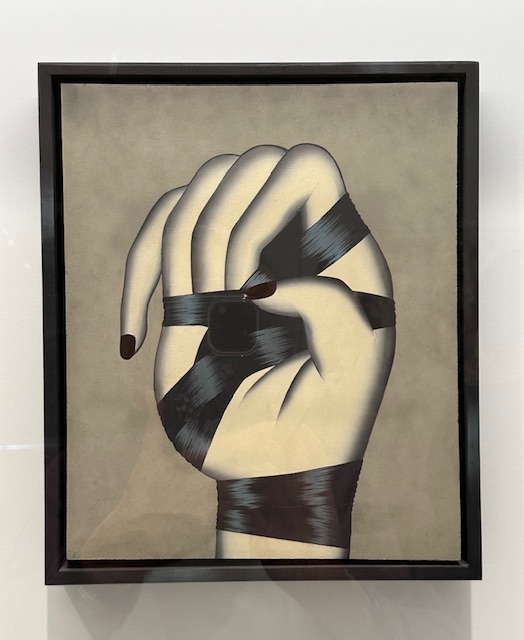
If you can visit The Art Institute of Chicago before August 11th, do not miss the exhibit, “Christina Ramberg: A Retrospective.” In 2025 the Ramberg exhibit travels to art museums in L.A. and Philadelphia.
Ramberg was a devoted artist; she drew, painted, sewed, quilted, and compiled scrapbooks. Her sometimes-edgy art without faces (and only parts of a body represented in each production) leaves much open to interpretation. Everyone flies their own perceptions into any piece of art, but with unsettling cut-offs there is a provocative quality to Ramberg’s work. What was she thinking as she cropped her art? She once answered this question about a corseted headless-legless woman. The curvy mid-section was bent over; Ramberg recalled watching her mother wriggle into tight undergarments to cinch her waist, popular in women’s fashion in the 50’s. The restraints suggested in cut-off torsos were further emphasized with subdued colors.
Here is what grabbed me when I first saw Ramberg’s Bound Hand. I use my hand to teach people about 5 basic needs. Partly as a mnemonic, and partly as a visual representation of what is at hand for us daily, my 5 EDCBA basic needs (as illustrated on a hand or drawn on a handprint) provide a handy chart. Consider how you meet this handful: Energy (thumb), Discipline (index finger), Creativity (middle finger), Belonging (ring finger) and Ability (little finger).
These needs are not hierarchical, but ideally are interdependent and flow into one another, grounded in a core self. Your met needs are a collaborative effort for your wellbeing. However, the daily-needs story gets complicated when needs are unmet; it is challenging when you are confronted by others trying to meet different needs (or disagreeing with how you meet needs). Bound-up needs stifle one’s equality and growth.
As insightful writer Ann Patchett writes in These Precious Days: Essays, “People want you to want what they want. If you want the same things they want, then their want is validated. If you don’t want the same things, your lack of wanting can, to certain people, come across as judgment.”
Despite critiques, Ramberg (1946-1995) kept evolving her creativity, although her life was cut short by Pick’s disease (frontotemporal dementia). Her creativity is contemporary in its cropped views of both femininity and masculinity. The headless-legless male and female torsos are riveting.
Ramberg frequently visited garage sales and flea markets where she collected the 155 dolls mounted on one wall of the exhibit. The dolls (some headless) represent ethnic, racial, and gender stereotypes. Ramberg said this about Doll Wall: “I was only interested in the dolls that had been owned by someone. The ones where the face was worn off and redrawn in, or where something very strange had transpired…I’m interested in what is implied. And the simple fact that they had a life.”
Let’s embrace life. Who needs wars?
Pearls of Peace (PoP) Quiz
291. What (if any) are your unmet needs?
292. How do you meet your need for creativity?

 Pearls of Peace: A Family Psychologist’s Circle-of-Life Blog