Pearls and Weeds

Are you a weeder? Folks, I’m talking about gardening here. If you are anywhere near a garden, you will notice that there are weeds (even in some gardens with careful weeders). Did you know that the definition of a weed is a plant in the wrong place? What one individual considers “weedy” may be different from another’s viewpoint. I’m calling dandelions a weed in my yard, as they are trying to replace my grass. They also blow themselves willy-nilly into my garden beds. I have an organic garden and dandelions are taking advantage of land without toxic products.

Dandelion greens are considered a health food, but I always found that they taste bitter. Recently I learned from a registered dietitian that it is only the stem that is bitter! There are health benefits in eating dandies — they lower blood pressure; reduce cholesterol and triglyceride levels; fight inflammation; aid in blood sugar management and weight loss; offer vitamins A, C, E and K; deliver iron, calcium, magnesium and potassium; provide high levels of the antioxidant carotene; promote liver health; support healthy digestion; treat constipation; and may have anticancer effects along with boosting overall immune health. Oops! I just gave up 2 barrels of dandy greens.  

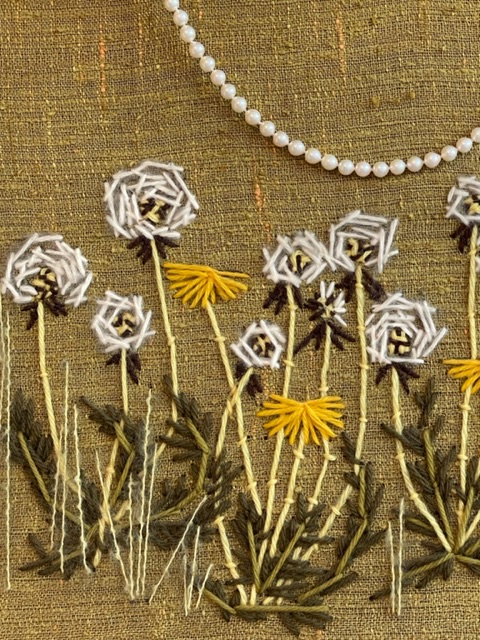
When I was in graduate school for 5 years, I did crewel embroidery as my go-to relaxation. One of my projects was a wall hanging of dandelions. They looked cute when I did not own a yard. It took me a long time to grasp the “big picture.”

Swiss psychologist Carl Jung had ideas for the “big picture” in human nature. Many misunderstand his concept of individuation, thinking that it is merely navel-gazing or being selfish, although Jung stated, “… the individual is not just a single, separate being… his [her, or their] very existence presupposes a collective relationship…the process of individuation must lead to more intense and broader collective relationships and not to isolation.”

People separate themselves from dandelions, but especially from other people with differing viewpoints. We each have a garden of thoughts/emotions/sensations filled with both annual ones (temporary) and perennial ones (long-lasting over years). You can decide whether your internal thinking has more blooming flowers or take-over weeds. I am aware that my garden as well as my internal thinking have some of each. I would like to tell you that my internal garden is “blooming” all day but it is not true. However, it is hard to admit to weedy behavior, especially if we are not aware of it.

What if all of us recognized our thoughts that “weed out” others? What if we understood a bigger picture that included other people’s “weeds?” Perhaps they planted their thinking in the wrong place. For example, anger often is displaced in the wrong place. Anger often cuts us off from understanding one another.

Pearls of Peace (PoP) Quiz:

94. When have you felt cut-off from other people?  

95. What do you do when you realize that you are in cut-off mode?    

A Pearl Called Democracy

Remember shadowy “Deep Throat” from the Watergate scandal? Do you know who owned that nickname? I did not, but Google knows. Reporters discuss the January 6, 2021 presidential scandal and keep referencing Watergate. Nixon loyalists had chanted “witch hunt” in 1972, but the dirty tricks were real. This sad choice of words has reappeared, but the dirty tricks are deadly.

It turns out that few knew the mystery-throated person’s identity — until 31 years after Nixon’s resignation (11 years after Nixon’s death). A former FBI Associate Director named Mark Felt (1913-2008) was “Deep Throat.” Felt had denied unwanted fame earlier, but in 2005 a family attorney broke the story when Felt had dementia at age 91. Bob Woodward and Carl Bernstein, then reporters for The Washington Post, had received secretive information about the Watergate burglars directly from Felt and confirmed the truth.

When truth is stranger than fiction, you know there is more to the story. The catchy “Deep Throat” label was issued by Howard Simons, a managing editor of The Washington Post. Simons copied the salacious nickname from a 1972 pornographic movie by the same name.  

Now, 50 years after the Watergate break-in on June 17, 1972, we are embroiled in another presidential no-no, only this time the stakes are so much higher and for so many more U.S. citizens. We might call this tragedy “Deep Water.” In the Watergate episode, police arrested 5 men in suits. So far, the number of folks charged in the January 6th “Deep Water” disaster — some wearing military fatigues and brandishing American flag poles as battering rams to breach the Capitol — comes to 865 and counting.

All the President’s Men, the movie version of Watergate, won 4 Academy Awards. I’m guessing that someone will make a movie out of the shocking January 6th events, but no future awards can rescue the trauma-soaked lives of countless families from the real-life drama at the Capitol.   

If you have been a Pearls of Peace reader, you may recall the trauma drama of how a pearl is born  (See “Pearls and Trauma,” 7-21-21: “…pearls have a trauma history…conception occurs as a natural defense against an intruder.”) America desperately needs to create pearls of peace out of trauma intruding upon democracy.

Pearls are incredibly diverse. We need to celebrate our diverse America. Have we forgotten poet and refugee advocate Emma Lazarus’ words? Although asked to write a poem, her words were forgotten and not inscribed on the Statue of Liberty until after her death (at age 38). “Give me your tired, your poor / Your huddled masses yearning to breathe free…” stands for precious democratic principles.

Everyone deserves to exercise liberty in voting. Everyone deserves assurance that their vote is honored. Correct vote tallies will keep us out of “Deep Water.” Voting defines our country’s pearl, democracy.   

 Pearls of Peace (PoP) Quiz:

92. When have you taken a stand for democratic principles in your life?

93. What might you do today to protect democratic values?

Guns & Pearls

Guns do not have to be the way the cookie crumbles (or a child dies). I am sickened to see over and over the pictures of innocent children proudly holding their Honor Roll certificates just before they were gunned down in a classroom with balloons to celebrate their achievement. Blame cannot ease the anguish of the surviving students and staff or the tormented “If only I had….” guilt reactions from families of victims. We need problem-solving.

Yes, we must de-stigmatize mental health services and provide more outlets for folks to receive compassionate support both in schools and their communities. Yes, we must have gun security measures in every state. But what about the soul of America?

There have been other challenges over centuries in the U.S. in allowing every child’s birthright, a right to receive a good education in a peaceful school, but we must act collectively this time. It is the children from previous school shootings who seem most capable of leading us forward. The term “full circle” comes to mind.

Mandala is the Sanskrit word for circle. In India the mandala is a spiritual symbol. Both in Egypt and India the circle represents a snake eating its own tail. I ate the gun circle cookie that was given to me. Named the ouroboros (Greek for tail-devouring snake),the symbolism behind the circle is renewal. I believe renewal is possible in America. Call me a cockeyed optimist.

Today mandalas are used as coloring projects for both children and adults. Ancient Indian mandalas (or colored circles) were used as a focal point to regard the sacred space of meditation. Psychologist Carl Jung interpreted mandalas to mean an integration of opposites. What we need today is for individuals with opposing views to color together on the same mandala page, or to find renewal of common humanity together.

When will our law-makers come together in their rotundas in most state capitals and in Washington, DC to make a common mandala? We cannot let these circular sacred spaces be used primarily for lying-in-state memorials for the prominent dead.

I wrote the above lines early Sunday morning. Then I went to church and was surprised by a snippet of synchronicity! Our beloved children in Religious Education were featured – pictures of their assembled mandala with flowers, leaves, and other objects from nature were projected on a large screen. The children had covered a circular tabletop with an intricate mandala design! Children model renewal for us daily.  

In The Picture of Dorian Gray, Oscar Wilde wrote about the Venetian merchant Marco Polo witnessing people living on the island of Zipangu (Japan) put rose-colored pearls in the mouths of the dead. Let’s not say good-by so early to precious pearl children.

Pearls of Peace (PoP) Quiz:

90. What child can you think of who needs to hear from you how precious they are?

91. In what ways can you come together with another who may have views opposite of yours?

Grief Pearls

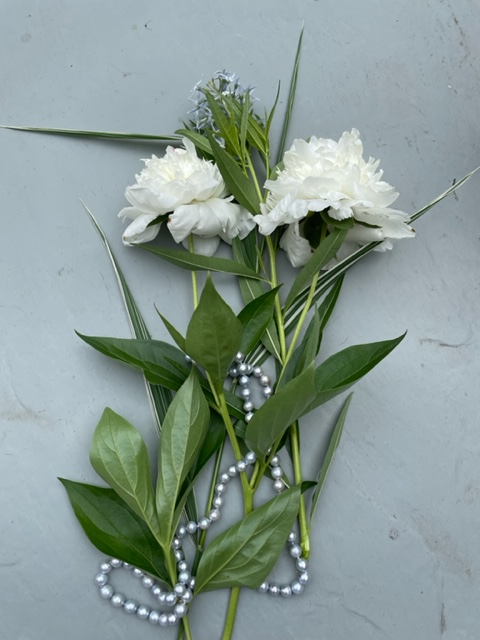
The precious peony flower is a time capsule, albeit a very brief one. Our life plots are time capsules bonding one generation to the next in interdependence. Ojibwe environmentalist Winona LaDuke understands interdependence: “What we have is because someone stood up before us. What our Seventh Generation will have will be a consequence of our actions today.”

“What is it that you DO with your time?” Lin-Manuel Miranda told his interviewer, Willie Geist, that his synopsis of his famous Broadway hit, Hamilton, revolved around this question. It is an everyday question for ALL of us. Actions make differences.

I admit that I have spent much unskillful time focused on recent news of the day, although I am turning more to PBS for what I call “wholesome TV.” I love PBS’s Classical Stretch at 7:00 AM on weekdays with former Canadian ballerina Miranda Esmonde-White. Exercising to classical music (with sunny views of an ocean backdrop) involves present-moment aliveness. With the morning weather turning warmer, my AM habit now intersperses mornings of Tai Chi in a local park with others where I enjoy swaying like a peony in the breeze. Since April, 2020, I join with 40-50 others in an everyday meditation group for 20 minutes of meditation time — another “wholesome” action. I celebrate our time-capsule minutes.

After my mother died in February, I joined an online writing class with Natalie Goldberg (Writing Down the Bones) and found much of my writing to Natalie’s prompts were connected to grieving. This was no surprise to me. What did surprise me was how frequently others wrote about loss. Did the pandemic loosen our collective psyches on grieving? The staggering one-million-death mark can make one take notice of grief.

Our culture is not welcoming of grief-talk. People may ask you, “How are you doing?” although long drawn-out remarks rarely are encouraged. Often it is in the drawn-out remarking (or writing) that healing from loss scabs can layer up. The past few months of the Russian-Ukrainian tragedy and the past few weeks of one U.S. mass shooting after another leaves massive scarring; many are dumbfounded with grief.

Perhaps we need more non-verbal grieving rituals like those in ancient Greece. The Greek people used hair in grieving symbolism: hair might be cut or burned by mourners with the locks of the deceased hung by doorways. People have an interdependent need for others to witness their grieving. I am wearing my mother’s butterfly jewelry.

When I share thoughts on my mind, it may prod another to open up to slightly different thinking. Others’ feedback (often privately off-line) then carries my thinking forward. This is how interdependence is strung in present-time.

Precious peonies both grieve the loss of petals                                                                           and celebrate springtime                                                                     with meditative calmness and joy,                                   as grieving and celebrating are interdependent pearls in the time-capsule of life.

Pearls of Peace (PoP) Quiz:

88. What is it, exactly, that you do with your daily time?

89. What actions would you like to add to your week?

Memorial Pearls

Over the book of time, Memorial Day changed. Did you know that originally it was known as Decoration Day? The day was set aside on May 30, 1868, to honor sacrifices of Civil War soldiers according to a proclamation by General John A. Logan who represented Union soldiers.

When World War I took over public consciousness, the focus shifted from commemorating those killed on Civil War battlefields to all men and women who died while fighting for the United States. In 1971 the day became a national holiday and the date switched to the last Monday in May.

But I find the earlier switching from the original “Declaration Day” to be the stories worth noting. It turns out that General Logan was aware of an annual memorial time in the South that began in 1866 by the Ladies Memorial Association. Four women in Columbus, Mississippi (a burial site for both Union and Confederate soldiers) decorated the graves of the dead. “…one of the women spontaneously suggested that they decorate the graves of the Union as well as the Confederate dead, as each grave contained someone’s father, brother or son. A lawyer in Ithaca, New York, Francis Miles Finch, read about this reconciliatory gesture and wrote a poem about the ceremony in Columbus, ‘The Blue and the Gray,’ which The Atlantic Monthly published in 1867…From the silence of sorrowful hours / The desolate mourners go / Lovingly laden with flowers / Alike for the friend and the foe….”  

A more poignant story predates the dear Ladies. A friend corrected my first version of this post. Actually, the earliest tribute was held May 1, 1965, by thousands of freed slaves in Charleston, South Carolina. Adults and children paid tribute to 257 deceased Union soldiers who were buried in a mass grave. The fact that this story is not a part of our collective knowledge about Memorial Day is troubling.  

Yes, every life represents someone’s grandfather, father, brother, son–or someone’s grandmother, mother, sister, daughter. We are family, all of us on the planet, including those who support Russian or Ukrainian soldiers. Sorrowful hours accompany far too many of us these days.

Reconciliation is what we need more of in these turbulent times. Today, Confederate soldiers in Arlington Cemetery are given respect just like the Union soldiers. All 228,000 graves receive an American flag on Memorial (Decoration) Day in the tradition known as “Flags In.”

Let’s use the inclusive “Flags In” as a rallying call for our country. It is time that we come together. When we have to decorate commemorative killing sites at grocery stores, churches, and elementary schools for innocent victims of war-style weapons, it is time to make big changes in our beloved country.

We all must take a stand this time. I applaud Steve Kerr, NBA coach and gun-violence survivor, as well as Fred Guttenberg, father of a slain high school student in Parkland Fl, for using their national platforms to make a difference. I have joined Kerr and Guttenberg in supporting the non-profit Brady: United Against Gun Violence.

Our bodymind health is on the line, yours and mine. If we do not promote gun safety this time, whose family will be next in line to decorate a grave?

Pearls of Peace (PoP) Quiz:

86. Whose grave site(s) do you commemorate this Memorial Day?

87. What will you do to foster change in America?   

Peacemaking Politics

Cat Walk

In Peacemaking Among Primates, Dutch-American primatologist Frans de Waal labels aggression a “social fire.” When ignited, it can be lethal. And yet, de Waal found peacemaking activities are common in the animal kingdom. Ruthless competition is not more prevalent than sharing and peacemaking among our relatives, the primates. There are territorial squabbles, but many primates are talented in reconciliation efforts. It is daunting to consider de Waal’s observations about monkeys versus humans: “…whereas monkeys generally make-up within minutes, humans can take days, years, even generations to do the same.”

Chimpanzee colonies have developed checks and balances on aggression with peacemaking occurring through a hug and a kiss. Rhesus monkeys groom the fur of their former enemies. The bonobo version of reconciliation is engagement in more overt make-up and make-out sexual behaviors. Other species appear to have make-up behaviors also – wolves, domestic goats, bottlenose dolphins and captive ravens are found to “reconcile” differences.

Only domestic cats have failed to show behavior that reconciles relationships after conflict! Those independent cats are reminders that peacemaking is NOT universally present. 

In de Waal’s book titled Chimpanzee Politics: Power and Sex Among Apes, he cites a definition of politics as a social process containing three ingredients: “who gets what, when, and how.” He compares aspects of chimp life to Machiavelli! However, monkey leaders, the alpha males, do not impose leadership by themselves; they have accomplices.

Monkey business gained new interest this year. For the first time in 70 years, a female Japanese macaque named Yakei (who lives in a nature reserve) violently overthrew three high-ranking males and her own mother to become the first female leader! Yakei’s alpha status is stunning to watch according to reserve workers. “Social smarts are more important than physical strength for Japanese Macaques,” reports Katherine Cronin of Chicago’s Lincoln Park Zoo.

It was imagined that Yakei would lose her reign in mating season, however the plucky Yakei waltzed her wiggle successfully and mated with Maruo, rated 15th in the troop. Staff members call him “quite the catch” as he is very calm and kind to baby monkeys. Yakei gave a rare birth to twins in 2019, but one of her babies disappeared. Meanwhile, Yakei is a loving mom to her remaining twin in spite of fighting her own mother to rise in rank.

Do animal behaviors remind you of any humans?

How did I come to write about monkeys this week? Maybe the latest news on monkeypox was an influence. The idea of yet another animal infecting us — when we cannot get a grip on handling the bat virus — is disturbing.

Is our current culture raising people to be like cool cats, independent creatures who are not adept at reconciling differences? Cat walking in a swaggering sway, as if to say, “Nobody better mess with me,” describes quite a few people.                                                          

Pearls of Peace (PoP) Quiz:

84. What peacemaking skills did you learn in your family?

85. Where do you place yourself on an independent-interdependent continuum?

Veterans of Pandemic Time

A 74-year-old woman summed up pandemic time: “It limited and slowed down face-to-face interactions while speeding up progress on some projects that had lain dormant…time is precious. Using it wisely is harder when your activities are limited and your schedule falls apart.” T. S. Eliot captured such time distortions with these words: “For most of us, there is only the unattended Moment, the moment in and out of time.” You may ask, “What was Eliot trying to say?”

My take on Eliot’s message is that time feels slippery. What feels like a “long” time to one person may feel like a “short” timeframe for another. And to make matters complicated, people are not good at attending to present moments. Our nearly constant mind chit-chat ties up so much of our time that we may feel we run “out” of time on a given day.

A 71-year old man offered these timely reflections: “[The pandemic offered]…me more time for contemplation and strategic thought…I did not feel that I lost time…[lessons included] some patience, some resilience…like a repeat when I was drafted in the service, like something you were compelled to do, [it was] better to accept that than to bemoan it…the greater your gratitude, the greater your happiness.” All of us are veterans of the pandemic invisible war with its ongoing deadly strikes. The veteran make-it-through toughness with a nod to gratitude makes me think about Father Time. 

Consider the grandfatherly image of archetypal Father Time who holds a farm-harvest tool, a scythe. Greek mythology’s Cronos was a god of time, harvest, justice and fate. This pandemic season is challenging economic harvesting and our sense of justice; it is fateful for many. Father Time represents veteran journeying through life seasons and enduring whatever befalls him. In some art Father Time holds Baby New Year, a hope-filled rejuvenation possibility. However, Father Time did not have to worry about running out of baby formula for his protégé.

British detective novelist Agatha Christie explained time this way: “I have been on a journey. Not so much a journey back through the past as a journey forward—a starting again at the beginning of it all—going back to Me who was to embark on that journey forward through time.” This optimistic time-travel is another way of suggesting that we trust and embrace our essence, a core self, to lead us onward.

The essence of a pearl is embracing “what is” and growing forward. If there is a pearl to harvest in any shell, it comes out of a trauma ancestry. Pearl conception begins as a natural defense against an intruder – an irritant entering an innocent “parent” oyster or mussel shell. Today’s pandemic is an invisible irritant.   

Is there a pandemic space-time continuum? Harvest your interpretation about the meaning of time, pandemic time or otherwise. Your thoughts matter.

Pearls of Peace (PoP) Quiz:

82. What has pandemic time meant for you?

83. How might you find some pandemic pearls?    

Desert Pearls

Is peace hard to find in ANY culture?

I may have stumbled onto a peaceful culture last week. While on a birthday trip with a dear gal friend, we visited Tuzigoot National Monument in Arizona. Tuzigoot, a First Nation word for “crooked water,” is a description of the nearby Verde River snaking its path through the Verde Valley.

Stone-by-stone the Hisatsinom, meaning “ancient people,” built a layered condo (or ridge-top pueblo) with 87 ground-floor rooms between 600-1400 AD. There were few exterior doors, as entry was by ladder through roof openings. It is estimated that by1200 the tribe had doubled and continued to thrive until abandoning the desert valley around 1450. Why did they leave their homeland? Did violence play a role? It is believed that some from the tribe migrated north. Violence often is the reason for migrations.

According to a National Park ranger, the later-named Sinagua burial discoveries tell the story of a hunting-gathering peaceful people – no evidence of warrior-style deaths were found. The tribe lived similarly to earlier Hohokam culture in southern and central Arizona. Farming efforts produced maize, squash, and cotton. These game hunters added deer, antelope, bear, muskrat, rabbit, and duck to their diet. A nearby salt deposit was mined, and salt became useful for trading purposes.    

Hisatsinom artisans made pottery and axes for daily use. Some pieces of woven cotton clothing appeared to be tie-dyed! Turquoise ornamentation was common, as turquoise is found where copper and other minerals proliferate. The Verde Valley is a major source of copper. Turquoise is a hydrated phosphate formed through a chemical reaction. Water containing copper and aluminum leaks through rocks to create veins where turquoise appears.

Today we locate leaks in our government.   

Organizational psychologist Adam Grant distinguishes “performance cultures” from “learning cultures.” In the former category, people want to prove themselves; disagreement is viewed as a threat to the managing parts of one’s personality. Learning-culture folks focus on improving themselves; every interaction is viewed as a possibility for learning.

In his book, Think Again, Grant suggests the difficulty in reconsidering any belief that one holds deeply. Making a shift in one’s thinking can feel like a loss of a part of one’s personality. However, re-thinking any topic is what leads to creativity and new possibilities for old problems. In Adams’ view, “We laugh at people who still use Windows 95, yet we still cling to opinions that we formed in 1995.”

 Investigating one’s thoughts can free up ass-umptions (some thoughts that are not one’s best attempts).

Is peace hard to find in your personality? It is no wonder that we do not have peace in our world when we have difficulty finding peace in our own personalities. Was it easier to live peacefully in the desert? There were rattlesnakes around the crooked Verde River. Today we are more challenged by crooked thinking.

Pearls of Peace (PoP) Quiz:

80. When have you challenged your thinking about some previous belief?

81. What new possibilities arose from your reconsideration?  

PTSD Pearls

We often focus on the down-side. There is a reason. According to research, a negativity bias starts showing up in your baby brain. While infants initially pay attention to positive facial expression and tone of voice, this changes with the approach of a first birthday. Brain responses to negative stimuli begin showing a surge in activity in information processing, as if some gagging voice in one’s cranial theater sputters, “Fire!”

People consistently overemphasize negative aspects of an event rather than positives. Survival for our ancestors depended upon being on high alert and we carry a defensive negativity bias forward. We constantly tinker with imagined “what if” scenarios. This ancient survival part of our personality keeps kicking up dust storms. What if _________________? Fill in the blank. Your “what ifs” may be different from mine.

The purpose of “what if-ing” is to preempt disaster from delivering us into Neverland. Remember Peter Pan, leader of the “Lost Boys?” His band of boys were lost from parents, living independently in Neverland. What was Peter’s disaster? Peter looked through a window and saw his parents with a new baby; he assumed his parents did not want him. To make matters worse, in the book version Peter Pan killed the “lost” boys to prevent them from aging!

This drama may represent Scottish author J. M. Barrie’s real-life issues. His early history shows a tragic legacy. When he was 6, his 13-year-old brother died while ice-skating. This brother was his mother’s favorite child. The dear 6-year-old tried, as children often do, to comfort his Mum to no avail. Barrie never grew taller than 5 feet and had a notion that leaving childhood was disastrous.

Whatever your child-speak connotation to Neverland might be, a catch in your throat from feeling “on the outside” of some “window” can linger in your body for a long time. Today we might label such lingering malaise PTSD or post-traumatic stress disorder.

Instead of calling PTSD a “disorder,” I’d label it post-traumatic stress development. When you encounter a developmental phase in your life there is a hope for growth. PTSD is rampant in war times, but I see PTSD as a developmental possibility. We sometimes grow most when we are seriously challenged. However, with a focus primarily on negatives (like disorders and pathology), it can seem like a lengthy search to locate positive outcomes.

This reframing in no way takes away from the reality of PTSD as frequently mind-numbing and a difficult staging in any person’s growth efforts. Calling something developmental implies that eventually one has a strong possibility of progressing beyond the initial trauma. Israeli psychologist Amos Tversky warned, “When you are a pessimist and the bad thing happens, you live it twice.”

 Become aware of your negativity searchlights. Rediscover inner lightness in thinking, relating, and overall wellbeing. No rose-colored glasses are needed, but you might smell more roses in your life.

Pearls of Peace (PoP) Quiz:

78. When have you experienced PTSD?

79.  How did you grow from that experience?                

Pearls of Resilience

Egyptian pottery, 3500-3200 BCE

Resilience conveys staying-power in the ability to withstand stressors. What supports resilience? A social support system undergirds resilience. What supportive network kept a piece of pottery intact for 5000+ years? Resilience also has links to having a meaning or purpose. The purpose of pottery sealed into inner protective chambers of Egyptian tombs was to help the deceased transport necessities for an afterlife.

If humans can preserve fragile artifacts for safe-keeping, why not treasure human life itself?

What purposes underlie the excruciating stressors of war?

Evolutionary psychologists Martin Daly and Margo Wilson of McMaster University in Ontario, Canada studied 60 different cultures around the world. While 95% of these groupings of people had some form of blood revenge, 93% of them also included forgiveness or reconciliation. The researchers did not believe that killing was so much an evolutionary edict as it was meant to fulfill some goal. Afterlife was not a consideration, but higher social status placed high on the goal list.

It turns out that humans are not alone in seeking higher status. Chimpanzees have been followed closely since their behavior was highlighted at the Jane Goodall research center in Gombe, Tanzania. Chimps sometimes engage in gang violence and kill their neighbors. Chimpanzee wars result in the winning side gaining members from a losing tribe. Through domination of another community of chimps, the aggressors also expand their territorial range and possible food supply chains. Does this  sound familiar?

The noun resilience comes from Latin resiliens, meaning “to rebound, to recoil.” I picture a slinky when I think of recoiling after being stretched to the max. Slinky resilience occurs over and over, each time reshaping a semblance of “holding together.” Ukrainian mothers are “holding together” as they stand in long lines to get on trains, get off trains, obtain food, find shelter, and most importantly, tend to their precious children. Many women are forced to leave their homeland without partners. Courageous Ukrainian parents and grandparents are today’s pearls of resilience. They deal with the unfolding tragedy in Ukraine with passion and persistence.

One thing we must not hold onto is hatred. The resilient words of Volodymyr Zelensky are for everyone: “Don’t let rage destroy us from the inside.”

Look carefully at the spiraling circles holding onto Egyptian pottery. It is curious to find in another part of the planet that similar swirls were carved into stone at the Newgrange Stone Age passage tomb in Ireland around 3200 BCE (blog post, Pearls and Swirls, 1-10-22). I wrote then about an “interdependent wholeness.” I did not imagine a war-ravaging crack about to shatter our coming months.       

Resilience is a possibility for all of us. It works best when we are “holding together” with passion and persistence, the definition of “grit.” Remember, pearls are born from grit.  

Pearls of Peace (PoP) Quiz:

76. When do you use a resilient part of your personality?

77. What can you do today that shows passion and persistence?