Pearls and Swirls

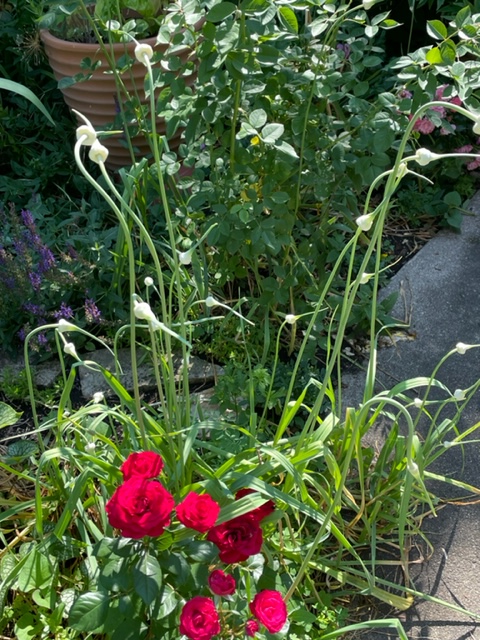
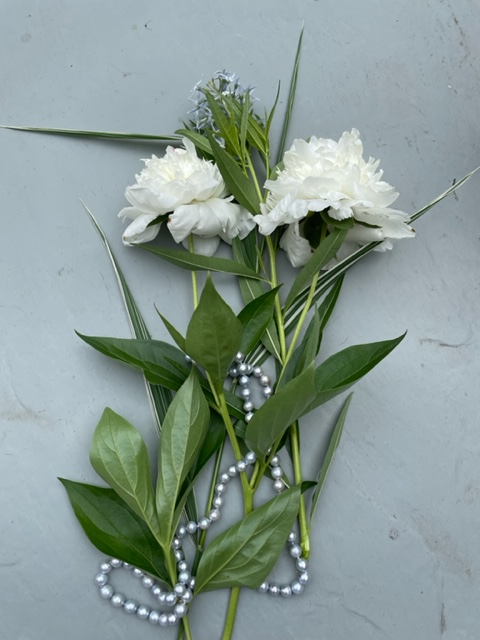
When roses arrived in a recent bouquet, I admired the swirling or twisting spiral of petals toward the mysterious center of the blooms. Each delicate petal followed neighboring petals to create an interdependent wholeness. If flower petals can spiral together for a common goodness, why are people having such difficulty? There are many reasons. Some reasons are not pretty. We need new approaches to come together in our country in this new year.

I like to think of new beginnings as evolving or spiraling. Swirling spirals are highlighted in the captivating art of Georgia O’Keefe’s flowers or seashells, suggesting some inner core vitality. Of course, Georgia took her inspiration from nature’s many swirls and spirals. When she painted White Shell with Red, she painted 5 whorls, or revolutions in the spiral growth, into center circling of the moon shell. The mollusk tribe keeps ancient company: with a 545-million-year fossil history, it predates the 230-million-year earliest dinosaurs. Remember, certain mollusks are home territory to pearls.

We might consider both pearls and swirling patterns as timeless. The curb-stone entrance to the inner chamber of the passage tomb, Newgrange in Ireland, has 3 inter-connected spirals. No one knows what message the stone carver meant to preserve, but the iconic design dating from 3000 BC is believed to represent creation, evolution, and perhaps cosmic energy. Or maybe the ancient Celts were nature artists like Georgia O’Keefe and simply observed that seashells and flower petals often grow in swirling spirals.

In Native or First People’s petroglyphs, it is suggested that the spiral petroglyph stands for the wind, or a blowing out of the old to open the way for the “new.” Another interpretation for a petroglyph spiral design is generation, or life as coiled until ready for emergence.

Distant galaxies appear as spiral nebulae. Years ago, on top of Mauna Kea on the big island of Hawaii, my family and I saw a sky densely swirled with stars. Through a telescope we were told that we were seeing distant galaxies. I only saw “dim” and “tiny” swirling masses, but I was awe-struck at witnessing the trail of what quantum mechanics scientists call the multiverse.

You will interpret your spiraling years with your own symbolism but take time to pause and follow your trailheads to an inner self. Each one of us has an inner telescope to amplify self-territory, a state of being where we experience inner beauty. Internal Family Systems (IFS) founder, Dick Swartz, lists 8 qualities of our innermost nature: calmness, compassion, creativity, courage, confidence, clarity, curiosity, and connectedness. Spiral inward and take some deep breaths.

Pearls of Peace (PoP) Quiz:

46. What inspires you in nature?

47. When do you take a pause to connect with your innermost nature?            

Pearls of Hope (2)

Happy New Year!

On New Year’s Day I was invited to attend a heart-warming Kawanzaa celebration online.  Kawanzaa was created in 1966 by American Maulana Karenga with the motivation of providing African Americans a holiday to celebrate Black heritage and culture. The week-long celebration (December 26-January 1st) incorporates African harvest traditions and derives from a Swahili phrase meaning “first fruits.” The keynote speaker was Atena Danner, a literacy learning facilitator, who read 7 of her dynamic poems to honor the 7 principles of Kwanzaa: unity, self-determination, collective work and responsibility, cooperative economics, purpose, creativity, and faith. Each poem released pearls of hope for a better future for all.

Another celebration treat was a Lion King video of the song, Circle of Life: “From the day we arrive on the planet…there’s more to see than can ever be seen / More to do than can ever be done….” Yes, but each person can do SOMETHING.

Participants were encouraged to write into the “chat” their intentions for the coming year. I was touched by the many hopes for harmony and peace for all. My intention was to increase my listening to other people’s differing opinions. What if everyone became a better listener when others said things that one considers “different?” Too often we only speak and listen to people who have similar viewpoints to our own. We protect ourselves from disagreements. We miss out on the chance to discover the pearls of others. As a Nigerian proverb reminds, “A pearl is only a pearl once it’s out of its shell.”

Is it time to break out of some shell you have constructed over time? Pick a new intention to harvest this year. Now pick a start date (and savor it). Motivational writer Daniel Pink offers a list of 86 calendar days that are auspicious for new beginnings: 12 first days of the months, 52 Mondays, the 4 days that begin each season, July 4th, your favorite holiday, a birthday, the first day back from vacation, or an anniversary date (wedding, first date, divorce). Your start-up intention can embody hope in this new year.

Chilean-American Isabel Allende was forced to leave her homeland during a military coup that resulted in the assassination of her relative, Salvador Allende, president of Chile. Traumatized and exiled in Venezuela–and wanting to keep her family memories alive– Allende began a writing habit. She wrote a series of unmailed letters when her 99-year-old grandfather was dying in Chile and she could not visit him. Allende’s letter-writing turned into a 500-page first novel, The House of the Spirits. Allende began her writing January 8th. She now waits for that day to begin each new novel.

You can set intentions on ANY day you declare as auspicious, but TODAY is another possibility.

Pearls of Peace (PoP) Quiz:

44. What is one hope-intention that you can embody?

45. How will you nurture the motivation part of you to make it happen?   

Pearls of Health

COVID: Between a rock and a hard place…

Are you a victim of your fears? The pandemic amplifies fears even if one is fortunate enough to escape the virus. Psychologist and mindfulness meditation teacher Tara Brach advises, “OK. Fear here. Forgive. Forgive.” This is a good first step: name it to tame it. Now we need to address the gems of recognizing our fears. As another saying goes, we have issues in our tissues. Our bodies ache, cramp, and pain us at times. What are these issues in our tissues?

Often, our rocky issues connect to our stories involving previous fears in a life snafu or trauma. A tornado near-escape (I had one in childhood), surviving a scary illness or accident (I had one of those too) or any other type of physical attack make up one kind of trauma. But an emotional storm in the mind is a trauma also. Have you noticed that physical and emotional trauma hang out together? However, our consciousness often escapes us when it comes to minding our bodily tissues.

In Somatic Internal Family Systems Therapy, psychotherapist Susan McConnell writes: “Our individual hurts and collective societal burdens lodged in our tissues await the light of our courage and compassion shining into the depths of our interiority, leading us to the essence of our being.” Thinking like a body-mind psychotherapist is like pearl farming. An oyster’s shell hides its essence. What nonverbal clues of people lead to hidden pearls? What subtle breathing clues are exhibited? What body tissue tensions show up in one’s posture?

When we are suffering, we just want the hurt to go away. In focusing solely on escaping our suffering, we ignore the issues in our tissues. What we might benefit from most is tuning into a compassionate self to understand and validate our fearful body-mind parts. Fear in your personality is protective. Ask yourself, “What is my fear trying to protect?”

Slow your breath to the count of 4 on the in-breath and exhale to the count of 8. Thank your fear for trying to keep you healthy. One kind of acceptance happens when we rub a painful leg when there is a cramp. As Susan points out, using physical contact helps to hold one’s attention in the present moment and even imagined physical contact releases oxytocin in the body. Oxytocin, often called the “cuddle chemical,” is just as important to your singular wellbeing as it is to social interactions with others as it reduces stress responses. Oxytocin contributes to relaxation. In turn, this relaxed response allows one to soften and find a centered self.

Touch and being “in touch” with our body-mind is key in these pandemic hard times. Our fearful personality parts deserve some cuddling.

Pearls of Peace (PoP) Quiz:

42. Where in your body might you hold some fear?

43. What happens in your thinking and behavior when you change your relationship to fear?   

Pearls of Time

Holiday time often pairs with excess—shopping, presents, food, and/or drinking. A recent revealing read, performance coach Diane Grimard Wilson’s Brain Dance book, explains that most days people just try to make their brain feel good–whether through alcohol, drugs, or any other type of addicting behavior. Brain scans on people with an alcohol addiction show major deficits of alpha waves in specific parts of their brains. Alpha waves are linked with feelings of relaxation and peacefulness. Drinking alcohol increases alpha waves initially, but at a later time the brain switches to faster beta wave frequencies that can lead to anxiety and perhaps more drinking. How tuned in are people to their brain waves at ANY TIME?

Diane admits that she learned most about her brain waves after she was catapulted into brain trauma from a car barreling into her car as she watched in disbelief. She was driving home from an exercise workout and had stopped at an intersection. The accident delivered an unwelcome package—a moderate concussion and post-concussion syndrome. Many symptoms sounded like a hangover that refused to leave. Numbing confusion with fragmentation and immobility is not a peaceful time.  

As the holiday season rolls along, I am aware that many individuals are not experiencing much peace on earth in their current life. At a recent conference, I heard presentations about incarcerated folks who have not been included on much positivity or peace any time. Due to injustices in life and compromised decision-making, they are “serving time” with limited possibilities. It reminds me of the concept of “satisficing,” a word coined by psychologist, economist, and Nobel prize winner in economics, Herbert Simon. Stemming from his years of combining psychology and economics, Simon explained “satisficing” (a combination of “satisfy” plus “suffice”) as the behavior of decision-makers in situations where an optimal solution is not immediately available: a “good enough” solution is accepted. However, what is “satisficing” to one person does not meet up with another’s expectations.

Fortunately for Diane, she opened the gift of a second chance in life with the assistance of neurofeedback, Eye Movement and Desensitizing Reprocessing (EMDR) psychotherapy, and the support of a very loving spouse. Her story is one of “satisficing” in ways that model how to make good use of your time in a crisis. Diane became a board-certified neurofeedback clinician! She studied the very training protocols that helped her cope with her brain trauma. No one wishes for bad things to happen to them but when they do, there are possibilities in responding. Diane’s perseverance in finding how to make her brain rewire, as well as helping to heal the brains of her clients, is truly inspiring.

How you choose to spend time matters. Consider your own ways of improving your precious brain to have more peace in your life.

Pearls of Peace (PoP) Quiz:

40. What do you do on a regular basis to enjoy peaceful times in your life?

41. How might you share the gift of peace this holiday season?                                         

Pearls of Strength

Have you ever been in awe of a swirling mass of starlings that flow in a myriad of shapes as they perform an airborne ballet together? It is called a murmuration of starlings. Some other birds fly together in V-shaped formations, but starlings dance in a spinning and swirling flow together in the sky. Murmuration, meaning low and continuous sounds, comes from starling-wing music when as many as 10,000 birds synchronize their moves.

Traveling through the Great Plains—Nebraska, Kansas, Oklahoma—in one day I saw 9 different starling murmuration configurations. Each one was captivating in its beauty. Starlings fly in close relationship with their flock mates for protection from predators and for warming. What our world needs today is people murmuration–a flock of folks who get vaccines together to protect ourselves from the pandemic predator. Peaceful bodies, free from viruses, are not about politics; peaceful bodies are about survival.

Norwegian Johan Galtung is considered to be the father of peace and conflict studies. The 91 year-old sociologist has Ph.D. degrees in both mathematics and sociology. He founded the Peace Research Institute Oslo in 1959 and the Journal of Peace Research in 1964. What is Galtung’s idea of peace? Peace means there is a relation between 2 or more entities which includes people, nations, regions, or civilizations.

If you think about it, relational interactions are everywhere you may look. Some relational interactions are peaceful; others are conflictual. Galtung considers how our social interactions have evolved from “primitive” times (hunters and gatherers) to agricultural societies to the modern industrial world. Relations shifted, becoming more hierarchical and even impersonal, as these changes occurred.

We are missing out if we do not care about the personal best from each person. We need each person’s  flow in the flock. “Flow” is a concept proposed by Hungarian-American psychologist Mihaly Csikszentmihalyi. In his book, Flow: The Psychology of Optimal Experience, a sense of flow is defined as a presence, a state in which you are so involved in some activity that you are entirely focused. One might assume that health and survival would be good focus options. Flow activities do not have to involve a competition or a masterful piece of art, although these experiences do involve a flow mentality. Csikszentmihalyi’s research found that a person’s skill can develop best when they reach an intersection between their skill level and challenge. A sense of flow can be a struggle, as challenges often are difficult.

What might happen to the strength of countries if we engaged in peaceful dialogues about our conflicts? Is your flow tank full? It is a possibility that we could be a people of murmuration, flowing together to resolve the weighty issues of life.

Pearls of Peace (PoP) Quiz:

38. When have you felt a sense of flow in your life?

39. What dialogues might you have with another that could move both of you in positive directions?

Pearls of Hope

Winter sunset…

Emily Dickinson identified hope as withstanding the “chillest land” in her stalwart poem, “Hope is the thing with feathers.” In other words, the sun never sets on hope because hope has possibilities for a new day.  

Environmentalist Jane Goodall and co-author Douglas Abrams wrote The Book of Hope: A Survival Guide for Trying Times (NY: Celadon Books, 2021). Jane does not wear rose-colored glasses (or pearls) but she does deliver pearls of hope. There are 4 reasons for hope outlined: the amazing human intellect, nature’s resiliency, the power of young people, and an indomitable human spirit.

Goodall emphasizes that “real hope” requires action! Think of hope this way–when you take on hopeful actions, you create a domino effect because hope has contagious possibilities. When you choose your domino, you set up possibilities for another’s domino. We actually need a healthy contagion of positive domino action with yet another COVID variant circling the planet. Hope activities come in many forms.

Here is part of a much larger conversation between Jane Goodall and Doug Abrams:

Jane: “Hope is what enables us to keep going in the face of adversity. It is what we desire to happen, but we must be prepared to work hard to make it so…You won’t be active unless you hope that your action is going to do some good. So you need hope to get you going, but then by taking action, you generate more hope. It’s a circular thing.”

Doug: “Do animals have hope?” 

Jane: “Chimps will often throw a tantrum when they don’t get what they want. That is some form of frustrated hope.”

Doug: “Is hope an emotion?”

Jane: “No…it’s an aspect of our survival…it’s not a skill. It’s something more innate, more profound. It’s almost a gift…it is a human survival trait and without it we perish.”

You might guess that Jane’s “gift” metaphor might make me think of pearls. A pearl is a gift from the sea, parented by an oyster or mussel shell due to an irritant (or parasite) entering the innocent shell. Like the COVID irritant, the shell may be “taken” by surprise, but it immediately gets down to business–layering a fluid on top of the irritant. People have the ability to layer on protective measures when irritants appear too. Vincent Van Gogh explains a version of hope: “The heart of man [or woman or child] is very much like the sea, it has its storms, it has its tides and in its depths, it has its pearls too.”

Not every shell produces a pearl. But pearls-of-hope actions are a possibility. Whether we are battling COVID or any other life-storm, if we realize our indomitable human talents together as the human race, we can find pearls of hope.

 Pearls of Peace (PoP) Quiz:

36. What life irritants are you dealing with today?

37. How do you find hope in the depths of your challenges? 

Pearls and Pipes

Once upon a time there were old faithful pipes…

I knew I had a problem when I found a small pool of standing water in my (usually) dry basement. When I looked up to the ceiling, the culprits–100+ year old pipes with drips–were oozing into freefall. Thankfully, it was not a gusher emergency, just a droplet here, a droplet there. The clear pearls of water forming might have been fascinating to watch if not for the ominous meaning they held.

The first plumber call was an apology for being “backed up” and gave me an appointment of December 13. The second plumber I tried could come on December 1. Plumber number three said they could come the next day. Meanwhile, a bathroom toilet stopped flushing and began dribbling water from the base. It turns out that a new toilet was needed upstairs. A temporary fix was tried in the dribbling basement until two plumbers could be scheduled for complete relief after Thanksgiving. I began a mind-search for gratitude pearls.   

There are many pearls of gratitude in my family. We celebrate Thanksgiving with both sides of the family (that’s two wonderful turkey dinners on both Thursday and Friday). This is my favorite holiday gathering of the year. It feels good to give thanks. I was especially grateful this year for the sharing of good-times stories with family members away from the mundane (and costly) repair issues of homelife and the ominous TV coverage of the new COVID variant, Omicron.

We often find new meanings in our retelling of a stressful time. Psychologist Monisha Pasupathi summarizes: “We become the stories that we tell; our stories aren’t single authored.” These co-created story plots influence our lives whether we are conscious of them or not. Perhaps next Thanksgiving I can laugh at leaky pipes with new story lines.

From the earliest of times people shared stories. Before printing existed, fables and myths were handed down through generations. I am fascinated by the lovely story-buildings in Europe. In the Middle Ages special legends were painted onto exterior walls of buildings where each floor told a different tale. Such floors were called “stories.” Just like those traditional walls hold certain story plots, your personality holds many plots in your story-house of life experiences. I envision that we store subconscious memories and pipe-dreams down the basement stairs of our personality story-house. It is time to uncover those pipe-dreams and discover the pearls they may offer.

Pearls of Peace (PoP) Quiz:

34. What happened to you over Thanksgiving that held both positive “upper” and negative “downer” messages?

35. Are there pipe-dreams you have held onto for decades that might hold meaning for you now?

Gratitude Pearls

“When I’m cold I just put another rope of pearls on.” – Dorothy Parker, writer, critic, and satirist

Realistically, what we need most when we shiver from any coldness of life, or just-tired-of-negative-news malaise, is gratitude. This week encompasses our nation’s traditional day of giving thanks for the good news of life. The goodness is that we are HERE! Give a shout-out to your ancestors who undoubtedly experienced much literal and figurative coldness in their lives but they persevered. Perhaps they wore pearls. Hopefully, they expressed gratitude. Often.

Reviewing life events and finding thanksgiving moments is meaningful in a myriad of ways. Producer and composer Barry Goldstein wrote a song entitled “The Moment” which expresses gratitude simply for being alive and “not wasting” another second of life. What we “waste” often are moments when we might express our gratitude to others. Gratitude for others’ contributions to our lives affirms our belongingness and interdependence. If our DNA is anywhere close to 99.9% the same as the next guy or gal, how can we fail to care about each other?

As gratitude researcher and psychologist Robert Emmons points out, gratitude implies humility, a realization that we might not be who we are or where we have landed in life without the contributions of others. One pearl does not make up a string of pearls. A solitary pearl is lovely, but there is something precious about pearls that hang together.

Interdependence, a stringing together of caring for each other’s needs, is especially key at the beginning and ending of life. We are grateful for the birth of a beloved baby and we are grateful for having known a beloved one when they die. Gratitude is felt keenly; it is not unusual to have tears accompany gratitude moments. The part of your personality that may keep you from feeling gratitude is a complainer or critic. When you are busy with a downer-mentality, it is difficult to let your gratitude meter flow freely.

This week tap into the resilience of gratitude moments. The power in gratitude takes you closer to having self-compassion as well as having compassion for others. Yes, there is much suffering, cold rhetoric, and violence in our world. I am not suggesting that you forget that. I am suggesting that you hold onto a sense of gratitude while you address the chilly issues in life that cause suffering. Gratitude is a healer. It will warm up what needs warming up.

Whether you attend Thanksgiving with family or enjoy a Friendsgiving, tell at least one other person something you are grateful for in them. 

Pearls of Peace (PoP) Quiz:

32. What is the first thought that comes to mind when you think of gratitude?

33. What are you most grateful for from your childhood?

Mindset Possibilities

Somewhere, over the rainbow…

Have you noticed how quickly a rainbow disappears? A rainbow pops in and out of brilliance. Yet, our frequent fixed-mindset perspectives entail wanting rainbows (and other goodies) to “last” or “stay the same.” Have you noticed seasons changing? The climate and our weather, including weathering the pandemic, is a moving target. We may not live the “same” as we did pre-pandemic.

Consider Frank Baum’s voyage-and-return plot for all ages, The Wonderful Wizard of Oz, published in 1900. There are messages for both adults and children in Baum’s classic story. While he visited Kansas only once, Baum was deeply moved by a tornado which ripped through the state in 1893, killing 31 people and destroying two towns. Baum turned his grieving into a redemptive narrative about a girl and her dog who are traumatized in weathering a tornado.

Dorothy Gale was named for Dorothy Gage, his 5-month-old niece who died during Baum’s writing about Oz. He created his name for a made-up kingdom by staring intently at his filing cabinet. The three drawers were marked, A to G, H to N, and O to Z. The letters O-Z captured his imagination!

Heroine Dorothy endured many challenges before reaching the Wizard. Coping with fear and uncertainty are mainstays in Baum’s original story. Dorothy asks the pretend-Wizard if he is frightened and he replies truthfully: “Child, you’re talking to a man who’s laughed in the face of death, sneered at doom, and chuckled at catastrophe…I was petrified.”   

One takeaway message is the growth mindset of Dorothy, an orphan raised by her aunt and uncle amidst conflict at home. Aunt Em orders Dorothy: “Find yourself a place where you won’t get into any trouble!” Like many runaways, Dorothy takes this message to heart and runs off with her dog, Toto. Then the tornado strikes.

When Dorothy meets the Tinman, Scarecrow and Lion, she discovers that everyone struggles. Each friend feels inadequate–not having enough compassion, or intelligence, or courage. When all work together to save Dorothy from a Wicked Witch, each one becomes resilient in discovering their personalities are flexible! Each discovers inner strengths (in spite of the Scarecrow’s and Tinman’s bodily disabilities), although they were unable to recognize their possibilities initially.  

It is through the storms of life that we tend to learn some of our best lessons if we have a growth mindset. We feel surprise in seeing rainbows after stormy times, but life is full of opposites. Our personalities are full of opposites. It is up to each of us to name our vulnerable fears. We can nurture self-compassion for our struggles and foster a belief in growing our potential. It is then we are better able to have compassion for others also weathering bumpy times.

Pearls of Peace (PoP) Quiz:

30. What are times when you have held a fixed mindset?

31. How might you nudge yourself into a growth mindset more of your day?   

Purring Co-regulation

Visiting cat curiosity…

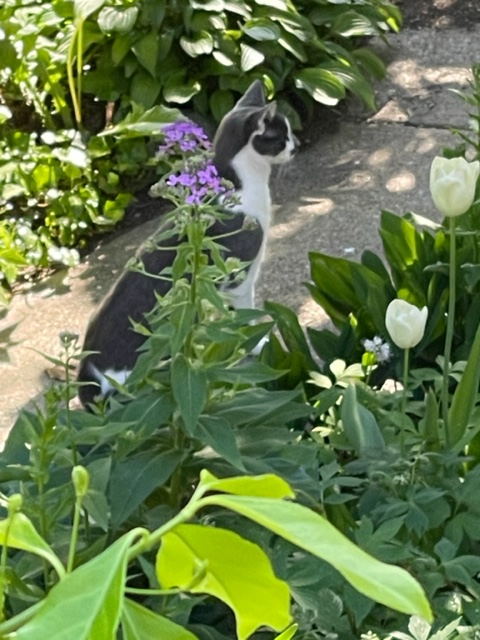
As a young child I was curious about cats. I fancied myself a cat trainer – also, I was “trained” by them. Many cats visited. None were allowed in our house as my brother and I were allergic to cats. I fed itinerant cats table scraps outside. The vagabonds seemed happy with leftover dining offerings as a welcome change from getting mouse fur stuck in their teeth.

Cats are very independent creatures. Some consider that cats are only semi-domesticated which fits my experience. Egyptians reportedly were the first people to domesticate cats around 1500 BC. Cleopatra supposedly had a favorite pet cat she named Tivali (meaning gift of God). Cats were revered in ancient Egypt as they were protectors of the home, often attacking snakes who found themselves in the wrong place. An Egyptian goddess, Bastet or Bast, was characterized as a lioness and later as a woman with a cat’s head. Bast represented justice, fertility and power.

I learned a lot from taming feral cats. Each one had a different personality. I learned co-regulation, although that was too big of a word for a 6-year-old child. Midnight was my favorite cat – perhaps because she submitted to our co-regulating bonding for longer periods of time than other skittish cats. Midnight and I were curious about each other. She followed me, but I also followed her.

 Midnight was an excellent huntress. Her mousing efforts sometimes were dropped off at the back door for my inspection. I was clueless about mousing behavior, but Midnight enjoyed my after-the-fact co-regulating praise. I enjoyed her steady purring when we cuddled. Purrs are a cat-regulating sign of safety and comfort. Sometimes a cat purrs when alone, just rolling around as if self-soothing. Kittens are born deaf and blind, but they soon begin purring vibrations to bond with their moms.  

People are not as independent as we may imagine. We also are dependent as newborns. As we grow up our everyday responses are colored through our connections with other mammals. According to psychologist Stephen Porges, mammals are defined by a need to co-regulate with another, however unresolved trauma interferes with our co-regulating. A person who appears to self-regulate efficiently is one who has a nervous system filled with training times of effectively co-regulating with others. Porges points out that there are folks who co-regulate more effectively with their pets than their spouses…perhaps a topic for another day.

Cats know about co-regulating, but they also know how to pause after a busy day – they roll around on their backs, paws to the sky, while purring with contentment in their eyes. While most of us do not worship cats, we might learn some lessons from them.  

Pearls of Peace (PoP) Quiz:

28. Can you think of times when you experienced co-regulation with a pet?

29. Who is in your life today that you co-regulate with on a regular basis?