Communicate Perils or Pearls

Jitish Kallat, Public Notice 3 (The words communicate 2 historical moments: A speech by social reformer Swami Vivekananda on 9-11-1893 and the terrorist attacks on 9-11-2001), Art Institute of Chicago

In an interview with psychologist Jill Suttie, journalist Nicholas Carr details social media history and its variable effects upon the public. The telegraph and telephone arrived in the 1800’s. The first commercial radio station followed in 1920. As a wireless telegraph, radios provided Morse codes to ships and lighthouses where wires could not reach. Then came an onslaught of radio news, music, and perhaps most important – opinions that dominated the one-size-fits-all airwaves for mass consumption. Some complained that radio was “dumbing down the population.” A dangerous force of radio’s power was when German Nazis took over radio stations in the 1930’s and communicated their propaganda.

Carr makes the argument in his book, Superbloom: How Technologies of Connection Tear Us Apart, that more efficient communication does not equate with better communication. He refers to research that suggests that learning more about other people does not lead to liking them more or even understanding them more. In fact, finding out the various ways that another person is different from one’s self-perception can lead to disliking that person. Simply put, people tend to focus on differences more than similarities and we dislike “the other” who is “different.”

Currently our online lives can overwhelm us with massive amounts of information which we filter through our existing biases. Another problematic issue is that folks are addicted to social media. Carr states it well: “We’re not being manipulated to act in opposition to our desires. We’re being given what we want in quantities so generous, we can’t resist gorging ourselves.”

Social media outlet algorithms find what we use regularly and then load us with similar topics. With the oncoming AI locomotive barreling down media tracks, who can escape this runaway train? AI offers virtual “companions.” Is this communication or manipulation?

A sidecar in social media is the “Influencer.” The definition of an Influencer is an individual who is able to generate interest in something by posting about it on social media. Initially an Influencer was a celebrity (think Elon Musk who was, or still is, an Influencer of the U.S. President), but today’s Influencers can be anyone with a large following on social media. This is enough content about communication perils.

Where are the communication pearls? Communication skills are key in relationships, careers, and world diplomacy. We simply must teach children effective communication and problem-solving skills. Early in my career I was part of a small group of psychologists teaching Myrna Shure and collaborator George Spivak’s Interpersonal Cognitive Problem Solving, later renamed I Can Problem Solve (ICPS). I worked with Myrna at Hahnemann Medical College and Hospital (Philadelphia) and her 8-week curriculum for students from preschool to 6th grade. ICPS engages both teachers and parents in training children on how to think and communicate with an understanding of alternatives. Much communication requires alternative problem-solving steps.

Who teaches adult versions of I Can Problem Solve?

Pearls of Peace (PoP) Quiz

403. Who are your social media Influencers? ‘

404. What communication skills do you use daily? 

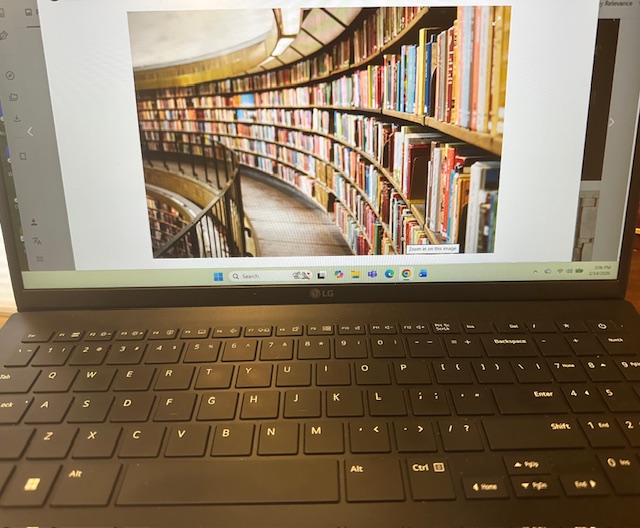
Library Perils and Pearls

“Anyone who writes is a seeker. You look at a blank page and you’re seeking. The role is assigned to us and never removed. I think this is an unbelievable blessing,” proposed Louise Glück, U.S. poet and Nobel laureate. Alongside writers, let’s include readers as seekers. Readers seek ideas and knowledge to whet their curiosity appetite.

1950’s research found that Americans were spending less money on books; instead, they purchased radios (remember those?), TV’s, and musical instruments! Concerned that citizens were reading less, the American Library Association (ALA) and the American Book Publishers formed a nonprofit to bolster reading. National Library Week was born in 1958 to re-invigorate readers. The first theme was “Wake Up and Read;” this year’s theme is “Drawn to the Library.” Notice, the word “reading” is absent.

In this 67th year of the event, April 6-12, 2025, National Library Week offers far greater services than 1950’s libraries. Besides books, contemporary libraries supply patrons with internet training/usage, career workshops, museum passes, video games and toys! National Library Week includes a focus on the increasing ways libraries create community by bringing people together.

Yes to community bonding, but who reads books? The Bureau of Labor Statistics Time Use study found that the time Americans devote to reading has dropped over the past 20 years. A Gallop survey in 2022 found that Americans simply are reading fewer books per year than previously. Social media has dethroned books. Bookshelves are lonely. AI tools are eclipsing reading and writing. Research with college students using AI-generated summaries reveals convenience and time-saving as plusses, but “text engagement” suffers; AI was “less effective in promoting deeper understanding.” 

Research at Duke University presented participants with reading and writing tasks, followed by reading comprehension questions. Complete reliance on AI for writing tasks led to a 25.1% reduction in accuracy. When using AI in the reading task, there was a 12% decline in participants’ reading comprehension. https://papers.ssrn.com/sol3/papers.cfm?abstract_id=4567696

Censorship dictates what U.S. readers might read. A government directive to the Naval Academy Library demanded the removal of nearly 400 books this past week. The “State of America’s Libraries Report” offers a canary-in-the-coal-mine view of what faces the U.S. in general. ALA President Emily Drabinsky outlines both the challenges and the resilience of libraries: “The unprecedented wave of organized censorship intensifies, particularly in our public libraries. Adverse legislation that would undermine librarian agency and authority is getting a hearing in legislatures across the country. Climate change continues to impact libraries, damaging buildings in some areas and turning libraries into recovery centers in others. Budget cuts and staffing challenges undermine our ability to fulfill our missions. In these extraordinary times, libraries take action.”

As an avid reader/writer, I am glad that libraries offer diverse experiences, but sad that reading is slipping through diverse educational cracks. What does this say about what Americans are seeking? Is reading going underground?

Pearls of Peace (PoP) Quiz

383. What meaning does reading hold for you?

384. How often do you visit your public library?