Saying YES to Hope

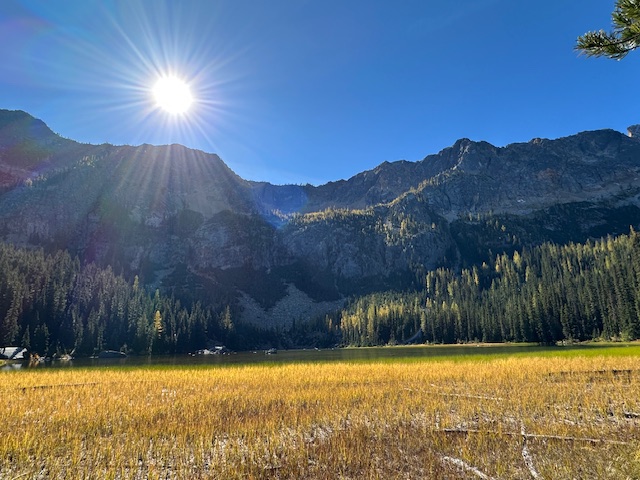
Cutthroat Lake (Named after the local cutthroat trout), North Cascades, WA

English primatologist and anthropologistJane Goodall is an inspirational leader. Her messages for planetary health were still percolating as she entered her 90’s. In celebrating her birthday in 2024, Goodall said in an interview on TODAY,” Slow down, Jane, you’re 90.”  Then she concluded, “I have to speed up because I don’t know how many years left I have.”

Goodall gave her final public interview just 8 days before she died on a U.S. speaking tour 10-01-25 at age 91. Longtime assistant Mary Lewis reported working with Goodall on a document at 10:30 PM just hours before Goodall died while sleeping.

UN Messenger of Peace Goodall found that the question most asked of her was this one: Do you honestly believe there is hope for our world…for the future of our children and grandchildren? Her answer was a stalwart YES — with a call to action: I believe we still have a window of time during which we can start healing the harm we have inflicted on the planet – but that window is closing. If we care about the future of our children and theirs, if we care about the health of the natural world, we must get together and take action…Many people understand the dire state of the planet – but do nothing about it because they feel helpless and hopeless.” 

Goodall sustained a keen sense of hope that can serve as a legacy. She exudes hope in The Book of Hope: A Survival Guide for Trying Times co-authored by Douglas Abrams, with Gail Hudson. Abrams proposed this dialogue-with-Jane book after his Book of Joy with The Dalai Lama and Archbishop Tutu.

Goodall lists 4 reasons for hope despite “a time of fear:”

  1. The amazing Human intellect; 2. The resilience of Nature; 3. The power if young people; and 4. The indomitable Human Spirit.

Roots & Shoots programming initiated by Goodall in 1991 is a prime example of youthful power. While the fledgling environmental project began with 12 high schoolers in Dar es Salaam, Tanzania, today Roots & Shoots hands-on programming exists in 100 countries. The purpose is to train youth to create positive changes for animals, the environment, and their local communities. It is the embodiment of hope.

Saying YES to hope is key to many present-day predicaments. Saying YES means taking power. In the children’s book, A Million YES’s, author D.J Corchin (with illustrator Dan Dougherty) describes the contagion of positive actions: “Word got around quickly. The girl suddenly made more and more friends who all lined up for her incredible YES’s.”

Jane Goodall was a practical and philosophical role model: “You won’t be active unless you hope that your action is going to do some good. So you need hope to get you going, but then by taking action, you generate more hope. It’s a circular thing.”

Say YES to active hope.

Pearls of Peace (PoP) Quiz

436. What gives you hope?

437. How might you say YES more often to make positive environmental changes?

Cultural Change and Climate Change

Receding Nisqually Glacier and its Mount Rainier runoff in 2025

Washington state Nisqually indigenous people are described as people of the river and grass. Nisqually original homeland consisted of nearly 2 million acres encompassing present-day towns of Olympia, Tenino, and Dupont, including a reach as far as Mount Rainier. Nisqually life in the Puget Sound watershed has existed for the past 10,000 years. However, drastic changes for the tribe occurred 150+ years ago with the arrival of Euro-Americans. Many current families live along the Nisqually River 14 miles east of Olympia on a reservation of approximately 5000 acres with tribal land holdings nearby of 1000 acres (which only were reacquired in the past 25 years).

Fort Nisqually was established in 1833 as the first white settlement on Puget Sound. Shifting land allotments for the peaceful Nisqually people are painful reminders of shifting movement of the Nisqually Glacier and Nisqually River on Mount Rainier. Shifting names accompany this impressive mountain: Tahoma, Lushootseed, Cowlitz, Klallam, Upper Chehalis, Twana, and Chinook Wawa preceded Mount Rainier, named for Rear Admiral Peter Rainier. Renaming a mountain is symbolic for relocating communities. Relocation is challenging; forced relocation is traumatic.

Both steep topography and roaring rivers characterize Mount Rainier. When developers situated roads and buildings alongside the grade of a river, they did not anticipate shifting climate changes. Repeat flooding severely damaged the Carbon River Road, taking away car access to some northwestern parts of Mount Rainier National Park. On the western edge, the Longmire development sits adjacent to Nisqually River. The river is “up” 30 feet in elevation higher than park buildings and roads which rely on a levee for protection. In 2006 one storm dumped 17.9 inches of rain over a 36-hour period on Mount Rainier, causing the park to close for 6 months.

Nisqually Glacier is losing land mass and retreating at a more rapid pace in the past century due to rising temperatures. When the summer melt period exceeds winter snow accumulation, receding glaciers pick up their melt pace. At one point Nisqually Glacier was recorded as moving as quickly as 29 inches per day! Glaciers are Nature’s laboratories for climate change. Unless there is some global stabilization of temperatures, the projection is for increased glacial retreats which in turn lead to dangerous debris flows into Mount Rainier’s rivers.

Cultural changes as well as climate changes can impact local ecosystems in some drastic ways. We often do not address the long view on a consistent basis. The concept of “7 generations ahead,” an ancient Haudenosaunee (Iroquois) credo, needs to be everyone’s credo.

 Oh, I did not mention yet that Mount Rainier is an active volcano. A cousin active volcano, Mount St. Helens, blew its lid in 1980, changing the topography in the surrounding valleys. Layers of mud and debris were sent flowing for 17 miles, while ash fell all the way east to Montana. Yikes!

Pearls of Peace (PoP) Quiz

419. When you think of climate change, what are your first thoughts?

420. How are today’s U. S. cultural changes affecting you?