As a child did you sing, “The ants go marching one by one…hurrah, hurrah… they all go marching down, to the ground, to get out of the rain…the ants go marching two by two…hurrah, hurrah…they all go marching down, to the ground, to get out of the rain…?” My family and I witnessed ants marching – in a long line – from the patio door to the kitchen of our timeshare condo in Spain. Initially we thought the ants marched two by two until we realized that it was a double line. Some ants were coming. Some ants were going. They had constructed an ant highway to their kitchen!
Scientists at the Weizmann Institute of Science in Israel conducted a fascinating study of ants and their big cousins, humans. The study goal was to assess the collective problem-solving skills of humans when contrasted with longhorn crazy ants (Paratrechina longicornis) who are 3 millimeters in size. The “crazy” labeling comes from the ants’ mislabeled erratic, frenetic movements. This David-and-Goliath match-up is fascinating as both ants and humans are among nature’s few species known to cooperatively transport large objects.
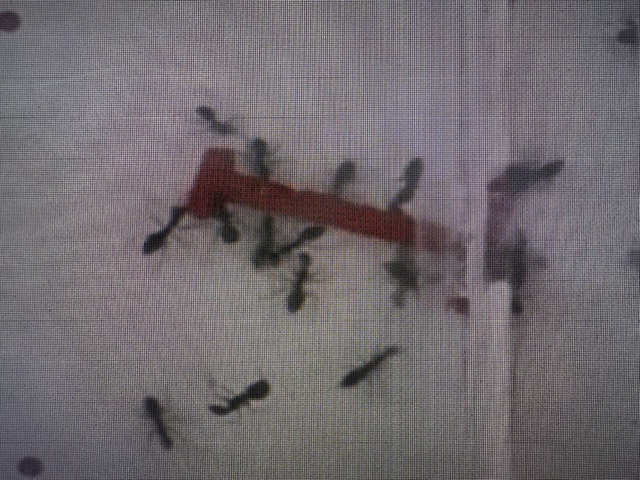
The research task involves maneuvering an odd-T-shaped item through a maze with tight spaces and around corners. The puzzle affectionately is dubbed the “piano-movers’ problem.” Ants are tricked into believing that T-thing was food needing to be transported to their nest. Trial-and-error attempts for the ants with their tiny maze versus the humans with their big-boy-and-girl-sized maze suggest that ants may know how to work together better than adult humans! When collective ant families teamed up, they were able to more efficiently guide the item through complex spatial challenges than a group of humans motivated by competition!
Complexity science researcher Ofer Feinerman and his team worked on this experiment for 3 years with 1,250+ individuals and multiple ant colonies. https://studyfinds.org/ants-smarter-than-humans/ Larger ant teams performed significantly better than smaller groupings or solo ants; the opposite was true for humans when they were not allowed verbal communication or nonverbal gestures; humans wore masks and sunglasses. Human teams “deteriorated” compared to solo human participants. Humans simply worked better ALONE. Researchers summarized: “Each person egoistically thinks they have the most relevant information — and the wisest assessment of it — to accomplishing the overall goal.”
What are the takeaways? Researchers concluded that individual ants do not grasp the “big picture,” but collectively ants develop problem-solving skills by working together. Ants show persistence, cooperation, and perhaps collective intelligence. My takeaway is that humans lose out when they do not affirm the “soft” power of cooperation. In today’s state-of-complexity world we might consider how cooperation can win over competition. Do ants really have a cooperative edge over humans?
South African bishop and anti-apartheid activist Desmond Tutu understood cooperation: “My humanity is bound up in yours, for we can only be human together.”
Pearls of Peace (PoP) Quiz
373. What applications do you see from this ant-versus-human research?
374. How best do you solve your problems – individually or with group support?
 Pearls of Peace: A Family Psychologist’s Circle-of-Life Blog