Invest in Togetherness

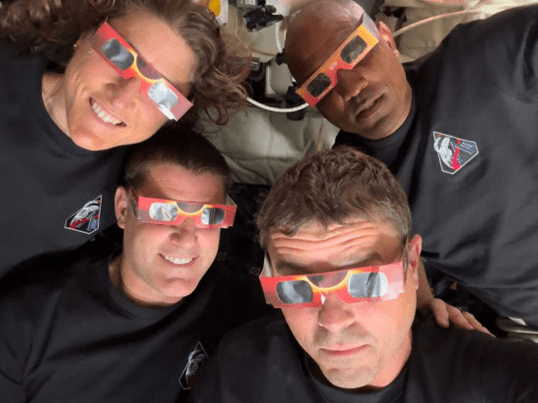
Artemis II crew in eclipse viewers to protect eyes in observing a solar eclipse during their lunar flyby

Artemis II Misson commander Reid Wiseman, pilot Victor Glover, and 2 mission specialists, Jeremy Hansen and Christina Koch, circled the far side of the moon. They traveled further in outer space than any other humans, unless unknown alien travelers might qualify as “human!” The utter joy of the astronauts in seeing first-time sights was contagious. I watched the splashdown with family and was spellbound by the sheer complexity of NASA predictions that the astronauts would return to Earth at 8:07 ET. A correction was made when first announced that it was 8:07 and 47 seconds, only to be updated to 8:07 and 27 seconds. This was one of countless NASA precision details that dazzled us.

The three Americans and one Canadian experienced Earth views that showed the entire planet in just one windowpane out of their spacecraft windows. “Trust us, you look amazing,” exclaimed pilot Victor Glover to those of us at home plate. The team of astronauts did not see wars. They did not see nation boundaries. They saw one colorful planet holding togetherness in the infinite cosmic darkness.

As the astronauts were heading home, Glover communicated with a fellow astronaut on the ground: “Tell the world to keep this energy going. Let’s invest in togetherness.”

Some readers will recall their goose bumps when watching another team of moon pioneers in 1969. Communication from that moon voyage sticks like velcro in your memory if you watched the epic moments: “That’s one small step for man, one giant leap for mankind,” exclaimed Neil Armstrong. Along with Buzz Aldrin, Armstrong walked in awe on the moon’s surface while lesser-known command module pilot Michael Collins orbited alone. During his solo sojourn he was cut off from radio communication for 21+ hours, but Collins calmly collected his teammates for a safe return home.

What effective communication are we humans cut off from today? With strife on many parts of our precious planet, our communication to resolve differences is key. Perhaps we are forgetting about the plaque that was left on the moon by Apollo astronauts with the following words: “Here men from the planet Earth first set foot upon the moon. July 1969 A.D. We came in peace for all mankind.”  The plaque held the signatures from the Apollo 11 crew and President Nixon.

Let’s applaud NASA on another successful space mission but let’s also take care of our planetary cousins. Too often we endorse peace for some, not all.

Civil Rights activist James Baldwin wrote in Nothing Personal, “…it is not fixed; the earth is always changing. The light is always changing; the sea does not cease to grind down rock. Generations do not cease to be born, and we are responsible to them.”

Yes, we owe it to future generations to invest in peace for togetherness on planet Earth.

Pearls of Peace (PoP) Quiz

488. What meaning do you take away from space exploration?

489. How might you engage in peaceful dialogues with someone who has different views from your own?
The Ants Go Problem-solving

As a child did you sing, “The ants go marching one by one…hurrah, hurrah… they all go marching down, to the ground, to get out of the rain…the ants go marching two by two…hurrah, hurrah…they all go marching down, to the ground, to get out of the rain…?” My family and I witnessed ants marching – in a long line – from the patio door to the kitchen of our timeshare condo in Spain. Initially we thought the ants marched two by two until we realized that it was a double line. Some ants were coming. Some ants were going. They had constructed an ant highway to their kitchen!

Scientists at the Weizmann Institute of Science in Israel conducted a fascinating study of ants and their big cousins, humans. The study goal was to assess the collective problem-solving skills of humans when contrasted with longhorn crazy ants (Paratrechina longicornis) who are 3 millimeters in size. The “crazy” labeling comes from the ants’ mislabeled erratic, frenetic movements. This David-and-Goliath match-up is fascinating as both ants and humans are among nature’s few species known to cooperatively transport large objects.

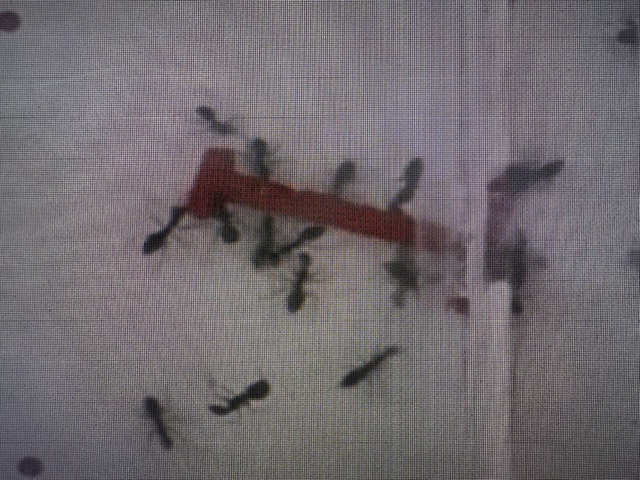
The research task involves maneuvering an odd-T-shaped item through a maze with tight spaces and around corners. The puzzle affectionately is dubbed the “piano-movers’ problem.” Ants are tricked into believing that T-thing was food needing to be transported to their nest. Trial-and-error attempts for the ants with their tiny maze versus the humans with their big-boy-and-girl-sized maze suggest that ants may know how to work together better than adult humans! When collective ant families teamed up, they were able to more efficiently guide the item through complex spatial challenges than a group of humans motivated by competition!

Complexity science researcher Ofer Feinerman and his team worked on this experiment for 3 years with 1,250+ individuals and multiple ant colonies. https://studyfinds.org/ants-smarter-than-humans/ Larger ant teams performed significantly better than smaller groupings or solo ants; the opposite was true for humans when they were not allowed verbal communication or nonverbal gestures; humans wore masks and sunglasses. Human teams “deteriorated” compared to solo human participants. Humans simply worked better ALONE. Researchers summarized: “Each person egoistically thinks they have the most relevant information — and the wisest assessment of it — to accomplishing the overall goal.”

What are the takeaways? Researchers concluded that individual ants do not grasp the “big picture,” but collectively ants develop problem-solving skills by working together. Ants show persistence, cooperation, and perhaps collective intelligence. My takeaway is that humans lose out when they do not affirm the “soft” power of cooperation. In today’s state-of-complexity world we might consider how cooperation can win over competition. Do ants really have a cooperative edge over humans?

South African bishop and anti-apartheid activist Desmond Tutu understood cooperation: “My humanity is bound up in yours, for we can only be human together.”

Pearls of Peace (PoP) Quiz

373. What applications do you see from this ant-versus-human research?

374. How best do you solve your problems – individually or with group support?