Democracy Pearls

Sitka spruce tree, 1000 years old (191 ft. tall, 55 ft in circumference), Quinault Rain Forest, WA

Just as the “world’s largest spruce tree” appears to have a tilted top, democracy seems tilted these days. Let’s imagine that like the massive and strong roots of this magnificent Sitka spruce tree, the massive and strong roots of democracy can hold steady.

Stanford University is sponsoring a webinar series called “Reimaging Democracy.” When I first received the email invite, my unspoken question was to ponder why we have to “reimagine” something that we were taught –  from childhood onward – was an American birthright.

Professors of Law at Standford, Jud Campbell and Fred Smith, opined about whether our country is experiencing a “constitutional crisis.” This is unsettling territory. Neither of the professors believe that we have “crossed the Rubicon,” but each used phrases like these: “…a moment of transformation…a moment of uncertainty…there are increasing signs that we are at greater risk…people use politics to solve problems.” Interviewer Bernadette Meyler asked a burning question of each speaker: “What keeps you up at night?” Smith answered with his own question: “Are we going to have fair and free elections?” Campbell added, “I share that fear as well. To say something different, we have come out of differences before, but the information system today of divided opinion may not come together.”   

In an earlier webinar of this series, American political scientist Francis Fukuyama was featured. His book, The End of History and the Last Man combined philosophical notions from earlier centuries. A strong influence upon Fukuyama was Plato (428-347 B.C.) who is attributed with this idea of democracy: “…dealing with all alike on a footing of equality, whether they be really equal or not.” Add another 1000+ years, and a German philosopher, George Wilhelm Friedrich Hegel (1770-1831), was another influence with his vision that each period of history is an improvement on prior eras. Does such “old guard” thinking prevail today? Equality is challenged on many fronts. Can current history be considered an “improvement” from prior times?  

Is democracy up for grabs? If so, whose hands are going to catch a democracy that seems off-kilter, as if it were tossed into thin air?

I watched a kite flyer trying to maneuver strong headwinds and determined rain along the Pacific Ocean this weekend. The kite dipped and swerved with jagged and jerky motions as if it might plunge from the sky at any moment. However, despite kite trauma, I did not see the kite fall. I do not see democracy falling either. There are checks and balances in a democracy. It is up to each citizen to call for checks and balances in times of questionable circumstances.

Lyrics from Canadian singer-songwriter Leonard Cohen’s “Democracy” seem pertinent:

“Sail on, sail on

O mighty Ship of State!

To the Shores of Need

Past the Reefs of Greed

Through the Squalls of Hate

Sail on, sail on, sail on, sail on.

Pearls of Peace (PoP) Quiz

438. How do you define equality?

439. What does democracy mean to you?    

Women’s Herstory Month 

“Women are like teabags. We don’t know our true strength until we are in hot water.” Whether First Lady Eleanor Roosevelt actually said this is unknown, but women’s true strengths often go unrecognized, even by women themselves. Let’s reflect on a mostly unknown woman’s story and her accomplishments.

Austrian-American Gerda Hedwig Lerner taught American history and initiated the first college course on women’s history in 1963 while an undergraduate in New York’s New School for Social Research. Subsequently, she created the first known master’s degree program in women’s history at Sarah Lawrence College and first doctoral woman’s history program at University of Wisconsin-Madison. Her mission was simple: she wanted to offer studies in “people who did not have a voice in telling their own stories.”

Lerner’s early history included anti-Nazi resistance in Austria as a Jewish woman. She volunteered for “Red Aid” to help those who were arrested. Along with her mother, Lerner was jailed for 6 scary weeks, spending her 18th birthday imprisoned. She lived in a cell with two Christian women who were detained for political reasons. Her cell mates shared food with her as Jews received restricted meals. Lerner was able to immigrate to America with the aid of a sponsor – the family of her resistance fiancé. There are many poignant immigrant stories of individuals who escape dire circumstances to later enrich our collective history.

With her second husband, Lerner co-authored the screenplay of Black Like Me based on white journalist John Howard Griffin’s epic 6 weeks of traveling in the South disguised as a black man. Her doctoral dissertation told the story of resistance sisters from a slaveholding family who left their Southern home to become abolitionists in the North.

Learner became a founding member of the National Organization for Women (NOW) and began publishing books on women’s history with such titles as Black Women in White America (1972), and The Female Experience: An American Documentary (1976). She organized the first Women’s History Week in 1979, modeling it after a weeklong celebration of women’s contributions to culture and community by the Sonoma, California school district.

President Carter followed up with the first presidential proclamation to assign the week of March 8 as National Women’s History Week in 1980. Congress passed a resolution declaring a national celebration the following year. With the support of the National Women’s History Project, in 1987 Congress extended this recognition of women to our current month-long event every March. The United Kingdom and Australia followed to celebrate every March. Canada chose October for their women’s history recognition to correspond with their Persons Day on October 18th.

The 2025 theme of Women’s History Month, “Moving Forward Together,” celebrates equality and women’s collective strength. Equality includes children and men. Equality includes immigrant families. My equality ancestors were immigrants. How about your equality ancestors?

Pearls of Peace (PoP) Quiz

375.  How many women do you know who accomplish great things but are mostly unknown?

376. What women’s stories can you tell in Women’s Herstory Month?       

Black History & Herstory Month

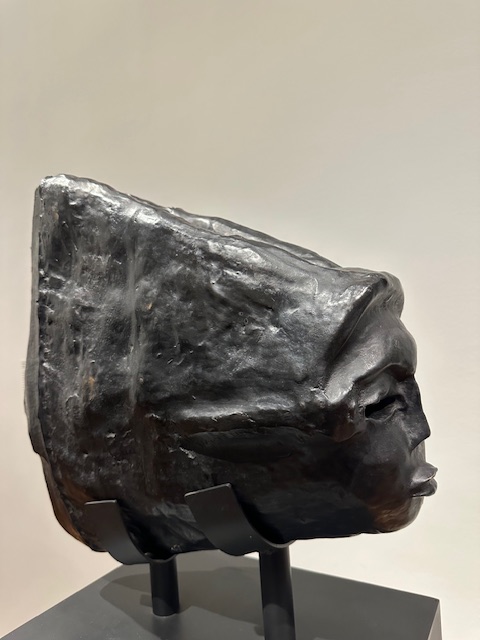
To Craft a Double Consciousness or Two-faced, Theaster Gates, 2018, Art Institute of Chicago

Black History month has a predominant focus on men who championed racial equality — with some exceptions.

On Rosa Parks’ birthday (2-4-25), Congresswoman Joyce Beatty (Ohio) spoke passionately about Parks’ enduring legacy in U.S. voting-rights progress. The Rosa Parks Commemorative Coin Act was initiated to honor the lifelong peaceful equal-rights activist.

In 1996 Parks was honored with the Presidential Medal of Freedom and the Congressional Gold Medal in 1999. A department store seamstress, Parks received a nearly 100% affirmation vote with only Representative Ron Paul (Texas) in dissent for her Gold Medal. Parks observed the voting from her Detroit home where she had moved due to the firing from her seamstress job and her family enduring threats.

Upon her death in 2005, Parks was honored to lie in state in the U.S. Capitol Rotunda. In 2013 the Postal Service recognized Parks’ “soft” power with a Forever Stamp on her 100th birthday and Congress approved Parks’ statue in Statuary Hall for her importance in “forming a more perfect union” and “establishing Justice.” Her seated granite statue, dressed similarly to that momentous day on the Montgomery, Alabama bus, was the first full-length statue of an African American individual in the Hall. Her statue joined busts of Martin Luther King, Jr. (1986 placement) and Sojourner Truth (2009 placement).

Rosa Parks was a member of the NAACP and was elected secretary. She had knowledge of many injustices in mandated racial segregation in public places. When she was ordered to give up her bus seat to a white passenger, she merely sat still. Arrested, she was pronounced guilty of “disorderly conduct and violating a local ordinance.”

As Joyce Beatty took the Congressional podium, she elaborated on the iconic memory of Parks refusing to give up her bus seat: “Rosa Parks was more than one moment… as America nears its 250th birthday, we must honor not only our founding fathers but also the mothers of our democracy.”

Let’s honor more mothers of democracy as “first” Black women to crack ceilings: Barbara Jordan – Black Southern woman elected to Congress, Rebecca Lee Crumpler – Black woman graduate in U.S. medical school, Ida Lewis – editor-in-chief of Essence magazine, Ruth Batson – Black woman on Democratic National Committee, Ketanji Brown Jackson – Black woman on Supreme Court, and Kamala Harris among others.

A first National Youth Poet Laureate, youth role model Amanda Gorman took another Washington, DC podium. Invited by Jill Biden to address the nation at President Biden’s inauguration, Gorman’s words from “The Hill We Climb” are especially poignant at this time in U.S. history/herstory:

“…We lay down our arms
so we can reach out our arms
to one another
We seek harm to none and harmony for all
Let the globe, if nothing else, say this is true:
That even as we grieved, we grew
That even as we hurt, we hoped
That even as we tired, we tried”

Pearls of Peace (PoP) Quiz

371. What story do you tell for “a more perfect union?”

372. How are you growing from grief?                     

Unmet Needs

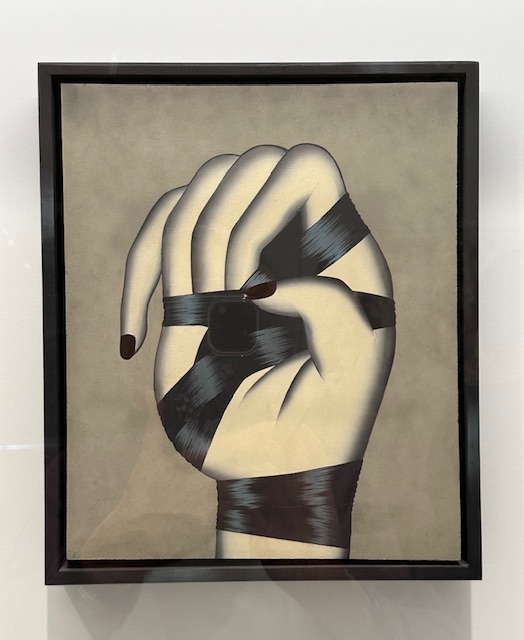
Bound Hand, 1973, Christina Ramberg

If you can visit The Art Institute of Chicago before August 11th, do not miss the exhibit, “Christina Ramberg: A Retrospective.” In 2025 the Ramberg exhibit travels to art museums in L.A. and Philadelphia.

Ramberg was a devoted artist; she drew, painted, sewed, quilted, and compiled scrapbooks. Her sometimes-edgy art without faces (and only parts of a body represented in each production) leaves much open to interpretation. Everyone flies their own perceptions into any piece of art, but with unsettling cut-offs there is a provocative quality to Ramberg’s work. What was she thinking as she cropped her art? She once answered this question about a corseted headless-legless woman. The curvy mid-section was bent over; Ramberg recalled watching her mother wriggle into tight undergarments to cinch her waist, popular in women’s fashion in the 50’s. The restraints suggested in cut-off torsos were further emphasized with subdued colors.

Here is what grabbed me when I first saw Ramberg’s Bound Hand. I use my hand to teach people about 5 basic needs. Partly as a mnemonic, and partly as a visual representation of what is at hand for us daily, my 5 EDCBA basic needs (as illustrated on a hand or drawn on a handprint) provide a handy chart. Consider how you meet this handful: Energy (thumb), Discipline (index finger), Creativity (middle finger), Belonging (ring finger) and Ability (little finger).    

These needs are not hierarchical, but ideally are interdependent and flow into one another, grounded in a core self. Your met needs are a collaborative effort for your wellbeing. However, the daily-needs story gets complicated when needs are unmet; it is challenging when you are confronted by others trying to meet different needs (or disagreeing with how you meet needs). Bound-up needs stifle one’s equality and growth.

As insightful writer Ann Patchett writes in These Precious Days: Essays, “People want you to want what they want. If you want the same things they want, then their want is validated. If you don’t want the same things, your lack of wanting can, to certain people, come across as judgment.”

Despite critiques, Ramberg (1946-1995) kept evolving her creativity, although her life was cut short by Pick’s disease (frontotemporal dementia). Her creativity is contemporary in its cropped views of both femininity and masculinity. The headless-legless male and female torsos are riveting.

Ramberg frequently visited garage sales and flea markets where she collected the 155 dolls mounted on one wall of the exhibit. The dolls (some headless) represent ethnic, racial, and gender stereotypes. Ramberg said this about Doll Wall: “I was only interested in the dolls that had been owned by someone. The ones where the face was worn off and redrawn in, or where something very strange had transpired…I’m interested in what is implied. And the simple fact that they had a life.”

Let’s embrace life. Who needs wars?

Pearls of Peace (PoP) Quiz

291. What (if any) are your unmet needs?

292. How do you meet your need for creativity?