Black History & Herstory Month

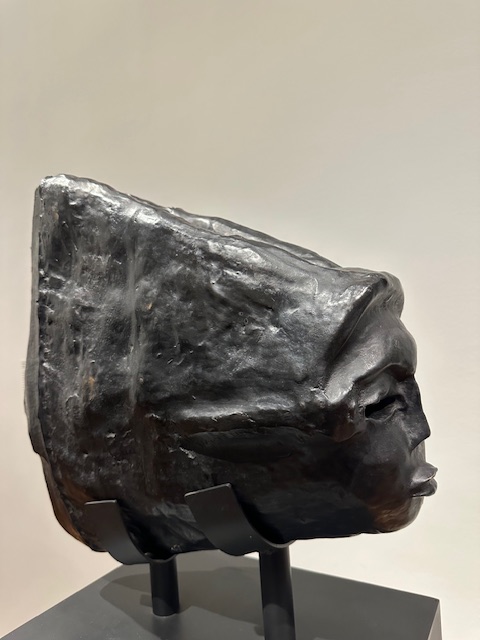
To Craft a Double Consciousness or Two-faced, Theaster Gates, 2018, Art Institute of Chicago

Black History month has a predominant focus on men who championed racial equality — with some exceptions.

On Rosa Parks’ birthday (2-4-25), Congresswoman Joyce Beatty (Ohio) spoke passionately about Parks’ enduring legacy in U.S. voting-rights progress. The Rosa Parks Commemorative Coin Act was initiated to honor the lifelong peaceful equal-rights activist.

In 1996 Parks was honored with the Presidential Medal of Freedom and the Congressional Gold Medal in 1999. A department store seamstress, Parks received a nearly 100% affirmation vote with only Representative Ron Paul (Texas) in dissent for her Gold Medal. Parks observed the voting from her Detroit home where she had moved due to the firing from her seamstress job and her family enduring threats.

Upon her death in 2005, Parks was honored to lie in state in the U.S. Capitol Rotunda. In 2013 the Postal Service recognized Parks’ “soft” power with a Forever Stamp on her 100th birthday and Congress approved Parks’ statue in Statuary Hall for her importance in “forming a more perfect union” and “establishing Justice.” Her seated granite statue, dressed similarly to that momentous day on the Montgomery, Alabama bus, was the first full-length statue of an African American individual in the Hall. Her statue joined busts of Martin Luther King, Jr. (1986 placement) and Sojourner Truth (2009 placement).

Rosa Parks was a member of the NAACP and was elected secretary. She had knowledge of many injustices in mandated racial segregation in public places. When she was ordered to give up her bus seat to a white passenger, she merely sat still. Arrested, she was pronounced guilty of “disorderly conduct and violating a local ordinance.”

As Joyce Beatty took the Congressional podium, she elaborated on the iconic memory of Parks refusing to give up her bus seat: “Rosa Parks was more than one moment… as America nears its 250th birthday, we must honor not only our founding fathers but also the mothers of our democracy.”

Let’s honor more mothers of democracy as “first” Black women to crack ceilings: Barbara Jordan – Black Southern woman elected to Congress, Rebecca Lee Crumpler – Black woman graduate in U.S. medical school, Ida Lewis – editor-in-chief of Essence magazine, Ruth Batson – Black woman on Democratic National Committee, Ketanji Brown Jackson – Black woman on Supreme Court, and Kamala Harris among others.

A first National Youth Poet Laureate, youth role model Amanda Gorman took another Washington, DC podium. Invited by Jill Biden to address the nation at President Biden’s inauguration, Gorman’s words from “The Hill We Climb” are especially poignant at this time in U.S. history/herstory:

“…We lay down our arms
so we can reach out our arms
to one another
We seek harm to none and harmony for all
Let the globe, if nothing else, say this is true:
That even as we grieved, we grew
That even as we hurt, we hoped
That even as we tired, we tried”

Pearls of Peace (PoP) Quiz

371. What story do you tell for “a more perfect union?”

372. How are you growing from grief?                     
Gender Equality – A Moonshot?

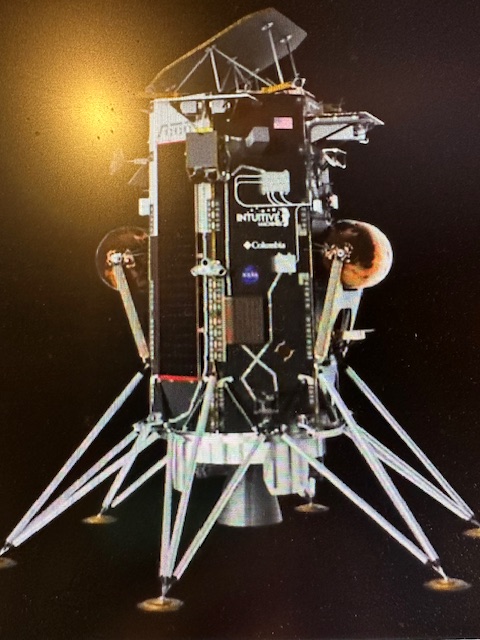
Model of Odysseus by Intuitive Machines

International Women’s Day was celebrated with “her-story” highlighted on March 8th with 2024’s theme of #InspireInclusion. The moonshot theme each year is a call to set right the global issues that impact women. In 1908 in New York City 15,000 women marched to petition for shorter working hours, equal pay, and the right to vote.

While becoming an official day of international commemoration in 1977 (initially recognized by the United Nations in 1975), a much earlier global movement had emerged in 1910 when German feminist Clara Zetkin called for an international event during the Second Conference of Working Women held in Copenhagen. The 100 women in attendance from 17 countries unanimously supported Zetkin’s proposal.

During World War I women protested the war which churned on from 1914-1918. In 1917 a significant women’s protest in Russia (held on the Julian calendar date of February 23rd — March 8th in Europe’s Gregorian calendar) was an influence in Russia dropping out of the war and gave International Women’s Day their special date. Stalwart Russian women organized their protest for “bread and peace.”

This year protests were wide-ranging. In Thailand protestors highlighted the need for longer maternity leave with members of Thai labor unions wearing purple pregnancy dresses. German protestors focused on women’s need for better working conditions. In London’s Parliament Square protestors sought to bring attention to girls’ right to education in Afghanistan. Groups of protestors in downtown Seoul, Korea, called for freedom for Palestinian women while supporters for families of missing and kidnapped Israeli women staged a protest in Cape Town at the South African parliament.

Despite the reforms afforded to women today, the harsh realities of inequality still exist. In America women earned 83 cents for every dollar that men earned in 2022 (84 cents in 2024), according to the Bureau of Labor Statistics. Internationally, women’s average disposable income rates 31% lower than for men. Gender equality cannot exist when there is such widespread income inequality.

According to UNICEF statistics, world-wide since 1995 the proportion of young women married as children has declined from 1 in 4 to 1 in 5. Equality is a pokey process. Globally, nearly 1 billion girls and women lack the job skills they need for the fast-changing job market; 1 in 4 girls (ages 15-19) are not receiving an education or job training as compared to 1 in 10 boys in this age range.

The UNICEF initiative, Skills4Girls Portfolio, hopes to reach 11.5 million adolescent girls with job skill-building by 2025. For example, in Jordan only half of all young women are either employed or engaged in educational training programs. Through mobile Innovation Labs, Skills4Girls provides girls with training in coding and 21st century business skills.     

It seems unbelievable when we can send technology to reach the moon that we still lack “bread and peace” for our planet’s earthlings.

Pearls of Peace (PoP) Quiz

271. Where do you see gender inequality in education?

272. How might you engage in the effort to uplift girls’ skillsets?