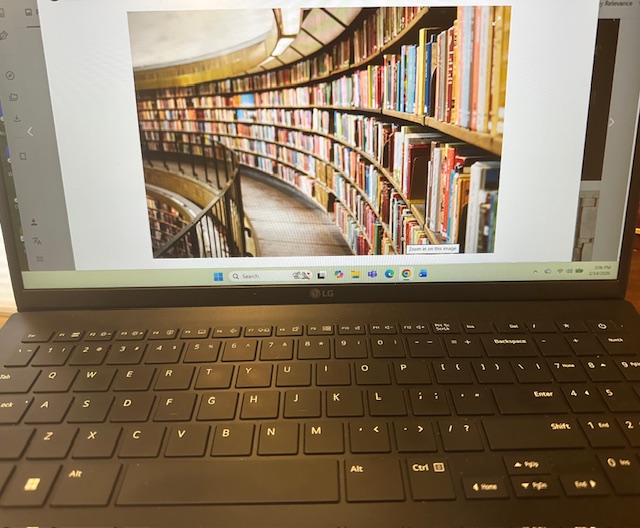
The average American reportedly reads (but may not finish) 12-13 books a year according to a Gallop poll. However, this number is misleading because “heavy” readers skew the data. (I confess to being a “heavy” reader.) The median number is 2-5 books per year. An estimated 17-40% of adults in the U.S. read no books in a given year. Gallop reports that women read more than men (approximately 15.7 books versus 9.5). College graduates are more likely readers with 90% reading at least 1 book annually, while 34% of individuals with H.S. or less years of schooling read 1 book per year. Surveys in recent years report declining numbers of books read annually.
We have AI to read for us. Will the reading slippery slope become more pronounced? I wonder how AI affects students doing their own research of a topic. How might AI impact overall reading (learning) habits? Linguist Naomi S. Baron, Professor Emerita, American University, also has concerns. She is worried about AI “…accelerating an ongoing shift in the value people place on reading as a human endeavor.”
Yesterday’s Cliff Notes are today’s “Blinks.” Apparently meant to be in the blink of an eye, one can skim a years-in-the-making book in a 15-minute summary. BooksAI is another “reader” for reading assignments. With Google NotebookLM, AI compares 2 books for your student assignment with the addition of posing questions to look smart in class.
As a contrast, Iceland has a culture of readers. Often cited as the most literate nation in the world, over half of Icelandic residents read 8+ books a year and 1 in 10 publish a book in their lifetime. According to the Guinness Book of World Records, Iceland has the most writers per capita in the world. AI estimates that 1 in 5000 people publish a book in the U.S. despite a self-published-book rise.
There is an endearing tradition, Jólabókaflóð (The Christmas Book Flood), in Iceland each Christmas. Books are gifts on Christmas Eve. Each Icelander typically will receive at least one book. With no knowledge of Iceland, this is a tradition I began with my children years ago and I continue it annually. I applaud Iceland’s country-wide tradition.
With its long, dark winters, Iceland has long celebrated a tradition called kvöldvaka, an evening time of honoring storytelling in communal spaces. A person might read from a book, recite a poem, or re-tell a story from Iceland’s early history. Children learned to read and write in such a setting while honoring their country’s history and geography. At a time when many were poor, the literacy rate in Iceland was high.
This makes me wonder how Americans spend their winter evenings. Is every person glued to a solo digital gadget? Are students skimming AI summaries rather than reading books? How might these AI “traditions” affect our culture?
Can we embrace both AI and reading?
Pearls of Peace (PoP) Quiz
472. How do you use AI?
473. How many books and/or eBooks do you read a year?





 Pearls of Peace: A Family Psychologist’s Circle-of-Life Blog