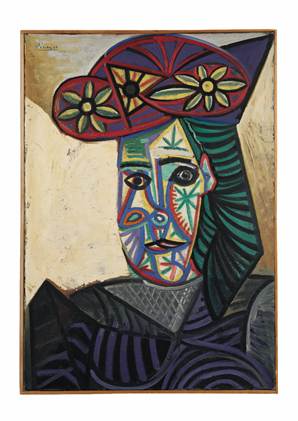
Picasso’s paintings of faces can intrigue or annoy. One does not move away quickly. There is a depth that holds one’s focus, allowing one’s mind to travel sideways. My mind travels to Internal Family Systems “parts” model (originated by marriage and family therapist Richard Schwartz). This evidence-based psychotherapy is one I studied and find practical in explaining human behavior.
When I look at Picasso’s portrayal of lover and muse Dora Maar, I see multiple parts of personality depicted. Picasso is a master painter of Rorschach-like faces. There is color shock, but more importantly, there is shock from differing facial details from what one expects. Was Picasso capturing complexities of Dora or was he projecting his own complexities onto canvas? Dora’s words would suggest the latter, referencing her lover’s fragmented renditions of her with disdain: “All his portraits of me are lies…they’re all Picassos. Not one is Dora Maar.”
Well, that is no surprise! We project our “stuff” (“parts” or feelings, beliefs, sensations and actions) all the time, although we often fail to “catch” what we are revealing about ourselves.
Have you ever watched a person’s face turn “colors” when they told you their story about an event? Did their ruby cheeks of embarrassment then shift into your own feelings of embarrassment about some time in your life? We frequently act as mirrors of one another. I see fear in the eyes of this painting. Is this because I have a fearful part about the current violence on our world stage? According to a Smithsonian report, Picasso had fears of Nazis in the time frame of both this painting and his anti-war Guernica masterpiece with its horse-eye fears. Both painter and observer project personality “parts” in varying degrees.
Have you noticed when a person is lying that they often do not maintain eye contact? (There are other possibilities for not keeping eye contact, but lying is one possibility). Other than eyes, perhaps the most obvious thing we watch in another is whether they are smiling at us and how wide their smile is. A smirk smile is vastly different from a friendship smile. These seemingly small details send nonverbal signals between individuals that there is safety, or not, in current relating.
One interpretation of the limited smile on the portrait of Picasso’s lover is intriguing: “[it] perhaps hints at the shadow of a faint, sorrowful smile,” states Agnés Sevestre-Barbé, a Picasso specialist. This painting occurred during World War II during Hitler’s reign when Nazis forces had surrounded Paris where Picasso’s studio was located. The time also coincided with an impending break-up of the 9-year relationship between Picasso and Maar. Picasso met Maar when he was 54 years-old and she was 28. The part plot thickens. Picasso reportedly left Maar after meeting his next conquest, 21-year-old Francoise Gilot.
Pearls of Peace (PoP) Quiz
432. When have you looked at another’s face and made an instant leap to “read” them?
433. Do you practice “catching” the part(s) of you projecting onto another?

 Pearls of Peace: A Family Psychologist’s Circle-of-Life Blog