Flowers and Flags

May hosts Mental Health Awareness Month; it also is the month honoring Asian American and Pacific Islander Heritage, as well as National Military Appreciation. Putting these celebrations together gives one pause. It is a complicated triangle.

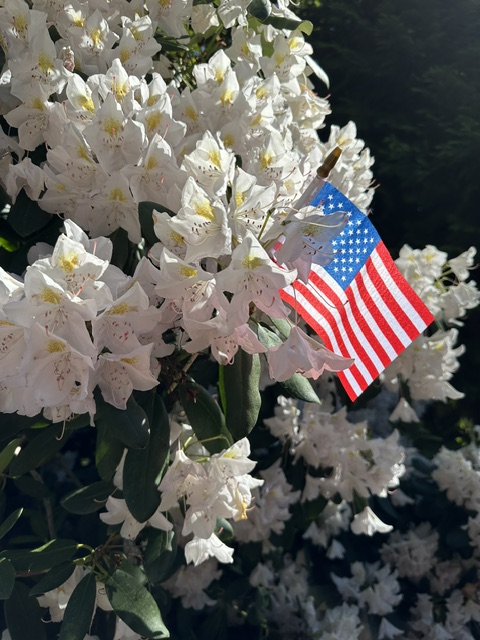
Memorial Day is when we grieve for American soldiers who died in service to their country. Initially, the day was called “Decoration Day” due to a ceremony begun by freed enslaved people, members of the U.S. Colored Troops, in Charleston, SC in 1865. Graves of Union soldiers were decorated with flowers and flags. After World War I the ritual grew to commemorate all soldiers. It is noble to honor sacrifice and valor.

Who honors the sacrifice and valor of innocent people of Japanese descent, nearly 120, 000 strong, who were seized by the U.S. government in 1942 and incarcerated in 10 isolated concentration camps? Approximately 2/3 were U.S. citizens who had their assets frozen. Japanese Americans made up 1/3 of Hawaii’s population. Mass removal was not completed there due to “labor needs,” but some were sent to mainland camps. After their years of detainment, the release of these Asian Americans in 1945 entailed a transportation ticket and $25.00. In 1988 the U.S. government delivered a formal apology and initiated reparations.

War strips humanity naked, sometimes literally as in the rape and plunder realm, but also figuratively. Many innocent people lose their livelihood and in in some instances, their very lives in continuous wars today. Are we supposed to appreciate such military actions?

Research listed on an official website of the U.S. government, the National Library of Medicine, reports on ill effects upon a soldier’s life in killing in combat in the recent wars in Iraq and Afghanistan. Supporting previous research, findings related “…that bearing responsibility for death in a warzone is associated with PTSD (posttraumatic stress disorder), depression, anxiety symptoms, suicidality, and hazardous alcohol use.” The researchers isolated “rumination” as a factor for negative post-deployment reactions. PTSD has haunted many veterans for decades.

Who is paying attention to mental health awareness in our government? Mental Health Awareness Month has been observed since 1949, but it is not highlighted enough. Awareness of both physical and mental wellness is not just an issue for soldiers but also for solders’ families.

 I want to endorse one government agency, Substance Abuse and Mental Health Services Administration (SAMHSA), for its toolkit of resources with themes on mental health for each week in May:

  • Week 1 — Understanding mental illness;
  • Week 2 — Early support matters – recognizing signs in children and youth;
  • Week 3 — Words matter and words can heal;
  • Week 4 — Supporting loved ones – connection is a powerful form of care.

Let’s make a better effort, America, to take up these themes as positive action steps all year.

Pearls of Peace (PoP) Quiz

500. Yes, this is the 500th question I ask in PoP: What does Memorial Day mean to you?

501. How might you promote mental health awareness? 

Pearls of Caregiving

November is National Caregivers Month. There are many ways that caregivers make daily life possible for loved ones, clients, patients, or community members. Consider all the caregiving efforts of relatives, friends, church members, doctors, nurses, vaccine researchers, psychologists, social workers, police, and many more helpers during and after the pandemic.

While vaccines cut down on hospital stays and deaths for those getting COVID today, lingering symptoms of COVID still threaten with long-hauler consequences such as chronic pain, brain fog, shortness of breath, anxiety, depression, and fatigue. PTSD (post-traumatic stress disorder) from COVID-related experiences exists for far too many individuals. PTSD symptoms include negative thoughts, anger/irritability, casting blame, flashbacks, insomnia, self-isolation/distancing, and difficulty concentrating.

As Arthur C. Evans Jr., PhD, the American Psychological Association (APA) CEO points out, “We cannot ignore the fact that we have been significantly changed by the loss of more than one million Americans, as well as the shift in our workplaces, school systems and culture at large. To move toward post-traumatic growth, we must first identify and understand the psychological wounds that remain.”

In conjunction with The Harris Poll, APA conducted a 2023 nationwide survey of 3,185 U.S. adults ages 18+. Almost a quarter (24%) self-rated an average stress level of 8-10 on a scale where 1 stands for little to no stress and 10 designates a great deal of stress. This reporting is an increase from pre-pandemic 2019 when the percentage was 19 %. Increases were found across all age groups except for those 65+. Of those who are parents of children under the age of 18, 48% reported that their stress is completely overwhelming; 41% of this group viewed their stress as so serious that they reported they cannot function. Nearly half (47% of the total sample) reported wishing for someone to help them with their stress levels, but 62% do not talk about their stress as they do not want to be a burden to anyone.

These Stress in America 2023 results show that adults ages 35-44 are reporting the most significant increase in chronic health challenges since the pandemic began – 58% compared with 48% in 2019; they also are the age group with the highest increase in a mental health diagnosis (45% reported a mental illness in 2023, while the percentage was 31% in 2019).

The stress survey results could not cover the immigrant families who arrive in the U.S. almost daily with incredible stress portfolios.  We can only guess what the stress levels are for the families around the world who find themselves as innocent bystanders of incapacitating wars.

Mr. Rogers could never imagine how much his famous words apply to a worldwide pandemic followed by raging war stories: “Look for the helpers.” We are looking for more helpers, the caregiving pearls, especially in caring for the children who are victims of unspeakable cruelty in too many places.

Pearls of Peace (PoP) Quiz

241. What are your experiences in being a caregiver?

242. When have you needed caregiving yourself?