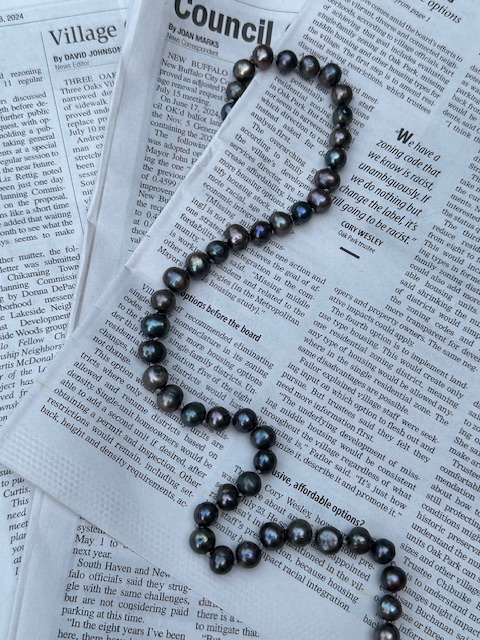
How do you tell a real pearl from a “cultured” pearl? It is difficult to tell the difference with a cursory look at outer appearances. An x-ray of the internal pearl is not available for most of us. A natural pearl may show ongoing “growth lines” where concentric layers of nacre build up. Nacre is often called mother-of-pearl; while it is whitish, it shines with different colors and is used to make buttons and other jewelry. Real pearls have special appeal, as their nacre layers can “bounce” light, making better “color.” Cultured pearls only have a thin outer layer of nacre.
One method of testing your pearls is to look at the holes drilled into the pearls; imitation pearls often have larger holes than real pearls. Now, gently rub two pearls together; imitation pearls will slide smoothly against one another while real pearls’ nacre is “gritty.” Grit is one of my favorite words, so you know that I admire the real deal. A growth-and-grit mindset is necessary for navigating the real world.
How do you tell real information from misinformation? Unfortunately, this is more difficult than detecting a real pearl! In the July/August edition of Monitor on Psychology, the magazine of the American Psychological Association, an article highlights the intense work of psychological scientists to increase their efforts to stop the life-threatening spread of false information about health.
Psychologist William Klein, associate director of behavioral research at the National Cancer Institute, regrets how politicized the term “misinformation” has become; he sees how social media is often responsible for rumors about health. It is especially disheartening when organized disinformation campaigns deliberately mislead folks with their layers of lies. Research shows that individuals tend to engage more and spread more false information online, compared with factual information. In one Canadian survey, 73% of 18- to 24-year-olds followed at least one influencer who spreads anti-science information. In the U.S. only 37% of adults had trust in CDC recommendations in 2022. So far, interventions regarding misinformation on health have limited success.
Carol Graham, Senior Fellow at nonprofit public policy organization Brookings Institute, cites not just political polarization as a factor in misinformation, but also the decline of local newspapers, the lack of post-secondary education opportunities in impoverished communities, as well as the mounting stress of reduced health and longevity in these neighborhoods.
Investment in declining communities is a critical issue, along with changing how Americans view mental health care. Funding for local newspapers can foster a sense of community, a dwindling concept. Vital communities take pride in their schools. Most of all, education is key in curbing misinformation. Wouldn’t a “cultured” society reform our schools so that all students can enter the labor market successfully?
To make misinformation less credible it will take a growth-and-grit mindset and layers of ongoing gritty change in tax-dollar choices.
Pearls of Peace (PoP) Quiz
313. How do you detect misinformation?
314. What can you do to stop the spread of misinformation?


FYI. The Oak Park League is doing a program—our fall kick off—
LikeLike