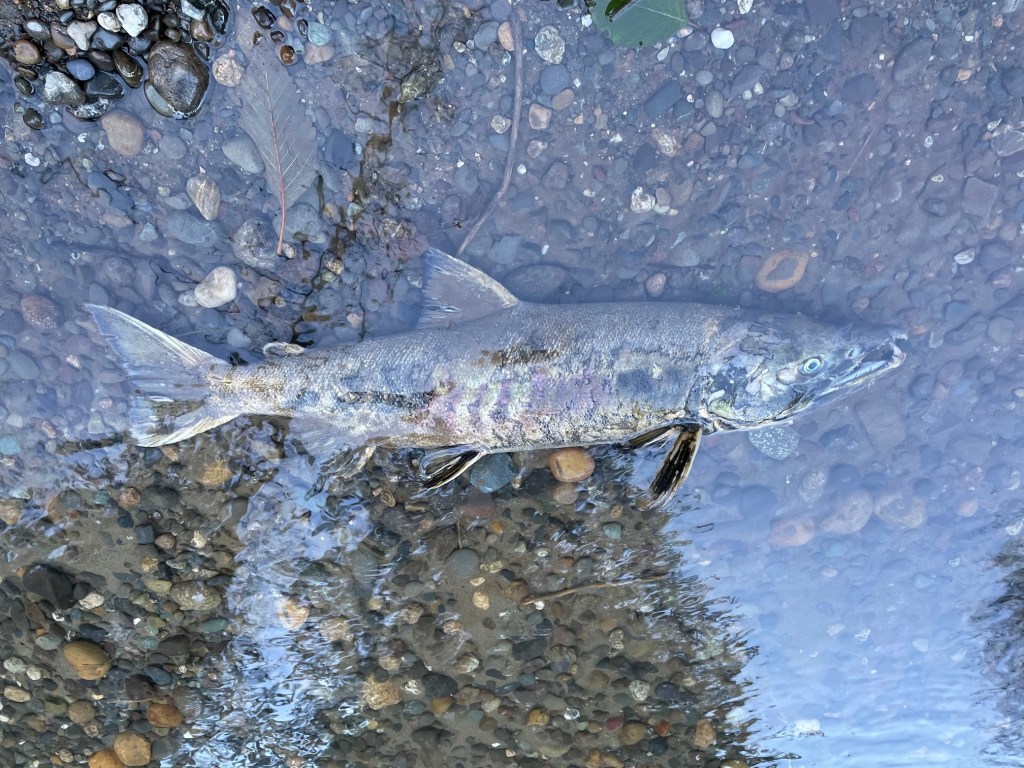
As I watched salmon swim upstream to spawn last week, I marveled at their persistence. Salmon are genetically programmed to swim to the precise water of their birth to lay their eggs. Salmon hatch in a fresh-water birth before migrating downstream to the saltwater ocean for about 4 years. Through magnetoreception and their sense of smell, most salmon know how to swim back to their birthplace. They spawn in the stones of gravel beds of small creeks. Some eggs are not under gravel for protection; I saw sea gulls trolling a stream for a take-out order of the small-pea-sized snack.
Each female salmon can lay up to 3000 eggs. After several months the eggs hatch into larvae with attached lunch bags; each “sac” holds some remaining yolk for feeding. When they run out of yolk, they must leave their gravel nest and begin eating plankton. It takes up to 3 years to become good swimmers and gain their camouflage spots. They also grow silvery scales to visually confuse future predators. Their resilience and adaptability are impressive despite dire odds. An estimate is that out of one salmon’s 2000-3000 eggs, only 4-5 survive for an ocean adulthood.
Salmon form “schools” or community with other salmon; they swim far from spawning territory to find deep-sea feeding. In returning “home” they stop eating. Despite their great stamina, they face many trials. They experience exhaustion. Death from high temperatures, parasites, and disease are possibilities for those that escaped predators such as seals, sea lions, sharks, orca whales and human fishing. The Pacific salmon and most Atlantic salmon die within a couple of weeks post-spawning. In the circle of life, salmon decomposing bodies release inorganic nutrients to the plankton. Scavenger animals descend. Change is constant.
We can identify with salmon and their challenging upstream-swimming effort. Adaptability and resilience are requirements for human constant changes.
Weather changes deliver spontaneous opportunities for adaptability. During a 1-hour morning trip to Seattle, there were 4 periods of fog suddenly dropping a dusty curtain that felt as though dusk was fast approaching. Fog is visually confusing. Cars adjusted their speed initially. With similar weather stealth, brilliant sunshine swept the highway clean each time. Sightlines were sparkling again.
Isn’t this the way one’s consciousness drifts from cognizant present time to murky moments where timely vision seems impaired? Weather changes are as sudden as consciousness changes. When murky moments take over, there can be dire consequences.
Perhaps our most important moments occur when we catch ourselves losing track of clear-sightedness. We must choose our focus. We must find our swimming community. We must be persistent. As Bob Dylan reminded us in 1964, The Times They Are A-Changin’ — “If your time to you is worth saving / Then you better start swimmin’ or you’ll sink like a stone.”
Pearls of Peace (PoP) Quiz
450. When you realize your murky moments settling like thick fog, how do you emerge from this state of mind?
451. How might you increase your resilience and adaptability?


Love this Pearls, Jan. As a frequent observer of the salmon, ( as well as fisherman and consumer)) it was a beautiful reminder of how remarkable this fish is. We were able to see thousands of salmon arriving at Multenomah Falls one year at their journey’s end.
LikeLike
Yes, the salmon story is remarkable! We sometimes forget that other creatures struggle in their relative brief lifespan when we are so caught up in our own struggles. We share our diverse planet.
LikeLike