Epigenetic Pearls

“…we can’t see at the level of a microscope. If we could, we would see that a human is not a single organism…[Each person] by definition is a community of 50 trillion cells, so I’m not a single thing, I’m a community.”

“Thought ‘energy’ can activate or inhibit the cell’s function-producing proteins via the mechanics of constructive and destructive interference.”

With thoughts like these, Bruce Lipton, cell biologist and research scientist, was honored in 2009 with the Japanese Goi Peace Award, an international award to recognize individuals/organizations who contribute to a peaceful world. His controversial research from his professor days at Stanford University is becoming more mainstream.

Lipton’s “new biology” suggests that one’s mind is capable of overriding genetic programming: “Thoughts, the mind’s energy, directly influence how the physical brain controls the body’s physiology.”

You do not have to be a cell biologist to put Lipton’s research findings to good use. Lipton urges us to ask questions about why we do what we do. On YouTube he elaborates with specific questions and partial answers:

  • What are your “programs” for how you live your daily life?
  • Where are you having trouble?
  • Stop looking outside. The things that don’t work in your life relate to faulty “programs” you gathered in your first 7 years when you downloaded “programs” from your parents/teachers.
  •  Basically, you operate from these “programs” (becoming habits) in your subconscious mind 95% of the time.
  • Your subconscious mind resists change.
  • If you want to change the subconscious mind, slow down your brain to a “lower vibration” (mindfulness practices, meditation, and psychotherapy are possible techniques).
  • Your conscious mind is creative.
  • Practice saying to yourself what you desire about yourself. Say it as if it already exists: “I am _____________.”

In case you want to take “new biology” to heart, this is the field of epigenetics — how one’s behavior and environmental factors can create changes that affect gene expression. One’s genetic code does not erase, but it is a possibility that you can change how your bodymind “reads” a DNA sequence.

Lipton explains: “… as we change our belief, we change our chemistry and then we change our culture medium and that’s what controls the cells. So we’re not victims, we are masters of our genes. By changing how we live, we change our genetics.”

We are talking about basic energy. I believe that energy is our first need to address every single day. Lipton’s research provides the science: “When molecules meet, they amplify the energy. In harmony, [it’s] “constructive interference” (good vibes)…or 2 energies may be “out of phase,” [with] “destructive interference” (bad vibes).”

What if everyone took Lipton’s research to heart? Would we still have wars, the epitome of bad vibes?

The Japanese awarded Lipton for his scientific contributions to world harmony. Apparently, the word did not get around (yet).

Pearls of Peace (PoP) Quiz

161. Are your ancestor “programs” burdens or blessings?

162. Do you experience mostly “bad vibes” or “good vibes”?       
Shadows and Pearls

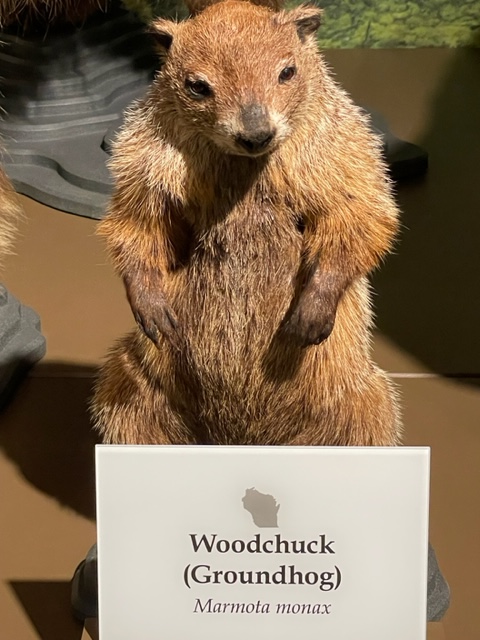
Punxsutawney Phil/Phyllis, that rascal groundhog that reportedly saw his/her/their shadow on February 2nd, gave us the Pennsylvania Dutch superstitious edict that there will be 6 more weeks of wintery weather. Nevermind, Phil/Phyllis is only “right” in predicting emerging spring 40% of the time. How “right” are you in assessing yourself? Do you have springtime energy or winter blues? Are you fixated on the shadows in your life?

Psychotherapist Katherine Morgan Schafler (The Perfectionist’s Guide to Losing Control: A Path to Peace and Power, 2023) is a former on-site therapist at Google. She asked her Google clients, “What if there’s nothing wrong with you?” This simple shift from the “let-me-figure-out-what’s-wrong-with you” perception is a game-changer.

Mental wellness is about accepting what is “right” within each of us; healing personality wounding does involve naming past shadows, but not submerging one’s thoughts and behavior to shadowland. I believe that mental wellness and trauma relief call for a steady diet of self-compassion. Schafler unpacks circular reasoning: “The best way to be more of who you are is to understand it’s already inside you. It’s there. It’s just that in order to get there, you have to stop being who you’re not. Stop trying to eradicate what’s ‘wrong’ with you. That’s never the solution…ask yourself: ‘What do I want?’”

Lasting change is a bit more complicated, but the gist of Schafler’s approach is on target. When we place most of our focus on “what’s wrong,” it is a path to pathologize or reduce our potential for possibilities. Schafler views a perfectionistic viewpoint as believing, “I’m broken.”

When we connect with an inner awareness of an already and always calm energy of self, soul, spirit (your choice of wording), we understand that we are not “broken.”

An online photo of “broken” pearls with burn scar shadows (after surviving a house fire) looks ominous; however, these pearls were restored to their natural beauty after cleaning and restringing. You might say that the inner pearl had remained intact.

In addition to representing concepts like love and wisdom, pearls are tough. They may incur scuffs and scratches, but they are not broken easily. In fact, pearls are among the most resistant gemstones to stress and strain; they can withstand immense external pressures without breaking.

If you are having groundhog days of same-old, same-old thinking, it is time to restring your thoughts. Are you going to believe a 40-percenter groundhog about the advent of spring energy? The birds are singing already. Superstitions are broken ideas. You already possess an inner springtime. Like pearls, you can withstand external pressures without breaking.

Stay curious. Acknowledge change as your constant companion. Groundhogs understand rhythms of change. They do not eat while hibernating for 3 months in winter. I’m guessing that groundhogs soon will be frisky for food and other pleasures.

Pearls of Peace (PoP) Quiz

159. What aspects of your personality could benefit from change?

160. When you change even one thought you have about yourself, does it lead to other changes?

Small Difference Pearls

Poet Marge Piercy captures the essence of worthwhile activities in To Be of Use: “…Hopi vases that held corn, / are put in museums / but you know they were made to be used. / The pitcher cries for water to carry / and a person for work that is real.” People thrive best when they feel useful, making small differences somewhere.

Today is the anniversary of Lois Whitacre Clark’s death. At age 99 ½ my lovely mother no longer felt useful, although she valiantly tried to leave her bed. When the pandemic kept her housebound for two years, she deteriorated both physically and cognitively. One could argue that her health decline was inevitable at her high-flyer age, but the shut-down contributed to Mom’s growing angst. Never one to swear, Mom called it the “pan-damn-ic.”

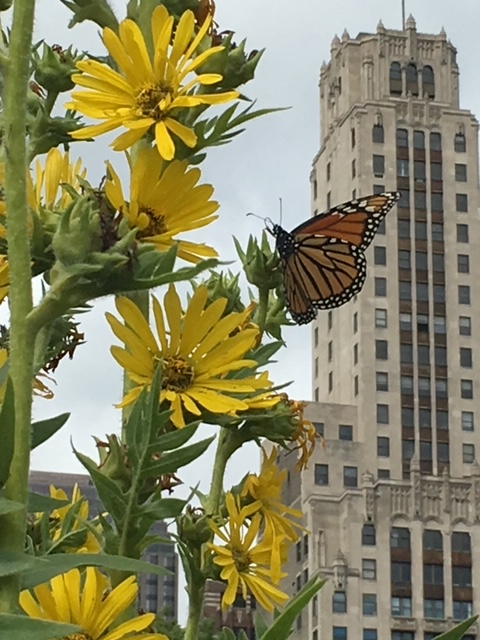
I asked Mom for the meaning of her symbol for life — a butterfly. She told me she needed time to reflect. She replied in an email:

“BUTTERFLY MEANING, you ask? Some words that come: unexpected; momentary brush with beauty; desire to see where it will light again; heart-warming; shear fragile strength; unbelievable endurance ability; capable; bonding influence; admiration; affection; attraction; attention; amaaaazing [yes, multiple a’s]; gossamer-winged; flitting; mesmerizing, fleeting, momentous, haunting, recalling…that’s all I have to say about THAT! NO ‘BOX OF CHO-CO-LATES’ right now!”  Sweet dreams, Mom

Mom actually described herself. She was a bonding-influence and heart-warming gal who possessed unbelievable endurance ability. In her vital days of working at Head Start (until age 76) and lifetime of volunteering in numerous community groups, Mom bonded with her whole community. Once she was awarded keys to her city, South Bend, Indiana; another year she was inducted into South Bend’s Community Hall of Fame. You can find her picture online – the gal wearing a butterfly pin.

Butterflies are amazing! Some are known to fly as high as 19, 685 feet. One group of high-flyer butterflies was noticed by fighter pilots! Mom was a high-flyer not only in age, but also in her actions to promote peace. Her hand-made display posters and peace signs were well used; her work was real, standing with beloved Michiana Peace & Justice Coalition friends for years in downtown South Bend every Monday evening during rush hour. One sign read, “Taxes for Schools, Not War.” Mom called these peaceful vigils “Moral Mondays.”

I was asked if I am “channeling” Mom in writing Pearls of Peace blogposts. My answer was, “Not really,” but when you consider that I somehow chose Monday as the day of the week to send weekly reflections into technology’s amazing “cloud,” it does seem Mom-like. I know that she appreciated my first blog in July, 2021.    

Let’s think beyond making small differences on “Moral Mondays.” We could use some peace the rest of the week too.

Pearls of Peace (PoP) Quiz

157. What is one heart-warming difference you might make today?

158. What world might we have if we string our small differences together?    

Pearls of Community Bonding

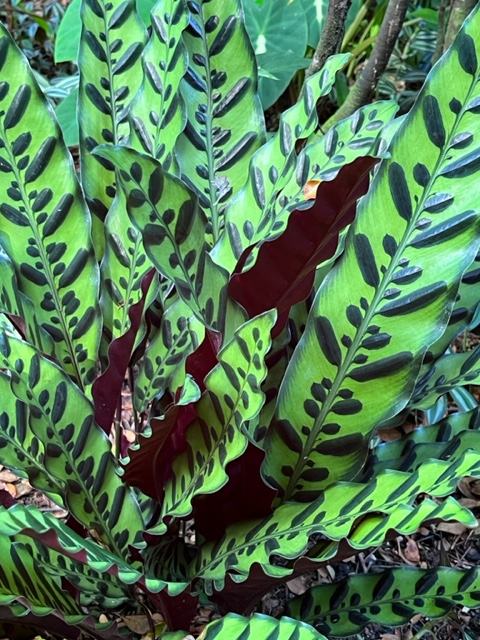
Rattlesnake Plant enfolds its brilliant leaves together at night but unfurls beauty every morning. The leaves-within-leaves plant reminds me of the hardy Hawaiian people. Although foreign takeover of their islands in 1983 attempted to separate Hawaiians from their sacred culture, there has been an ongoing momentum to unfurl genealogy stories and traditions orally. Ancestral land is revered in Hawaiʻi.

The U.S. government (who “annexed” their islands in 1898) wrote this description of Hawaiians: “…the Native Hawaiian people lived in a highly organized, self-sufficient subsistence social system based on a communal land tenure system with a sophisticated language, culture, and religion.” The communal, or ahupuaʻa system, featured land demarcations cascading from mountainous uplands to the ocean. Each section was enfolded into the next interdependent land division. Everyone had a  definitive role — to farm, fish, irrigate, heal, teach – and community bonding was strong.

Annabelle Le Jeune, an Asian American program outreach specialist for the Hawaiʻi nonprofit, Partners in Development Foundation, reports on current community bonding. With a tribute to local community leaders, the State of Hawaiʻi has reduced the state’s youth incarceration rate by 82%. In a similar disproportionate categorization of incarcerated individuals along racial/ethnic identities on the U.S. mainland, Native Hawaiians and Pacific Islanders are overrepresented in the Hawaiian juvenile justice system.

Keeping youth closed up and locked down does little to help them cope with issues of substance abuse, mental illness, family and generational trauma, and/or poverty. “Due to historical trauma that predates the illegal overthrow of the Hawaiian Kingdom, Indigenous people are more likely to experience poverty than their nonindigenous neighbors–and in their own homelands,” writes Le Jeune. “The island colonizers gained economic power through private land ownership, disrupting the connection and communal land system that the native people had with their ʻāina (land). Missionaries were also sent to Hawaiʻi to open boarding schools for children to reduce the Native Hawaiian language (‘Ōlelo Hawai‘i)…and promote Christian conversion.”

Hawaiian language and sacred cultural practices were forbidden both in schools and communities for nearly a century. Recently a cultural renaissance is opening and allowing the revival of the Native Hawaiian language. Passed by Congress and signed by President Bill Clinton in 1993, the U.S. apologized to Native Hawaiians for the overthrow of the Kingdom of Hawaiʻi (Public Law 103-15).

Systemic trauma is not reduced immediately with laws, but it is a good first step. We can address mistakes in our collective history. Politicians often are not given credit for righting seriously wrong behavior, however there is still much work ahead.

To reverse the ills of juvenile incarceration in Hawaiʻi, youth are returning to the land for work when released from the Hawai’i Youth Correctional Facility. After nearly 100 years, this facility has been rebranded as Kawailoa Youth and Family Wellness Center with a focus on pu‘uhonua (a place of healing).

Pearls of Peace (PoP) Quiz

155. When you consider your own schooling, what did you miss out on?

156. How might you address issues of our precious at-risk youth?     

Flourishing Pearls

Are you flourishing or floundering?

On January 1st I had several captive hours at an airport. I watched a lone duck swimming in circles in a courtyard pond. Was this duck flourishing in the sunlit zone or floundering somehow? Later the duck swam sideways, ditched repetitive circling, shook its feathers, and settled into cozy napping in the shade.

Mental Wellness Month is celebrated every year from January 1st to 31st with an intent to highlight the importance of mental health. Instead of a typical focus on New Year resolutions that revolve around one’s physical wellbeing — such as weight loss or renewed exercise affirmations — this mental wellness focus is a flourishing recognition for every person, but it is particularly important for those challenged with mental health issues.

January can be a letdown. A Happy New Year may seem dubious. Loneliness is on the rise in the U.S., and it can lead to a host of bodymind (both physical and emotional) challenges. According to psychology research, the cause of loneliness is not being alone, but being without some definite needed relationship or set of relations. Loneliness is a main determinant of one’s social wellness.

The Global Wellness Institute (GWI) defines mental wellness as “an internal resource that helps us think, feel, connect, and function: it is an active process that helps us to build resilience, grow, and flourish.” The Institute’s goal is to empower wellness worldwide. This forward-thinking vision for systemic public health includes mobilizing government policymakers, public servants, and businesses to endorse everyday wellness. 

Here are GWI policy questions that cry out for answers:

  • “When we are spending trillions of dollars on wellness, why do the rates of chronic disease and related health expenditures also continue to rise unsustainably?”
  • “Why does wellness feel so white and rich and exclusive?”
  • “What about those who don’t have the money or time to spend on wellness?”

On a community level, there are simple ways to celebrate Mental Health Awareness Month and support bodymind wellness. Local businesses can help employees to focus on wellbeing by providing “wellness gifts.” Examples are reusable water bottles, gift cards to health stores, stress balls, relaxation tools like a heated neck pillow, self-help books and gratitude journals.

I can attest to the flourishing momentum of maintaining a wellness gratitude journal, even while floundering. I kept a gratitude journal every day for a whole year on 3 different challenging years of my life (the year after my husband’s sudden death, the year after my father’s prolonged death, and a year while my mother was dying).

Every night before sleep I wrote 3 simple gratitudes in my journal for that day. During each day I would prompt myself to think of small turning points. At nighttime I not only had something to write about, but I put myself into a positive space for sleep without repetitive circling thoughts.    

Pearls of Peace (PoP) Quiz

153. What is your definition of flourishing?

154. How do you make peace with floundering times?                    

Reaching for Pearls of Peace

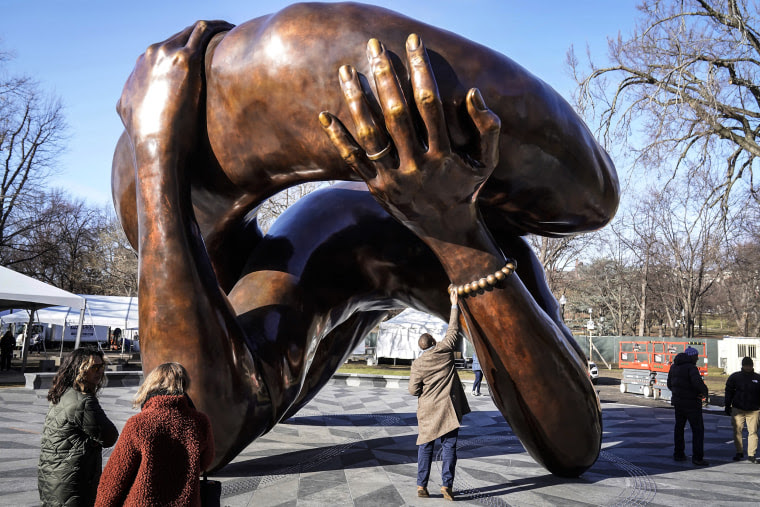
Four intertwined bronze arms — a 22-foot-tall sculpture memorializing Rev. Dr. Martin Luther King, Jr. hugging his wife, Coretta Scott King – had an unveiling on Boston Common on 1-13-2023. Artist Hank Willis Thomas created The Embrace from the essence of a photograph showing the couple hugging after MLK won the Nobel Peace Prize in 1964.

At age 35 King was the youngest person to receive this honor for his staunch support of overcoming racism and poverty. He donated his $54,123 prize money to promote civil rights in 6 organizations, including the Gandhi Society for Human Rights. Just 4 years later King died from a gunshot wound after championing nonviolence in a manner modeled by his mentor, Mahatma Gandhi.

Boston was home to MLK when he met his future wife. While King was a doctoral candidate of systemic theology at Boston University (BU), creative Coretta Scott was completing her degree of opera studies at New England Conservatory of Music. They married in 1953 and MLK graduated from BU in 1955.   

I feel privileged to have education ties to MLK.

BU was home for my counseling psychology doctorate, although many years after King’s studies there. Our paths did cross when I was in college. In King’s final campus speech before his untimely death, I heard him speak at Manchester College (now Manchester University) in Indiana. I still recall the experience of King, especially his resolute voice with a passion for peace and justice.

However, not everyone in that small Indiana community was appreciative of King’s peace message, as he was emphatically against the Vietnam War: “…our national administration is more concerned about winning an ill-considered war in Vietnam than about winning the war against poverty right here at home. I raise my voice against that war because I have seen what it has done to our nation…It has diverted attention from civil rights.” Our college president received hate mail, but today King is commemorated on campus with a bronze bust of him near the location of his speech.

Manchester celebrates the 75th anniversary of their Peace Studies Institute and Program for Conflict Resolution in 2023, the oldest undergraduate peace studies curriculum in the world. Originally a college for theology students, Manchester has religious roots in the Church of the Brethren, one of the historic churches devoted to peace.

  • A take-away lesson from MLK was echoed by his son, Martin Luther King, III, upon the unveiling of the giant-arms sculpture: “…we must learn nonviolence, or we will cease to exist.”
  • MLK believed in “…the sacredness of human personality…human life is too sacred to be taken on the battlefields of the world.”
  • A take-away message from artist Thomas gives pause for thought: “There are so many monuments to victims of war; there are very, very few monuments to love.”

Join me in reaching for pearls of peace.

Pearls of Peace (PoP) Quiz

151. How often do you consider sacredness in another’s personality?     

152. On this MLK Day, how can you embrace peace-making?           

Pain and Pearls

Have you ever found yourself in an awkward position? I have. My latest awkward move was falling off a curb on my first day of a Hawaiian vacation with extended family who live on Oahu. Wearing flipflops, like every other islander, I slid sideways off the edge of a curb and twisted my right foot as I tried to regain my balance. An observer commented, “You sure fell gracefully.” I could have spit venom at that moment, not so much at him, but at myself for harming my wellbeing.

In addition to painfully wayward physical moves, people make wayward social moves. We often lack “social fitness,” a concept well researched by Robert Waldinger, 4th director, and Marc Schultz, an associate director, of the 85-year Harvard Study of Adult Development (The Good Life: Lessons from the World’s Longest Scientific Study of Happiness). Lives of 724 men (and today including wives and 2000+ children of the men) were tracked regarding their work, home life, and health. Of the original group, men were sophomores at Harvard during World War II; John F. Kennedy was a participant. A second group included teenage boys from Boston’s poorest neighborhoods where their tenement homes did not have hot/cold running water.

Both groups of men showed positive as well as painfully wayward moves over a lifetime; some experienced alcoholism, some climbed the social ladder from bottom-up, while others at the top slid downward. The over-decades results suggest that wealth, fame, and hard work are not main ingredients in generating happiness and wellbeing.

It is troublesome that 80% of Millennials (currently ages 23-41) in a recent survey report that their major goal in life is to become rich; another 50% include fame as their secondary goal.

However, the single most important aspect for longevity and happiness is hiding in our relationships. Wealth and high achievement are no guarantee to make (wo)men healthy and lifestyle-wise. It is exercising social fitness — nurturing close connections — with family and friends that leads to happiness and bodymind health. Good relationships are a brain and mood booster, as well as a potent factor in living a long life. Loneliness is a sad and silent killer.

The number of social connections a person has is not the important ingredient – it is the pearl of high-quality relating that makes a difference. Your social fitness applies to all kinds of relationships, including relatives, romantic partnerships, friendships, coworker connections, memberships in groups, sports bonding, book clubs and committees. There is no timeline for strengthening current relationships or starting new ones. Begin today!

There are 8 billion of us that share our planet. Our collective social fitness seems a bit wayward at this moment. What social fitness skills might we master in 2023?

Let’s steady ourselves, improve our relationships, and get this planet we call home in an upright position.

Pearls of Peace (PoP) Quiz

149. What defines a high-quality relationship in your life?

150. How might you stretch your relating to include more high-quality relating?    

Pearls for a New Year

An underwater volcano, Home Reef, sprouted into a baby island in the Pacific Ocean close to Tonga in September 2022. It grew from 1 acre to more than 8 acres and is 50 feet above sea level. What else grows so robustly?

Actually, more than 80% of Earth’s landmass has volcanic origins from billions of years ago. Most islands have volcano parents. The remaining non-volcanic islands are the result of tectonic plates shifting and lifting up ocean flooring above the water’s surface.   

The relatively newcomer Hawaiian Islands were babies from volcanoes just 5-7 million years ago. Experts suggest that Hawaii’s first people were Polynesian and arrived around 400 AD. Prior to the existence of this human paradise, 30+ bird species – now extinct – vacationed and settled on the islands. Smithsonian researchers, husband-and-wife team Storrs Olson and Helen Smith, crawled through lava tubes to discover the bird bones of these species. It is a mystery that many were flightless!  

Currently, Kilauea and Mauna Loa volcanoes on the big island of Hawaii had unusual tandem eruptions in November 2022. The hot volcanoes pushed molten energy around like a commanding officer ordering troops to deploy in several directions. Volcanic eruptions are not exactly predictable. Who knows what trouble will bubble up next?

My family holiday plans included a trip to Hawaii where my nephew lives. While I was visiting the Lava Land Island, I chose not to witness molten flows firsthand, preferring to discover volcanic mysteries in the safety of the Bishop Museum exhibit on the island of Oahu. I learned that large plumes of hot lava cool as they fire skyward, hardening during their energetic flight. This spectacle of nature spurts volcanic rocks, referred to as volcano “bombs,” helter-skelter.

The peaceful small town of Haleiwa on Oahu offered another amazing ocean feature – thundering, gigantic waves. I watched intrepid surfers often take flight! With dazzling courage, surfers size up the next wave to “catch.” Watching an International Open surfing contest was both thrilling and frightening at the same time, perhaps like the experience of lava chasers on the big island.

Meanwhile, other people prefer flightless water skills in 7-person long canoes, kayaks, or paddleboards.

Thrills and frights — both are present as we set sail on a new year. What are the ways we might paddle together on our blue boat planet which is challenged by global warming and a variety of (wo)man-made risks? Here are a few ideas:

  • Leadership is key. I watched parents tenderly teach children how to stand up on a paddleboard.
  • Solo or group action takes a few guidelines.
  • New skill development involves much practice to paddle effectively.

A native Hawaiian adds this advice: “See oceans not as obstacles, but as pathways, connectors, connecting us with others, our ‘cousins’…here is where to begin.’”

Pearls of Peace (PoP) Quiz

147. What newness do you want for yourself and your planet this year?

148. How do you resolve (intend) to make it happen?

Holiday Pearls

Are you a sunset watcher? My parents were sunset devotees. I have sunset appreciation in my DNA. I’ve been privileged to observe the elusive green flash just as the setting sun slides silently beyond the visualized horizon. The latest plume of special coloring happened with my children on Winter Solstice. With an ocean-wave symphony in the background, we were treated to nature’s special effects along Hawaii’s Kona Coast. Capturing a photo of this momentary green gem is rare.   

Several conditions coincide to create this refraction phenomenon of sun rays:

  • Pollution is absent.
  • The sky is cloudless at the horizon.
  • The horizon is in clear view.

While a green flash is the “usual” burst of unusual sunset coloring, sometimes the color is vivid blue. It is possible to see a green or blue flash in sunrises, but it occurs just as sunshine pokes above the observed horizon. The atmosphere functions like a kaleidoscope prism and separates light into colors.

Light is like a special friend. We savor it. When one’s days approach the shortest day of the year in the Northern Hemisphere, winter comments frequently reference the importance of reaching Solstice and moving into longer daytime hours.

Consider the importance of light in treasured holidays at this time of year. Diwali, India’s most important holiday (celebrated in November), is called a festival of lights. The 5-day holiday is named after a row (avali) of clay lamps (deepa) placed outside Indian homes to symbolize an inner light or spiritual awakening within people. Originally a Hindu tradition, today the national holiday is celebrated by Jain, Sikh, and Buddhist communities also.

The Hanukkah story celebrates the light lasting day after day even when there was not enough oil in the menorah or candelabrum. When families light each candle for 8 days, they may say a blessing to give thanks for miracles, including the capacity to love and the blessing of receiving love. Kwanzaa, a secular African American celebration of ancestral roots (December 26-January 1st), also has candle lighting significance — 7 candles celebrate unity, self-determination, collective work and responsibility, cooperative economics, purpose, creativity, and faith.

The light in the Christmas story includes wise men (or early astronomers) who were avid sky-watchers. These magi (often referred to as kings), may have come from different countries. A later story gave their origins as Persia, India, and Arabia. They followed light of a specific star (or planet) to locate Bethlehem where they found the newly born Jesus. Each wise person brought a gift; gold, frankincense and myrrh were offered to the humble family. The very bright star was a prophecy that held religious significance as delivering hope to the world.

These shared themes of light and hopeful purpose have meaning today. Let’s teach school children about the similarities of treasured holiday (holy-day) traditions. Sunsets, sunrises, and the special effects of nature’s light are meant for everyone.

Pearls of Peace (PoP) Quiz

145. What does winter mean to you?

146. When do you experience the gift of “light” in your life?

Legacy Pearls

A long-time friend visited last weekend. She told how she took her inherited pearls for an appraisal. Upon opening their container, the precious pearls let loose; now unstrung, they tumbled down helter-skelter like falling leaves in a storm. Do you have any restringing projects in your legacy from your family tree?

All of us inherit certain legacies from our ancestors. They may be blessings and/or burdens. Some individuals inherit the blessing of a musical talent from a parent or grandparent. Others pick up pieces of ancestor legacies as burdensome trauma. Unsettling family stories often are not shared with children to “protect” them when they are young; it is only in later years that relatives or family friends might reveal tumultuous events in the family.

One example is Israeli-born musical composer Oteri Chaya Czernowin: “Growing up in Israel one is so imprinted with the identity of nationality and being a Jew…when I went with my father to a wedding, everybody said, ‘She looks just like your sister,’ who was murdered in the Holocaust. When you’re born with such a weight, it’s very natural that when you get to adolescence the last thing you want to hear about is nationality, origin, or anything connected to that. You just want to be a person, an ahistoric individual who believes in individuality…it took me a long time to reconnect and to assume the weight of my origin and nationality and get into a more aware dialog with it.”

The effects of traumatic stress can fall onto subsequent generations even when youth from these later generations are not exposed directly to any trauma. Psychiatrist Daniel Amen describes the transmission: “Through a process called epigenetics, you can inherit your ancestor’s fears, worries, or even prejudices without ever being aware of it. The [inheritance]…is written in your genetic code.” Some individuals experience strong reactions at the same age as a relative who experienced the original trauma.

Author Mark Wolynn (It Didn’t Start with You: How Inherited Family Trauma Shapes Who We Are and How to End the Cycle) describes how a shared family tree has poignant inherited history. He describes a young man who awakened in the middle of a night just after his 19th birthday with physical feelings of freezing and shivering. He was unable to deal with his ensuing insomnia every night until he learned about a tragic family story. His mother revealed that his uncle, a person unknown to him, froze to death at age 19 when working on power lines in a storm in Canada’s Northwest Territories. The family never spoke the uncle’s name after the unfortunate death.

The holiday season may present you with the gift of being with relatives. Perhaps you can ask some questions about relatives that you never knew. You may string together some new understandings about yourself.    

Pearls of Peace (PoP) Quiz:

143. Who is the storyteller in your family?

144. Have you ever thought what your life would be like if you had________________?