Hula Pearls

On 4-30-24 President Biden named May as Asian American, Native American, Native Hawaiian, and Pacific Islanders Heritage Month. This year marks the 25th year of the White House Initiative and President’s Advisory Commission on Asian Americans (AA), Native Hawaiians, and Pacific Islanders (NHPI) recognizing government workers in these communities who further equity, opportunity, and justice for their people. Biden’s current actions include creating a memorial to honor 10,000 Japanese Americans who received unjust treatment in internment camps during World War II, providing $22 billion in loans to AA and NHPI entrepreneurs, as well as backing Maui after horrific wildfires devastated a town on this Hawaiian Island.

It is tragic that hate crimes are on the rise against those of AA and NHPI ancestry post-pandemic. Thankfully, there was bipartisan support for the 2021 COVID-19 Hate Crimes Act sponsored by Senator Mazie K. Hirono of Hawaii. In addition to respecting people in the U.S., we also need more respect for the sacred lands, cultures, and traditions of our diverse population. America is a country built on the backs of immigrants and subscribing to the noble notion that all are created equal.

I was privileged to learn about Pacific Islander cultures at Polynesian Cultural Center on O’ahu in April. Each tropical island has special traditions. I learned that hula dancing may have origins in Tahiti (Ori), but Hawaii possesses a major hula claim. The Big Island, O’ahu, Kauai, and Molokai all proclaim having the first hula dancers. Some argue that Navigator Goddess Laka first danced hula on Molokai. Others give Goddess Hi’iaka credit (creating hula for her sister, Pele). Still others say Kapo’ulakina’u, Goddess of Fertility, was the first dancer. Notice that these stories have a goddess theme. Hula hand movements tell a story, often honoring deities, chiefs, and/or ancestors. Today there are few grass skirts, but colorful costumes and flower crowns for one’s hair are still a traditional nod.

Prior to the 1820’s Hawaii had no written language, but male and female hula dancers handed down cultural stories. Originally a sacred dance, hula dancers might celebrate deities for certain moon times, perform at ceremonies, or announce a child’s birth. When Christian missionaries arrived in 1820, church folks were so distressed by what they did not understand that they convinced Christian convert Queen Ka’ahumanu to outlaw hula dancing; however, the tradition survived with dancers performing traditional rites in private. Upon the Queen’s death, hula resurfaced.

When King David Kalakaua (aka Merrie Monarch) was crowned in1883, he brought hula into the open by making it part of his two-week coronation celebration. Unfortunately, hula was banned again after the next ruler, Queen Lili’uokalani, was overthrown by American businessmen in 1893. It was almost 100 years before hula dancing returned in government celebrations.                                

What does it mean to a people when their traditions are deemed unacceptable?

Pearls of Peace (PoP) Quiz

287. What cultural traditions do you maintain in your family?

288. When has a tradition from your ancestors been dropped from usage?  

Pearls of Purpose

“Another world is not only possible, she is on her way. On a quiet day, I can hear her breathing.” Writer Arundhati Roy

It is easier to believe this hopeful thought when one is surrounded by Mother Nature’s beauty — especially in a fertile atmosphere like Hawaii where my nephew and fiancée live and married this weekend. The wedding took place on a working ranch under a canopy of banana trees with a rocky mountain peak for a chapel steeple. As part of the ceremony, a tree sapling was placed between the couple as they held a pot of soil with a trowel. They jointly scooped soil into the tree. They will plant it at one of their ecological volunteer sites.

Earlier in Wedding Week the bridal party of 14 attendants joined family members for a volunteer activity at a non-profit 405-acre farm near the Ko’olau Mountains. Forming a long line across a trough of watery planting area, we stomped in thick mud to even the planting bed for the next taro crop. With mud halfway up to our knees, we encountered a few rocks underfoot. It was a literal slippery slope when leaning over to pull weeds growing in rich mud. Taro grows on a rotating basis to produce a constant food source. Much  produce from this farm goes to the local community living outside of tourist areas. If one does not visit rural Hawaii with its dirt roads, an opportunity for cultural understanding is lost. However, most tourists may taste taro at any luau or buffet meal as taro (karo) is a staple food in O’ahu.

The newlyweds are regular volunteers at Kako’o Oiwi, along with some of their friends who were wedding guests. These young adults feel a strong commitment to both helping sustainable food efforts and partnering with Hawaiian people preserving their culture. They find a dedicated purpose in volunteerism alongside their careers. Psychologist William Damon, professor at Stanford, defines the power of purpose (The Path to Purpose). When one’s skills meet the needs of the world, purpose becomes like a chemical reaction. In identifying something in one’s environment where improvement is necessary, the volunteer also identifies aspects of their skillset that make a contribution, such as leadership or creativity. A synergy develops as a win-win opportunity for both recipient and volunteer.

Damon finds that individuals begin their pursuit of purpose in their 20’s and 30’s. While career and family often are at the center, he adds volunteerism as bringing purpose to many individuals. Making a difference in the world is good for people! However, in one survey only 30% of individuals ages 50-92 reported feeling purposeful. Older adults may feel a loss of identity when they leave their careers without cultivating other purposes in life.

In an earlier book, Greater Expectations: Overcoming the Culture of Indulgence in Our Homes and Schools, Damon suggests that child-rearing that is predominantly focused on a child-centered philosophy does not prepare youth for moral maturity and competence: “Less is expected of the young, and in turn less is received.” I find that the same thing might be said of older adults. When we do not expect that seasoned citizens have skills and new purposes to be further developed, we all miss out.

Taking care of the environment is critical. It takes many feet in muddy and rocky places. What if we start to live with Roy’s quote in our own backyards?

Pearls of Peace (PoP) Quiz

285. Where do you find purpose in your life?

286. How many of your friends might join you in some common purpose?

Earth Day Climate Caretakers

Earth Day Climate Caretakers 4-22-24

Today is Earth Day! While we still celebrate the wonders of seeing the total eclipse of our precious Sun, the relationship-to-Earth details of this magnificent star are even more dazzling. According to astronomers, Earth is situated in Sun’s “goldilocks zone” — not too hot, not too cold, but just the “right” temperature to nurture plants which produce oxygen and sustenance to keep our planet alive. One creative step evolves into the next creative action.

How have we earthlings shown gratitude for the planetary gifts we receive? Today we might pause to take stock of our planetary caretaking abilities. A young woman, a 21-one-year-old Swedish activist, is a surprise leader in how to parent the planet. Her comment is revealing: “It falls on children to be the adults.” I heartily endorse this often-true statement in my first book, It Takes a Child to Raise a Parent: Stories of Evolving Child and Parent Development.

Greta Thunberg took on planetary caretaking in her childhood, finding out about climate problems at 8 years of age. She could not comprehend why there was so little environmental interest among adults, including her own parents. Her sadness over this dilemma led to dire mindbody signals of her distress: she stopped eating and talking as an 11-year-old, leading to the diagnosis of selective mutism, obsessive-compulsive disorder (OCD) and Asperger syndrome.

Thunberg evolved to combat climate change at home by insisting that her parents make lifestyle changes. Her mother, an opera singer, made sacrifices in her career when she stopped flying. Her father, an actor and author, became a vegetarian. Greta began a skip-school-on-Fridays protest movement which she labeled, “School Strike for Climate.” Alone initially, she sat for the entire school day outside the Swedish parliament building at age 15 with a hand-made sign. Other students stopped bullying and joined her.

Thunberg evolved from Friday peaceful protests. Regularly, she meets with both politicians and billionaires. Her mutism aside, she overcomes a previously shy demeanor as she steps into assertiveness when she speaks with fortitude: “I don’t want you to be hopeful. I want you to panic. I want you to feel the fear I feel every day. And then I want you to act.”

Illinois Governor J. B. Pritzker took action in training individuals in prisons (within 36 months of their release) to be capable of employment post-prison in clean-energy jobs. The Returning Residents Program is one aspect of a larger initiative in evolving Illinois’ participation in the Climate and Equitable Jobs Act (CEJA, an Illinois law since 2021). CEJA establishes rebates for using electric vehicles and charging stations among other projects. Other states focus on solar installation as a training component in their prison population. The Minnesota Department of Corrections runs a boot camp in the wilderness to prepare returning citizens in solar installation.

We just need more proactive climate caretakers.

Pearls of Peace (PoP) Quiz

283. What are your views on climate change?

284. How might you take an action step in caretaking our planet?

Poetry Pearls

I Dreamed I Could Fly (Porcelain), Nicholas Galanin

April is National Poetry Month. I have written a few poems over the years, but it is seldom that I take time to engage in poetry-writing classes. This weekend I immersed myself in an insight-filled and inspiring one-day poetry workshop with poet Terry Cahill. Prior to attending, I reread several of my previous poems. To my surprise, the first two poems I picked had the word “pearl” in them! One poem I wrote in 1986; the other was penned 30 years later. This latter poem’s final line holds the title of my blog, a detail only my subconscious brain retained!

Yes, I’ve admired pearls and enjoy wearing a pearl ring. A clue to my pearl attachment is my naming this blog, Pearls of Peace. I place tremendous value on the promise of peace, especially everyday peace. Final words from my first blog entry still inform me: Pearls represent a fresh start. Peace in the family, post-grief peace, and retirement peace all benefit from a fresh outlook. In these blog posts, we will explore how to string pearls of peace wherever you find yourself on your life’s odyssey.”

Word peace might even take flight to reach world peace. Here is my poem from 2016 (prior to blog initiation in 2021):

A Seashell, Tree and Me

A seashell knows how to live deep… 
A tree understands how to stretch its wings.  What about me?

A seashell gives birth to pearls… A tree harbors diverse creatures.  What about me?

A seashell lets go when the time is ripe…  A tree releases in the right season. What about me?

What shall we three release… Pearls of peace, safe harbors, And the strength of All of us — together.

Poetry is a power-filled connector; poems connect past traumas with dreamed-up futures. Poems may reflect distant memories, create a tribute to a poignant person or concept, explore fragile emotions in metaphors with incisive clarity, unleash subconscious ideation, elicit spiritual responses, serve as a bridge to creative problem-solving, or represent a cause to mobilize others. Indian poet Rabindranath Tagore inspired Indian independence through powerful poetry.

Irish poet David Whyte suggests a “good poem” is revelatory; it surprises us with new perceptions, like juxtapositioned “well-felt sadness” and “robust vulnerability.” Modern poetry loosens requirements for spacing or length or scoring the music of lines. Here are soundbites of Cahill’s wisdom: “Poetry does not need a lot of fancy words…the more concrete, the abstract comes through… the more surprised the poet is in writing a poem, the more surprised the reader will be.”  

I love how one creative high school teacher took her surprised 9th graders to a nursing home. The students and older adult residents wrote group poems. They also read their individual poetry to each other. You already might guess that I’m endorsing poetry writing as good for your brain!

Pearls of Peace (PoP) Quiz

281. When was the last time that you wrote a poem?

282. If you never attempted poetry-writing, what holds you back?    

The Other Eclipse

Eclipse chasers traveled to find quality view spots for today’s solar eclipse. Our Sun, compared to average stars, is “young!” While this total eclipse lasts 4 minutes (plus seconds) on one day, what about young children who are eclipsed daily in their families and education?

April 6th -12th is Week of the Young Child, a National Association for the Education of Young Children (NAEYC) event, first celebrated in 1971. It is critical to acknowledge early childhood (birth-age 8) as foundational for each child’s sunny opportunities going forward. Young children lacking positive role models during their earliest years may encounter impeded progress in schooling and overall wellbeing. NAEYC shines a spotlight on quality classrooms, strong child advocacy and positive family dynamics.

With an educational focus on kids’ early years, what about all of us getting jazzed about activities for tots and tomorrow’s teens?

  • Make a dancing playlist for Music Monday. Create a new dance. Dance with joy!
  • Consider a new family dinner on Tasty Tuesday. Try new recipes with kids. Cooking is more fun with kitchen company.  
  • Work Together Wednesday has a collaborative goal for adults to contact elected leaders to express the need to invest in quality early childhood education.
  • Use creativity in art/craft activities on Artsy Thursday.
  • Plan to use #WOYC24 resources for Family Friday.(https://www.naeyc.org/events/woyc/overview)

My 30+ year book club meets today to discuss family and peer dynamics of two inner city youth who grew up in Baltimore with the same name – Wes Moore (The Other Wes Moore: One Name, Two Fates). One Wes became Governor of Maryland. Enroute to political leadership, Moore was a Rhodes Scholar, a successful entrepreneur in delivering education technology supporting college students, and an executive director of Robin Hood Foundation, a nonprofit fighting poverty in New York City. Much loved by his mother, his father died of an acute illness when Wes was only 3 years old.

The other Wes Moore also missed his father (due to alcoholism). Again, there was a loving mother, but she struggled when Pell Grant funding for her college education was not extended. This Wes was eclipsed by an older brother who became a drug dealer. Wes struggled to find an identity of his own. He made a fatal mistake of following his brother to a jewelry store robbery. Wes became incarcerated with a life sentence as his brother killed the police officer (a father of 5) who worked as a security guard at the jewelry store.

Navajo (Dine’) tradition casts the Sun as a father figure. When fathers are missing or overshadowed by their own issues, children require not just a village but a whole country traveling with them. Quality education and caretaking of our precious youth must become a nation-wide priority. How many more individuals might shine brightly if provided with a positive environment and quality education possibilities?

Pearls of Peace (PoP) Quiz

279. What family dynamics made a significant difference in your early years?

280. How might excellent educational systems become possibilities for all?      

Creativity Enhances Aging

I co-presented a workshop on Creative Engagement at the American Society on Aging conference in San Francisco last week. Research shows that older adults who participate in creative actions have improved cognition and proprioception, enhanced meaning in their life, reduced loneliness, and recognition/engagement in a social life. Creativity makes brains bloom!  

There were notable speakers on diverse topics, but I will highlight presentations focusing on aging brains. Maureen Nash, MD, assesses and treats behavioral disturbance in older adults with mental illness or dementia in Portland, OR, where she is Medical Director at Providence Elderplace. In 2020 she was named Clinician of the Year by the American Association for Geriatric Psychiatry.

Nash’s key points are encouraging for those who fear that aging is a down-facing dog pose in life with no possible upward movement. Here are takeaway notes from an award-winning psychiatry specialist:

  • It is possible to develop new synapses in older adulthood. While older adults have reduced speed in learning new information, their “bigger networks” and life experiences can lead to an increased ability for problem-solving.
  • The best way to provide dementia care is to identify an individual’s unmet physical and psychological needs. Match interventions to the reasons behind their behaviors. It is possible to foster resilience in older adults with dementia.

Another session on the dementia journey focused on recovering resilience with music interventions (Vanderbilt University Music Research Institute). Music has roots in multiple branches in brains. One creative approach that includes individuals who are bed-ridden is to provide a small piano with wheels so that a pianist rolls into hospice settings, hospitals, memory centers, and rehabilitation spaces. It is important to get a playlist of familiar songs for each person. When some individuals no longer talk, they suddenly may sing along when a favorite song from their past returns them to an early memory.

Julene Johnson, PhD, at University of California, San Francisco, believes in “waking up” a person with dementia. A previous flute major, Johnson imagines a world where everyone has access to music, but especially those with dementia. Her colleague, social worker Dan Cohen, founder of the nonprofit organization Music & Memory, has a Netflix documentary that is inspiring. Check out Alive Inside: A Story of Music and Memory, to see a joy-filled intervention: https://www.youtube.com/watch?v=x9IHUPamCB4

As stated in the documentary, “Music can be a back door into the mind.” What might happen if we extended more research and focus with this gateway to the inner branching of brains in caring for older adults instead of spending millions of dollars on medical prescriptions that many physicians admit are not game changers?

Kim McCoy Wade, Senior Advisor for Aging, Disability and Alzheimer’s (Office of California Governor), recommends that everyone participate in positive aging: “Give people an action. What is your pro-aging action?”

Pearls of Peace (PoP) Quiz

277. What music would make your personal playlist?

278. If you have musical talent, where might you volunteer to make brains bloom?  

Golden Pearls

Picasso, Woman with Tambourine

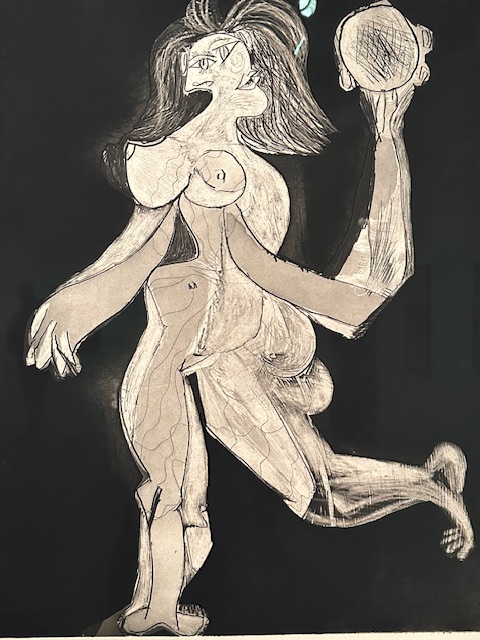
NBC’s Entertainment division president Brandon Tartikoff pitched this assignment (to two men) for a new show in the 1980’s: “Take some women around 60. Society has written them off, has said they’re over the hill. We want them to be feisty as hell and having a great time.” Tartikoff reportedly was told by one man that NBC would never air such a show. There was concern about an all-female cast (who became The Golden Girls), so the pilot episode also featured a gay housekeeper named “Coco” (played by Charles Levin). Dubbed “the fancy man in the kitchen,” he offered the Golden Girls tea and made enchiladas rancheros for them; he disappeared by episode two.

Writers interpreted “having a good time” to be sassy and sexy. “Blanche” (played by Rue McClanahan) bragged in season six that she had been in 143 relationships with men, while “Dorothy” (Bea Arthur) chalked up 43 guys, “Rose” (Betty White) had 30 companions, and “Sophia” (Estelle Getty playing Dorothy’s mother) added 25 notches to her belt. The Golden Girls’ sex quips even crossed the ocean to give Queen Elizabeth II’s mother, a huge fan of the show, some spice in 1988 at the London Palladium. This quip was part of the London episode: when “Dorothy” asked “Blanche” how long she waited to have sex after her husband died, “Sophia” jumped in with the response, “Until the paramedics came.”

Busy with a growing family and a demanding career in the 80’s, I may be one of a small number of people to never watch The Golden Girls. I recently asked other women what they thought about the show. Their responses were fascinating. The Golden Girls TV show was simply entertaining to some; despite canned laughter, others found feminist stronghold messages. People have different perceptions, but 30+ years later there still is a following of folks watching reruns.

Online I learned one of the more educational details about this show — actress Bea Arthur suffered from chronic fatigue syndrome (CFS), as did Susan Harris, a writer for the show. Bea’s character, “Dorothy,” in season 5 becomes ill but her doctor tells her that there is nothing wrong with her. Finally, “Dorothy” is diagnosed with CFS. For the many suffering from this mysterious and disabling condition, the show became validating. “Dorothy” shares other personal details that women experience — as a teenager “Dorothy” becomes pregnant and marries quickly. After 38 years of marriage her husband leaves her for a young flight attendant.

Life takes challenging turns. There are many single women in their older years due to widowhood, divorce, or never marrying. Some of today’s encore women are trying out the Golden Girls version of co-living, bunking together in one home, to save money and fend off loneliness. Time will tell if their experiment works well for them.

Pearls of Peace (PoP) Quiz

275. What TV series offers stories that you find poignant?

276. Do you know any women who decided to live together to share costs?                   

Growth Pearls

The Pew Research Center issued a December report (2023) showing 19% of Americans ages 65+ are in the workforce, either by choice or necessity. This number doubled in the past 35 years, partly due to older adults maintaining good bodymind health. Many more in this labor group have a college degree than decades ago. Also, work conditions have changed; office jobs are overtaking the physical labor necessary in factories and farms.

You may ask, “What motivates those who choose to continue working?” Answers range from being bored with golf or pickleball to the desire for a sense of purpose. Jane Goodall (89 years-young) continues her ecology-motivated passion for chimpanzees as well as her initiative to teach youth about conservation. Her legacy Roots & Shoots youth movement, beginning with 12 teenagers on her back porch in Tanzania, now offers programming in 100 countries. Working actresses Judi Dench (88 years-young) and Helen Mirren (78 years-young) also love their careers and defy sexist stereotypes for female actors.

Many everyday seasoned citizens return to the workforce after “retirement age.” A spunky teacher in her 60’s returned to the classroom as a substitute teacher at a private school where she puts in an 8-hour day instead of the 16-hour days that she frequently found herself working in a public high school. Her reason for a continuation of her career reflects my own reason for my current work in prevention psychology: “It’s fun, and it keeps my brain going.” I am a strong proponent of maintaining a growth mindset for every age, but it is especially important for those of us who are lucky enough to reach the seasoned citizen stage of development.

The research of psychologist Carol Dweck (Mindset: The New Psychology of Success) defines two mindsets:

  • Fixed mindset: You believe your qualities are set in neurological and psychological plaster—you have a fixed IQ, a set personality, and a certain moral character that defines you. A fixed mindset is a learned behavior.
  • Growth mindset: You believe that you are capable of continuing growth. Your personality is flexible. It has plasticity. You cultivate new qualities through your efforts. You can adjust your moral compass with your life wisdom. Your true potential is unknown.

I am not suggesting that aging into 65+ territory is easy, even for those with a growth mentality for lifelong learning. I believe that it takes a growth-and-grit mindset in your beyonder years. Psychologist Angela Duckworth (Grit: The Power of Passion and Perseverance) researched the importance of grit or what my parents called “stick-to-itiveness.” Duckworth’s father taught her about the value of “pushing through and doing the hard things.”

I watched the enduring persistence of the first flower pushing through snow in my garden; the Lenten Rose inspires me to make a growth-and-grit mindset my everyday compass.

Pearls of Peace (PoP) Quiz

273. When do you respond to life’s challenges with a fixed mindset?

274. What times can you recall when you were in growth mindset territory?

Gender Equality – A Moonshot?

Model of Odysseus by Intuitive Machines

International Women’s Day was celebrated with “her-story” highlighted on March 8th with 2024’s theme of #InspireInclusion. The moonshot theme each year is a call to set right the global issues that impact women. In 1908 in New York City 15,000 women marched to petition for shorter working hours, equal pay, and the right to vote.

While becoming an official day of international commemoration in 1977 (initially recognized by the United Nations in 1975), a much earlier global movement had emerged in 1910 when German feminist Clara Zetkin called for an international event during the Second Conference of Working Women held in Copenhagen. The 100 women in attendance from 17 countries unanimously supported Zetkin’s proposal.

During World War I women protested the war which churned on from 1914-1918. In 1917 a significant women’s protest in Russia (held on the Julian calendar date of February 23rd — March 8th in Europe’s Gregorian calendar) was an influence in Russia dropping out of the war and gave International Women’s Day their special date. Stalwart Russian women organized their protest for “bread and peace.”

This year protests were wide-ranging. In Thailand protestors highlighted the need for longer maternity leave with members of Thai labor unions wearing purple pregnancy dresses. German protestors focused on women’s need for better working conditions. In London’s Parliament Square protestors sought to bring attention to girls’ right to education in Afghanistan. Groups of protestors in downtown Seoul, Korea, called for freedom for Palestinian women while supporters for families of missing and kidnapped Israeli women staged a protest in Cape Town at the South African parliament.

Despite the reforms afforded to women today, the harsh realities of inequality still exist. In America women earned 83 cents for every dollar that men earned in 2022 (84 cents in 2024), according to the Bureau of Labor Statistics. Internationally, women’s average disposable income rates 31% lower than for men. Gender equality cannot exist when there is such widespread income inequality.

According to UNICEF statistics, world-wide since 1995 the proportion of young women married as children has declined from 1 in 4 to 1 in 5. Equality is a pokey process. Globally, nearly 1 billion girls and women lack the job skills they need for the fast-changing job market; 1 in 4 girls (ages 15-19) are not receiving an education or job training as compared to 1 in 10 boys in this age range.

The UNICEF initiative, Skills4Girls Portfolio, hopes to reach 11.5 million adolescent girls with job skill-building by 2025. For example, in Jordan only half of all young women are either employed or engaged in educational training programs. Through mobile Innovation Labs, Skills4Girls provides girls with training in coding and 21st century business skills.     

It seems unbelievable when we can send technology to reach the moon that we still lack “bread and peace” for our planet’s earthlings.

Pearls of Peace (PoP) Quiz

271. Where do you see gender inequality in education?

272. How might you engage in the effort to uplift girls’ skillsets?     

Leap Year Ladies

Did you even notice that we had one more day in February this past week? It was a good day for recognizing good women! On 2-29-24 President Biden issued a proclamation for Women’s History Month (March 1st-31st): “…we celebrate the courageous women who have helped our Nation build a fairer, more just society…though their stories too often go untold, all of us stand on the shoulders of these sung and unsung trailblazers…women are seated at every table where decisions are made….” This Administration boasts a record number of ladies-a-leaping cabinet secretaries.

I was not aware of the number of females named as cabinet secretaries (5), but I always recognize Leap Years. Two women in my family hold February 29th birthdays.

My maternal extended family honored my grandmother, Bertha (Alice) Ryan Whitacre, on a countrywide internet celebration. From North Carolina to Washington (and several states in-between), one remaining daughter, grandchildren and great-grandchildren gathered around the Zoom firepit to share memories. Grandma, called “Lady” by Grandpa, lived a long life (1896-1986) and was mother to 10 children (and miscarried 3 more). However, at age 12 she dreamed of becoming a missionary, even changing her middle name to Ryan as she admired Bertha Ryan, a missionary working with orphans in India.

Grandma waited until age 8 to have a February 29th birthday celebration. At the turn of the century in 1900 there was no extra day in February. According to Aunt Joyce, birthdays were not a big deal “back then,” although she recalled that along with her 9 siblings in childhood years, everyone celebrated Grandma’s un-birthdays at midnight on February 28th by banging on pots and pans. In honor of Aunt Joyce’s joy-filled memory, we had Zoom instructions to crash pan lids together. One cousin beat on a pan like a drum.

Meanwhile, my brother had a live celebration with another extended family, sending balloons skyward at sunset in memory of his wife’s Leap Year birthday. Pancreatic cancer cut short Pamela Scope Clark’s life (1960-2009). The helium-filled balloons all stayed together in a cluster until they were out of sight, perhaps a metaphor for how important it is for families to “stick together” through thick and thin. My sister-in-law Pam was mother to one son and step-mother to a second son, although as an obstetrics charge nurse she helped countless babies make the leap from watery wombs to first breath.  

Likely you have strong women in your acquaintances, whether Leap Year babies or not, who left legacies of everyday courage. Grandma is remembered for being a “gentle woman of steel.” This description also applies to my sister-in-law as well as many other women.

Women’s contributions too often are invisible in our “his-story” books. It is the unsung heroines whose quiet strength we most need to honor during Women’s “Her-story” Month.

Pearls of Peace (PoP) Quiz

269. Who among your acquaintances is an unsung lady to remember this month?

270. How might you celebrate “gentle women of steel” during this Women’s History Month?