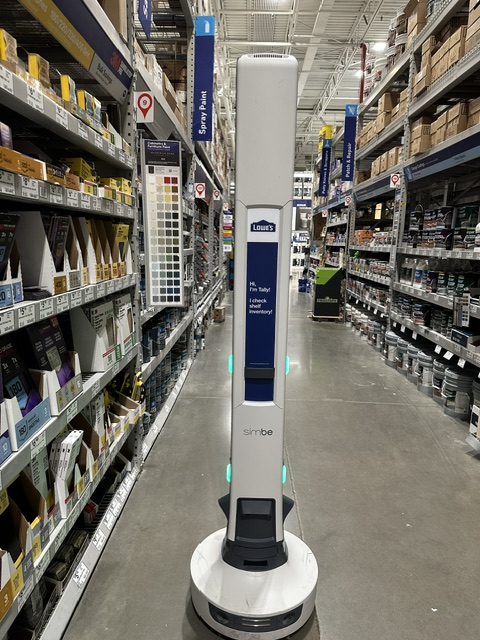
Brain Inventories

June is Alzheimer’s and Brain Awareness Month. Do you need help checking your brain’s inventory? I recently met “Tally” making cooing noises while she gracefully glided down the paint aisle at Lowe’s; she was checking shelf inventory. My curiosity ever present, I inquired if Tally might replace a worker. The answer was yes.

How long will it be before the Tally’s of the world (or out of this world) are AI responsible caretakers for all the individuals who need careful checking just to make it through a day? Alzheimer’s disease (AD) is spreading unchecked. According to the World Health Organization, the world-wide number of people expected to have an AD diagnosis is 82 million by 2030. Alzheimer’s Association reports 7.4 million Americans have AD currently; U.S. AD deaths doubled since 2000.

While AD symptoms can vary, personality and behavior changes often include apathy, disorientation, memory loss, and cognitive impairment. Brain confusion and/or physical decline can make it impossible for living independently. The caretaker role for a loved one with AD is a major time commitment. As a person journeys through the 7 stages of AD, increasing close attention is required.

Early memory loss may indicate Mild Cognitive Impairment (MCI) which may not be a sign of later dementia, as there are various causes for MCI. An individual can be aware of their MCI which often includes exhaustion in addition to mild memory loss. Moderately severe cognitive decline involves a drop-off of abilities to handle finances and other tasks of daily living. Agitation and aggression may show up when previously these emotions were not frequent. Perhaps having a blinking Tally, murmuring close by, would be a blessing.

Most people are not educated in dealing with AD and/or challenging personalities. Unfortunately, there is a shortage of gerontologists; geriatric medicine is one of the least popular specialties among new physicians.

Proactive educational help is developing. The Milken Institute School of Public Health at George Washington University (GW in D.C.) has established an “Expanding the Pipeline to Graduate Research in Alzheimer’s Disease and Related Dementias (EPGRAD) Program” as a fully funded 8-week summer education and research training program for undergraduates. The goal is to encourage students in the majors of medicine, science, technology, engineering, and mathematics to consider careers in AD and related dementias. New GW projects include a “Black Male Dementia Caregiver Burden Study” and a “Brain Health and Microbiome Study.”

What might you do to improve your own brain health? One health tip stands out for psychiatrist Drew Ramsey, MD (author of both Healing the Modern Brain and Eat Complete), who finds that many individuals in his practice are undernourished when considering brain health and mental health: eat a handful of leafy greens in one of your daily meals.

Multiple rabbits in my yard munch on greens all day. They are unlikely to need Tally.

Pearls of Peace (PoP) Quiz

504. How might you educate yourself about your brain health? 505. Have you considered how your own diet contributes to brain health?  

Creativity Enhances Aging

I co-presented a workshop on Creative Engagement at the American Society on Aging conference in San Francisco last week. Research shows that older adults who participate in creative actions have improved cognition and proprioception, enhanced meaning in their life, reduced loneliness, and recognition/engagement in a social life. Creativity makes brains bloom!  

There were notable speakers on diverse topics, but I will highlight presentations focusing on aging brains. Maureen Nash, MD, assesses and treats behavioral disturbance in older adults with mental illness or dementia in Portland, OR, where she is Medical Director at Providence Elderplace. In 2020 she was named Clinician of the Year by the American Association for Geriatric Psychiatry.

Nash’s key points are encouraging for those who fear that aging is a down-facing dog pose in life with no possible upward movement. Here are takeaway notes from an award-winning psychiatry specialist:

  • It is possible to develop new synapses in older adulthood. While older adults have reduced speed in learning new information, their “bigger networks” and life experiences can lead to an increased ability for problem-solving.
  • The best way to provide dementia care is to identify an individual’s unmet physical and psychological needs. Match interventions to the reasons behind their behaviors. It is possible to foster resilience in older adults with dementia.

Another session on the dementia journey focused on recovering resilience with music interventions (Vanderbilt University Music Research Institute). Music has roots in multiple branches in brains. One creative approach that includes individuals who are bed-ridden is to provide a small piano with wheels so that a pianist rolls into hospice settings, hospitals, memory centers, and rehabilitation spaces. It is important to get a playlist of familiar songs for each person. When some individuals no longer talk, they suddenly may sing along when a favorite song from their past returns them to an early memory.

Julene Johnson, PhD, at University of California, San Francisco, believes in “waking up” a person with dementia. A previous flute major, Johnson imagines a world where everyone has access to music, but especially those with dementia. Her colleague, social worker Dan Cohen, founder of the nonprofit organization Music & Memory, has a Netflix documentary that is inspiring. Check out Alive Inside: A Story of Music and Memory, to see a joy-filled intervention: https://www.youtube.com/watch?v=x9IHUPamCB4

As stated in the documentary, “Music can be a back door into the mind.” What might happen if we extended more research and focus with this gateway to the inner branching of brains in caring for older adults instead of spending millions of dollars on medical prescriptions that many physicians admit are not game changers?

Kim McCoy Wade, Senior Advisor for Aging, Disability and Alzheimer’s (Office of California Governor), recommends that everyone participate in positive aging: “Give people an action. What is your pro-aging action?”

Pearls of Peace (PoP) Quiz

277. What music would make your personal playlist?

278. If you have musical talent, where might you volunteer to make brains bloom?