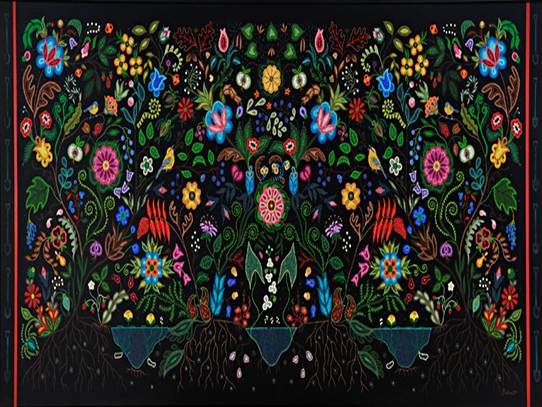
Canadian Métis visual artist Christi Belcourt begins by painting her large canvas black. “I see war, but I paint flowers. I paint what I want for this world…May we live long enough to see humankind turn away from violence and greed…towards creating a world based on caring and giving. May we live long to see the world embrace global disarmament.”
Belcourt paints with a poignant and peaceful hand. An environmentalist and social justice advocate, Belcourt is primarily recognized for her large floral landscapes. Her peace-bearing paintings contain carefully crafted dots (with as many as 200,00 dots) to represent traditional Métis beadwork. She has admired First Nation women’s beadwork patterns since her childhood.
Dazzling circle shapes in Belcourt’s paintings are her symbols for the life cycle “as if they are both molecules and stars.” Her intended purpose is profound: “The roots in my paintings…indicate there is more to life than what we see.” She intends for viewers to detect the smallest of details in order to grasp a bigger picture. Many of her art pieces feature endangered species. For example, a bird on the extinction list is painted with an accompanying bird “calling out.”
Belcourt summarizes her art in simple terms: “My paintings are primarily calls to action…I see…all living beings, including humans, as one…[with] freedom and dignity, care and enough for all.”
Belcourt’s art reminds me of other significant dot art. Aboriginal dot paintings began in the Northern Territory of Australia. They also are symbolic. Aboriginal dots are not merely abstract art. They are meant to hold deeper, sacred meanings from the world’s oldest continuous culture. Aboriginal circles represent waterholes or campsites; their U-shapes stand for people sitting cross-legged. Sacred lands are what tie these different, yet similar, Aboriginal and Métis Nation art forms together.
The earliest form of Aboriginal art depicted tribal stories drawn in desert sand. Fearful of people from different regions “reading” their meanings, artists evolved their sand sketching into abstract dots on cardboard, metal, and other surfaces to preserve sacred stories. This art also conveyed warnings. One theme was displacement from original homelands when outsiders claimed ownership. Observers of Aboriginal art might sense the flat dot paintings appearing to leap off canvass in sparks of energy.
Belcourt speaks for many today: “We are witness to the unbearable suffering of species, including humans. Much of this we do to ourselves. It is possible for the planet to return to a state of well-being, but it requires a radical change in our thinking…We are all a part of a whole…When we see ourselves as separate from each other and think of other species, the waters and the planet itself as objects that can be owned, dominated or subjugated, we lose connection with our humanity and we create imbalance on the earth.”
War OR peace…that is a perennial conundrum.
Pearls of Peace (PoP) Quiz
474. When have you witnessed artwork that left an imprint to enliven you?
475. What calls for action impact you?
 Pearls of Peace: A Family Psychologist’s Circle-of-Life Blog