Collage as a Jumpstart

After packing more boxes than I ever imagined, making a cross-country move, and unpacking all those boxes last summer, I needed a reset. I signed up for a collage class of the 4 seasons at the local community center. Having dabbled in a few collage workshops previously, I found the experience introspective, yet aimless at the same time. This class began my prescription for a renewal jumpstart amidst upheaval.

Our small group made a different collage for each season, interspersing each collage with writing about our contained-on-paper musings. We were given ancient symbols for seasons, a feast of colorful papers including wallpapers, buttons, and trinkets overflowing a table. We began with Spring, the farthest season from our summertime outdoors.

I immediately cut some circles — for circle-of-life? My scissor-handed mind turned to flowers emerging from stardust atoms, origins of everything (including origins of writing) and beauty of Earth’s springtime renewal. My eyes chose a wallpaper with a fairy. “What?” a part me asked, but I snipped the fairy (surrounded by stars) anyway. We were time-limited with the structure of the class, but I finished by selecting 3 trinkets from the teacher’s treasure stash – a metal flower button, a delicate paper flower, and a tiny plastic bird with an open beak.   

Here are snippets from my written musings in collage class: Spring has always been one of my favorite seasons. When Winter has been cold and on the fallow side in the garden, Spring bursts through frozen thinking with unending possibilities. I find the Viking symbol for Spring presenting an openness…(checking Google on my cell phone) on Vikings’ Spring: “The Norse goddess Ostara (considered the origin of our word, Easter) is strongly associated with Spring and new beginnings…surrounded by symbols… like flowers and fairies…the Ingwaz Rune, representing a seed or egg, embodies the potential for growth and new life.” When crocuses give birth to themselves, pushing through soil’s tunnel, there is magic for me. I’m even inclined to think of fairies – aren’t they just flowers with petals as skirts? After Winter’s hibernation there is hope with bulbs deciding to stick their necks out…Spring is like that – come out, come out, wherever you are – get blooming.

Collage is a laboratory for artists. When Matisse was in his 70’s, tangled in legal disputes with his wife which resulted in everything in his studio sent to bank cellars, he filled his walls with paper cutouts. Reinvigorated, Matisse discovered what he called “drawing with scissors.” His stained-glass windows for a chapel were designed from his energizing and colorful scissor cutouts. https://www.theguardian.com/artanddesign/2014/mar/29/henri-matisse-cutouts-tate-modern-drawing-scissors

Other artists, including writers, use the joining of collage fragments as a jumpstart for their artistic process. Painter Amy Sillman captures the essence of collage: “…there is something about placing 2 things on the same plane that clarifies their relationship in ways that words, for a time, cannot.”

Collage creates an opening to newness.

Pearls of Peace (PoP) Quiz

498. What does Spring conjure in your mind?

499. How do you use activities to” reset” yourself?   

War OR Peace

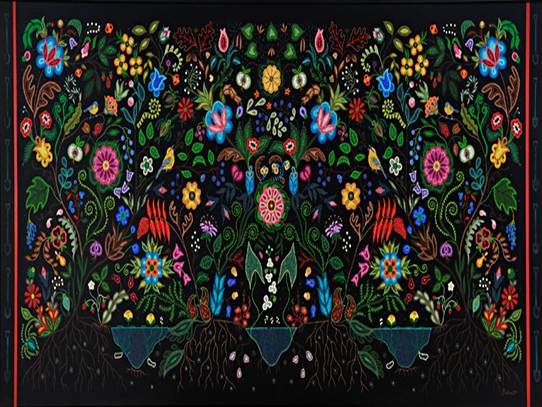
So Much Depends Upon Who Holds the Shovel, Christi Belcourt, 2008

Canadian Métis visual artist Christi Belcourt begins by painting her large canvas black. “I see war, but I paint flowers. I paint what I want for this world…May we live long enough to see humankind turn away from violence and greed…towards creating a world based on caring and giving. May we live long to see the world embrace global disarmament.”

Belcourt paints with a poignant and peaceful hand. An environmentalist and social justice advocate, Belcourt is primarily recognized for her large floral landscapes. Her peace-bearing paintings contain carefully crafted dots (with as many as 200,00 dots) to represent traditional Métis beadwork. She has admired First Nation women’s beadwork patterns since her childhood.

Dazzling circle shapes in Belcourt’s paintings are her symbols for the life cycle “as if they are both molecules and stars.” Her intended purpose is profound: “The roots in my paintings…indicate there is more to life than what we see.” She intends for viewers to detect the smallest of details in order to grasp a bigger picture. Many of her art pieces feature endangered species. For example, a bird on the extinction list is painted with an accompanying bird “calling out.”

Belcourt summarizes her art in simple terms: “My paintings are primarily calls to action…I see…all living beings, including humans, as one…[with] freedom and dignity, care and enough for all.”

Belcourt’s art reminds me of other significant dot art. Aboriginal dot paintings began in the Northern Territory of Australia. They also are symbolic. Aboriginal dots are not merely abstract art. They are meant to hold deeper, sacred meanings from the world’s oldest continuous culture. Aboriginal circles represent waterholes or campsites; their U-shapes stand for people sitting cross-legged. Sacred lands are what tie these different, yet similar, Aboriginal and Métis Nation art forms together.

The earliest form of Aboriginal art depicted tribal stories drawn in desert sand. Fearful of people from different regions “reading” their meanings, artists evolved their sand sketching into abstract dots on cardboard, metal, and other surfaces to preserve sacred stories. This art also conveyed warnings. One theme was displacement from original homelands when outsiders claimed ownership. Observers of Aboriginal art might sense the flat dot paintings appearing to leap off canvass in sparks of energy.

Belcourt speaks for many today: We are witness to the unbearable suffering of species, including humans. Much of this we do to ourselves. It is possible for the planet to return to a state of well-being, but it requires a radical change in our thinking…We are all a part of a whole…When we see ourselves as separate from each other and think of other species, the waters and the planet itself as objects that can be owned, dominated or subjugated, we lose connection with our humanity and we create imbalance on the earth.” 

War OR peace…that is a perennial conundrum.

Pearls of Peace (PoP) Quiz

474. When have you witnessed artwork that left an imprint to enliven you?

475. What calls for action impact you?    
Big-picture Peace

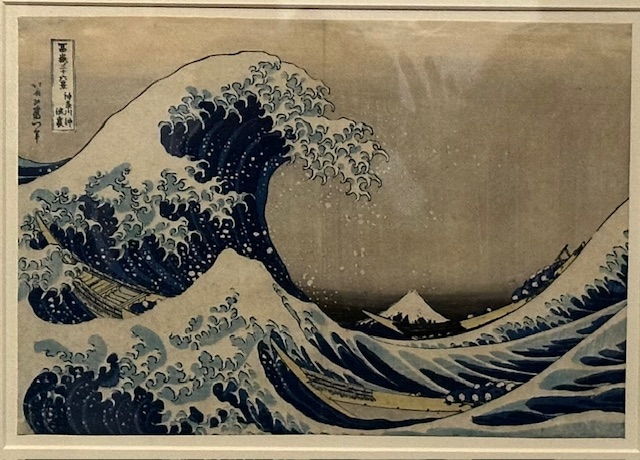
Under the Wave off Kanagawa, Katsushika Hokusai (1769-1849)

The United Nations International Day of Peace, annually set for September 21st, has a request: a 24-hour ceasefire of all hostilities on the planet. This year’s theme, “Cultivating a Culture of Peace,” calls for teaching the values of dialogue (see blog, “Mend Differences through Dialogue,” 8-19-24) and mutual respect to the 1.2 billion youth worldwide. Have we given up on adults knowing how to use dialogue and mutual respect in resolving conflicts?

It seems that adult problem-solving efforts to create peace on earth are like the tiny boats facing the looming giant wave in Katsushika Hokusai’s color woodblock print, Under the Wave off  Kanagawa. I must admit that the first time I saw this captivating image in Chicago’s Art Institute years ago, I was so focused on the wave action that initially I did not see the boats! Due to being on paper, the print is only on view for 3-4 months every 5 years. This original gem has re-surfaced from protective storage and again is on display (September 5, 2024–January 6, 2025) in the Art Institute’s Ando Gallery, my favorite room in the entire museum. This time, I knew to look for the boats. What if we are looking for world peace in all the wrong places?

Most museum visitors never see the Tadao Ando Gallery, or Gallery 109, as it sits in an innermost corner of the Art Institute’s Japanese collections. It is a compact space compared to many roomy galleries in other sections of the museum. Also, it is one of the few darkened spaces.

Ando was a self-taught architect. His haunting 16 free-standing wood columns in the womb-like environment compel one to slow down, take deeper breaths, and realize that this is a bodymind immersion into a different sense of time and space. Walking through the “forest” of oak pillars creates an atmosphere of peaceful reverence; the message is to refocus your gaze and get ready to look for what is beyond this “forest” grove.

We have English writer John Heywood to thank for his catchy proverb from 1546: “Can’t see the forest for the trees.” It seems to apply to many situations today, but especially to country leaders who lack the capacity to grasp the disastrous consequences of continuing wars. While dwelling solely on certain details, the big picture is often far from sightlines. Combating inequality, advocating for human rights, and championing climate actions for our planet are factors that lie beyond the immediate details of our international conflicts.

Re-look at Hokusai’s masterpiece. Mount Fuji holds still beyond the crashing wave. Again, we almost miss seeing beyond first details. This mountain is considered a spiritual place. How might we look for big-picture peace and create an interfaith spiritual culture for world dialogues? Isn’t peace first within a baby’s heart?

Pearls of Peace (PoP) Quiz 

327. When have you caught yourself missing some big-picture viewpoint?

328. How often do you refocus your gaze in looking for solutions to your personal sense of peace?