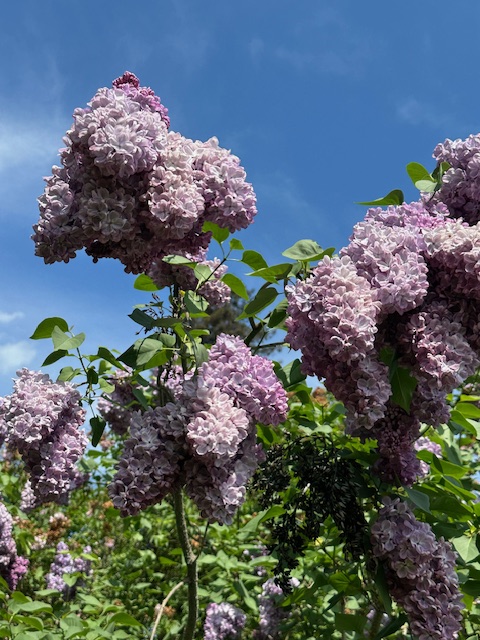
May is a wonderful month! If you are living in the Northern Hemisphere, you might welcome a reset from cold temperatures, a warming up in body comfort. Let’s also warm up peace in our hearts. I am a gardener at heart. I find much peace in gardening. Literally, gardening is grounding. I love the whiff of earthy soil turning over when I dig a hole to plant a new perennial in my garden.
A sweet inhale comes from the many scented blossoms that begin their seasonal run every spring. Angela Haupt (health and wellness editor at TIME) writes about holding a flower’s inhale for just 30 seconds to realize measurable body changes! Not only does your mood smile, but your heart rate slows and your nervous system switches on a calming state.
Cognitive psychologist Pamela Dalton is a researcher of taste and smell at Monell Chemical Senses Center in Philadelphia. She explains the science of smell. Our olfaction is so dominant that it evolves before the brain’s cortex, our thinking tool. A sense of smell helps define what we feel and may even be responsible for our survival — as in the case of smelling smoke before a life-threatening fire erupts. Although difficult to believe, the human nose can detect about 1 trillion different scents!
When you inhale a pleasant scent, you do breathe more deeply in the present moment. That deeper breath affects your entire body, including the releasing of muscle tension. Different from touch, hearing, or vision which have to pass through the brain’s thalamus before there is conscious awareness, smell travels directly to your amygdala and the hippocampus. The hippocampus holds your memories, so scent can trigger past emotions you experienced in some memory. Imagine a smell of a special food from childhood. Just a whiff of chocolate contains hundreds of different odor molecules.
Dalton suggests that such scented experiences form very early. Some compounds found in breast milk are linked with chemical properties in vanilla and may be responsible for why vanilla seems universally pleasant to nearly everyone across cultures.
I visited a lilac farm recently and experienced many inhalations of lilacs. While every person responds to scent in unique ways, this is a pleasing scent for me. Some think of lilacs with nostalgia. Seeing graceful lilac blooms swaying in the breeze brought back memories of my childhood home with a white lilac tree.
Lilacs represent peaceful vibes of tranquility with a sense (and scent) of renewal. The delicate blossoms are an early food source of nectar for bees and butterflies. Lilacs of various colors are associated with various representations.
Purple lilacs: Emotions of love and passion; White lilacs: Purity, humility, and innocence; Magenta/pink lilacs: Strong friendships and affection; Blue lilacs: Serenity and happiness; Violent lilacs: Reflection and wisdom.
Let’s embrace the symbolism of peace-enhancing lilacs.
Pearls of Peace (PoP) Quiz
494. What pleasant scents linger for you from your childhood?
495. What plant or flower gives you bodymind serenity

