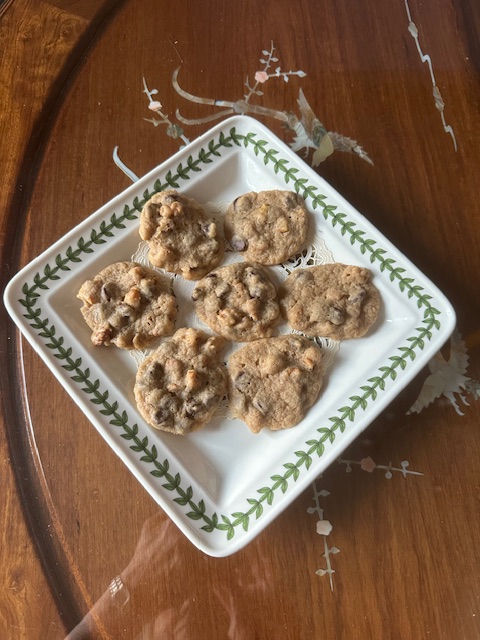
When the Chips are Down

National Chocolate Chip Cookie Day happens every year on August 4th. Who knew?

The average person supposedly eats nearly 35,000 cookies in a lifetime! I wondered how many of those are chocolate chip cookies, a favorite of many since this cookie’s humble birth in 1937. Reportedly, 53% of Americans prefer chocolate chip cookies over others.

The chip cookie trail is traced to Toll House Inn in Whitman, MA. One story has owner Ruth Graves Wakefield intending to make her usual chocolate cookies, only she ran out of baker’s chocolate. She substituted chunks of a Nestle chocolate bar to her mix. Another story has Ruth being creative and deciding to try something different in her prized cookies. In any case, the Toll House cookie chipped its way into delicious existence.

Another story has Nestle approaching Ruth for her original recipe which the company added to their wrapper of chocolate chips (which they began producing for Ruth’s cookies). What was her compensation? She made the company considerable chip cash, while she received a lifetime supply of chocolate and $1.00! Hmm…is this true? Supply and demand economics does not always play fair.

An original name for Ruth’s chip cookies was Toll House Chocolate Crunch Cookie. If you want to read up on the entrepreneur who possibly sold her recipe for unlimited chocolate, there is a clever book about her:How the Cookie Crumbled: The True (and Not-so-True) Stories of the Invention of the Chocolate Chip Cookie by Gilbert Ford. Just so you know, it is a children’s book for ages 4-8, but it highlights a woman entrepreneur’s experience. Ruth’s Toll House Inn restaurant became a popular stop.

“When the chips are down” comes from gambling and not from chocolate chip cookies – when all the bets are made and there is no going back, the cards are about to be turned over to show who “wins.” It is a moment of seriousness. Some might even say an ominous moment.

We seem to be at such a time in our U.S. supply-and-demand economy. Who knows which stories will emerge from a current chaotic chain of events? It might be a good time to bake some chocolate chip cookies and give them to strangers. Listen to their story. Be compassionate. We need to pull together in the country.

Some bakeries give away a freebie on this trivial holiday. You could go bakery-hopping to taste-test variations, although I recommend making them yourself. The smell of wafting chocolate from the oven is worth it. An online suggestion places 3 chips on the top if it bothers you when all chips are down inside the cookie. Inevitably, some have more chips than others.

Anyway, there are so many chips that are down in our world today that are of greater consequence than cookie-dressing and counting chocolate chips.

Pearls of Peace (PoP) Quiz

417. What are your when-the-chips-are-down issues?

418. When is the last time that you baked cookies and gave some away?

Understand Compassion in Grieving

“I write to understand as much as to be understood,” explained Elie Wiesel, Romanian-American Holocaust survivor and Nobel laureate. Isn’t this true for all writers? If writing is one’s career, there is motivation to put groceries on one’s table, but writing also is a powerful way to grasp and then share some deep understanding of a topic.

The tragic airline crash into Potomac River in Washington, DC grabbed people’s grief strings. An airplane carrying 64 individuals from Wichita, Kansas, and a helicopter carrying 3 soldiers collided just as the larger plane was preparing to land — on a crystal-clear evening. Undoubtedly, passengers were anticipating their meet-up with relatives and rides. Perhaps they were enjoying DC lights and sights. Aviation attorney and experienced pilot Arthur Wolk noted how numerous lights in this crowded airspace can conflict with flight instructions.

Soldiers in the helicopter were conducting a “routine training mission” to practice evacuating government officials if deemed necessary in an emergency. Instead of leading anyone to safety, the unthinkable occurred. Two days later a jet-ambulance crashed in Philadelphia, killing 7 and injuring 22 on the ground, a further tragedy. Smashed dreams and shattered families frighten even those without relationships with the victims. Encountering another’s trauma activates branches of trauma memories in one’s own life.

Journalist Rebecca Soffer, co-founder of online Modern Loss, is keenly aware of sudden death. She was 30 when her mother was killed in a car accident, one hour after giving Rebecca a ride from family camping. Then at age 34, Rebecca’s father died of a heart attack while on a cruise. Co-founder Gabrielle Birkner began her journalism career writing obituaries for a local newspaper. While 27-year-old Gabrielle was in the newsroom working on obituaries, she received unthinkable news that her father and stepmother were murdered in a home invasion. Both young adults sought companionship and compassion from those who might understand their grief.

Gabrielle interviewed psychiatrist M. Katherine Shear, founding director of Columbia University’s Center for Prolonged Grief at Columbia’s School of Social Work. Here is Dr. Shear’s definition of compassion: “Compassion is defined as the feeling of wanting to help someone who is hurting or suffering or has had to confront an untoward experience. Compassion means having a sympathetic awareness of that person’s pain along with a desire to ease the suffering.” She further pointed out that women are better at taking care of others than taking care of themselves. Often women feel that it is selfish to have self-compassion.   

Actually, one needs to hone their self-compassion to be capable of compassion for another’s suffering. It is possible to learn self-compassion skills. Allow yourself to address grief as a form of interdependent love, both for yourself and others. I can vouch for writing 3 things, large and small, in a daily-gratitude journal as one runway to land self-compassion.

Pearls of Peace (PoP) Quiz

365. When have you used writing (in any form) to cope with grieving?

366. In what ways do you show compassion for others?