Unmet Needs

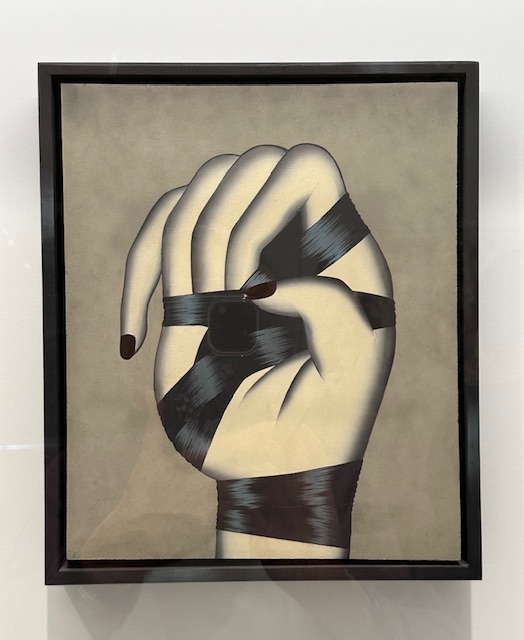
Bound Hand, 1973, Christina Ramberg

If you can visit The Art Institute of Chicago before August 11th, do not miss the exhibit, “Christina Ramberg: A Retrospective.” In 2025 the Ramberg exhibit travels to art museums in L.A. and Philadelphia.

Ramberg was a devoted artist; she drew, painted, sewed, quilted, and compiled scrapbooks. Her sometimes-edgy art without faces (and only parts of a body represented in each production) leaves much open to interpretation. Everyone flies their own perceptions into any piece of art, but with unsettling cut-offs there is a provocative quality to Ramberg’s work. What was she thinking as she cropped her art? She once answered this question about a corseted headless-legless woman. The curvy mid-section was bent over; Ramberg recalled watching her mother wriggle into tight undergarments to cinch her waist, popular in women’s fashion in the 50’s. The restraints suggested in cut-off torsos were further emphasized with subdued colors.

Here is what grabbed me when I first saw Ramberg’s Bound Hand. I use my hand to teach people about 5 basic needs. Partly as a mnemonic, and partly as a visual representation of what is at hand for us daily, my 5 EDCBA basic needs (as illustrated on a hand or drawn on a handprint) provide a handy chart. Consider how you meet this handful: Energy (thumb), Discipline (index finger), Creativity (middle finger), Belonging (ring finger) and Ability (little finger).    

These needs are not hierarchical, but ideally are interdependent and flow into one another, grounded in a core self. Your met needs are a collaborative effort for your wellbeing. However, the daily-needs story gets complicated when needs are unmet; it is challenging when you are confronted by others trying to meet different needs (or disagreeing with how you meet needs). Bound-up needs stifle one’s equality and growth.

As insightful writer Ann Patchett writes in These Precious Days: Essays, “People want you to want what they want. If you want the same things they want, then their want is validated. If you don’t want the same things, your lack of wanting can, to certain people, come across as judgment.”

Despite critiques, Ramberg (1946-1995) kept evolving her creativity, although her life was cut short by Pick’s disease (frontotemporal dementia). Her creativity is contemporary in its cropped views of both femininity and masculinity. The headless-legless male and female torsos are riveting.

Ramberg frequently visited garage sales and flea markets where she collected the 155 dolls mounted on one wall of the exhibit. The dolls (some headless) represent ethnic, racial, and gender stereotypes. Ramberg said this about Doll Wall: “I was only interested in the dolls that had been owned by someone. The ones where the face was worn off and redrawn in, or where something very strange had transpired…I’m interested in what is implied. And the simple fact that they had a life.”

Let’s embrace life. Who needs wars?

Pearls of Peace (PoP) Quiz

291. What (if any) are your unmet needs?

292. How do you meet your need for creativity?

Creativity Enhances Aging

I co-presented a workshop on Creative Engagement at the American Society on Aging conference in San Francisco last week. Research shows that older adults who participate in creative actions have improved cognition and proprioception, enhanced meaning in their life, reduced loneliness, and recognition/engagement in a social life. Creativity makes brains bloom!  

There were notable speakers on diverse topics, but I will highlight presentations focusing on aging brains. Maureen Nash, MD, assesses and treats behavioral disturbance in older adults with mental illness or dementia in Portland, OR, where she is Medical Director at Providence Elderplace. In 2020 she was named Clinician of the Year by the American Association for Geriatric Psychiatry.

Nash’s key points are encouraging for those who fear that aging is a down-facing dog pose in life with no possible upward movement. Here are takeaway notes from an award-winning psychiatry specialist:

  • It is possible to develop new synapses in older adulthood. While older adults have reduced speed in learning new information, their “bigger networks” and life experiences can lead to an increased ability for problem-solving.
  • The best way to provide dementia care is to identify an individual’s unmet physical and psychological needs. Match interventions to the reasons behind their behaviors. It is possible to foster resilience in older adults with dementia.

Another session on the dementia journey focused on recovering resilience with music interventions (Vanderbilt University Music Research Institute). Music has roots in multiple branches in brains. One creative approach that includes individuals who are bed-ridden is to provide a small piano with wheels so that a pianist rolls into hospice settings, hospitals, memory centers, and rehabilitation spaces. It is important to get a playlist of familiar songs for each person. When some individuals no longer talk, they suddenly may sing along when a favorite song from their past returns them to an early memory.

Julene Johnson, PhD, at University of California, San Francisco, believes in “waking up” a person with dementia. A previous flute major, Johnson imagines a world where everyone has access to music, but especially those with dementia. Her colleague, social worker Dan Cohen, founder of the nonprofit organization Music & Memory, has a Netflix documentary that is inspiring. Check out Alive Inside: A Story of Music and Memory, to see a joy-filled intervention: https://www.youtube.com/watch?v=x9IHUPamCB4

As stated in the documentary, “Music can be a back door into the mind.” What might happen if we extended more research and focus with this gateway to the inner branching of brains in caring for older adults instead of spending millions of dollars on medical prescriptions that many physicians admit are not game changers?

Kim McCoy Wade, Senior Advisor for Aging, Disability and Alzheimer’s (Office of California Governor), recommends that everyone participate in positive aging: “Give people an action. What is your pro-aging action?”

Pearls of Peace (PoP) Quiz

277. What music would make your personal playlist?

278. If you have musical talent, where might you volunteer to make brains bloom?