Saying YES to Hope

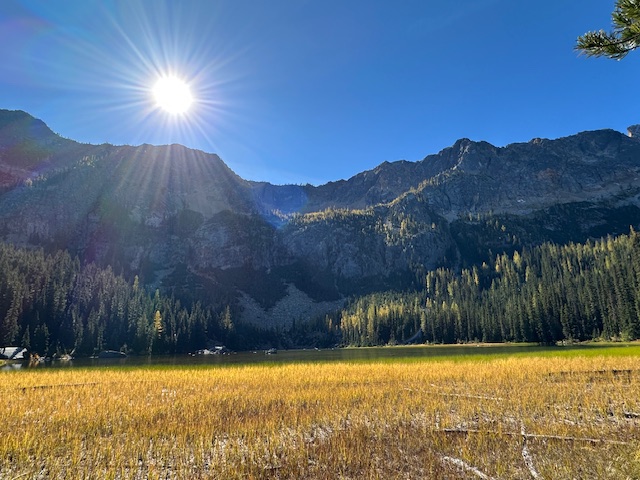
Cutthroat Lake (Named after the local cutthroat trout), North Cascades, WA

English primatologist and anthropologistJane Goodall is an inspirational leader. Her messages for planetary health were still percolating as she entered her 90’s. In celebrating her birthday in 2024, Goodall said in an interview on TODAY,” Slow down, Jane, you’re 90.”  Then she concluded, “I have to speed up because I don’t know how many years left I have.”

Goodall gave her final public interview just 8 days before she died on a U.S. speaking tour 10-01-25 at age 91. Longtime assistant Mary Lewis reported working with Goodall on a document at 10:30 PM just hours before Goodall died while sleeping.

UN Messenger of Peace Goodall found that the question most asked of her was this one: Do you honestly believe there is hope for our world…for the future of our children and grandchildren? Her answer was a stalwart YES — with a call to action: I believe we still have a window of time during which we can start healing the harm we have inflicted on the planet – but that window is closing. If we care about the future of our children and theirs, if we care about the health of the natural world, we must get together and take action…Many people understand the dire state of the planet – but do nothing about it because they feel helpless and hopeless.” 

Goodall sustained a keen sense of hope that can serve as a legacy. She exudes hope in The Book of Hope: A Survival Guide for Trying Times co-authored by Douglas Abrams, with Gail Hudson. Abrams proposed this dialogue-with-Jane book after his Book of Joy with The Dalai Lama and Archbishop Tutu.

Goodall lists 4 reasons for hope despite “a time of fear:”

  1. The amazing Human intellect; 2. The resilience of Nature; 3. The power if young people; and 4. The indomitable Human Spirit.

Roots & Shoots programming initiated by Goodall in 1991 is a prime example of youthful power. While the fledgling environmental project began with 12 high schoolers in Dar es Salaam, Tanzania, today Roots & Shoots hands-on programming exists in 100 countries. The purpose is to train youth to create positive changes for animals, the environment, and their local communities. It is the embodiment of hope.

Saying YES to hope is key to many present-day predicaments. Saying YES means taking power. In the children’s book, A Million YES’s, author D.J Corchin (with illustrator Dan Dougherty) describes the contagion of positive actions: “Word got around quickly. The girl suddenly made more and more friends who all lined up for her incredible YES’s.”

Jane Goodall was a practical and philosophical role model: “You won’t be active unless you hope that your action is going to do some good. So you need hope to get you going, but then by taking action, you generate more hope. It’s a circular thing.”

Say YES to active hope.

Pearls of Peace (PoP) Quiz

436. What gives you hope?

437. How might you say YES more often to make positive environmental changes?

Every Day is Earth Day

We celebrate our 55th anniversary of Earth Day with its theme, “Our Power, Our Planet.” The global focus for this year is energy – solar, wind, hydroelectric, geothermal, and ocean tidal-generated energy. Themes chosen each year gather collective plans for facing facts on ticking-clock climate awareness where it seems most needed. President of EarthDay Organization, Kathleen Rogers, delivers a summons: “The collective power of a billion voices is vast and one billion people speaking out on an issue is hard for governments, institutions, or industry to ignore.” Yes, but how many believe (or care) there is climate change?

Earth Day was initiated by Wisconsin U.S. Senator Gaylord Nelson. His foresight of impending climate issues led Americans in 1970 to advocate for environmental reforms. Establishing the Environmental Protection Agency (EPA) has roots in this movement. By 1990 Earth Day extended to 141 countries. In 2016 the Paris Agreement signed by 175 countries at the United Nations was a commitment to limit global temperature rise. The 192 countries currently observing Earth Day make it the largest global secular celebration.

Some celebrations are short-lived. On Earth Day, April 22, 2025, EPA reduction-in-force letters reached nearly 200 employees who were in limbo since their placement on “administrative leave” in February. They worked for the Office of Environmental Justice and External Civil Rights, or translated, they worked on “protecting low-income and minorities most at-risk from air and water pollution.” One employee, Ellie Hagen, received her layoff notification at 5 PM. Her whole team (Environmental Justice Community Health) was deemed “wasteful.” Hagen’s non-partisan work was to reduce lead exposure in Ohio family homes. It seems ironic that these government edict letters were delivered on Earth Day.

In March there was a rollback of environmental regulations. EPA’s “reorganization”has a proposed 65% budget-cut figure. Meanwhile, China has the world’s largest investment, as well as production, of renewable energy relying mainly on hydroelectric energy. Costa Rica has produced 98% of their electricity from renewable sources for 10 years. Sweden’s powerhouse goal is to reach 100% renewable energy by 2040.

Our precious Earth has limits. According to the Chicago Botanic Garden, one-third of plant species in the U.S. are at risk of extinction. The World Wildlife Fund (WWF), a Swiss-based international non-governmental organization (the world’s largest conservation organization), calculates that between 10,000-100,000 species become extinct each year. It is so unclear what the actual number may be. What is clear is that the current rate of extinction is due to a single species causing it – people. According to WWF, humans use 25% more natural resources than are sustainable on Earth. https://wwf.panda.org/discover/our_focus/biodiversity/biodiversity/

Whatever the actual extinction numbers are, Earth and her citizens are suffering from a biodiversity crisis. Put Earth Day on your calendar every day.

It is bloom time for the short-lived forget-me-not. 

                                                                 Pearls of Peace (PoP) Quiz

389. Is there some movement that you might join to caretake Earth for future generations?

390. What personally will you do today to return care for Mother Earth? 

Pearls of Purpose

“Another world is not only possible, she is on her way. On a quiet day, I can hear her breathing.” Writer Arundhati Roy

It is easier to believe this hopeful thought when one is surrounded by Mother Nature’s beauty — especially in a fertile atmosphere like Hawaii where my nephew and fiancée live and married this weekend. The wedding took place on a working ranch under a canopy of banana trees with a rocky mountain peak for a chapel steeple. As part of the ceremony, a tree sapling was placed between the couple as they held a pot of soil with a trowel. They jointly scooped soil into the tree. They will plant it at one of their ecological volunteer sites.

Earlier in Wedding Week the bridal party of 14 attendants joined family members for a volunteer activity at a non-profit 405-acre farm near the Ko’olau Mountains. Forming a long line across a trough of watery planting area, we stomped in thick mud to even the planting bed for the next taro crop. With mud halfway up to our knees, we encountered a few rocks underfoot. It was a literal slippery slope when leaning over to pull weeds growing in rich mud. Taro grows on a rotating basis to produce a constant food source. Much  produce from this farm goes to the local community living outside of tourist areas. If one does not visit rural Hawaii with its dirt roads, an opportunity for cultural understanding is lost. However, most tourists may taste taro at any luau or buffet meal as taro (karo) is a staple food in O’ahu.

The newlyweds are regular volunteers at Kako’o Oiwi, along with some of their friends who were wedding guests. These young adults feel a strong commitment to both helping sustainable food efforts and partnering with Hawaiian people preserving their culture. They find a dedicated purpose in volunteerism alongside their careers. Psychologist William Damon, professor at Stanford, defines the power of purpose (The Path to Purpose). When one’s skills meet the needs of the world, purpose becomes like a chemical reaction. In identifying something in one’s environment where improvement is necessary, the volunteer also identifies aspects of their skillset that make a contribution, such as leadership or creativity. A synergy develops as a win-win opportunity for both recipient and volunteer.

Damon finds that individuals begin their pursuit of purpose in their 20’s and 30’s. While career and family often are at the center, he adds volunteerism as bringing purpose to many individuals. Making a difference in the world is good for people! However, in one survey only 30% of individuals ages 50-92 reported feeling purposeful. Older adults may feel a loss of identity when they leave their careers without cultivating other purposes in life.

In an earlier book, Greater Expectations: Overcoming the Culture of Indulgence in Our Homes and Schools, Damon suggests that child-rearing that is predominantly focused on a child-centered philosophy does not prepare youth for moral maturity and competence: “Less is expected of the young, and in turn less is received.” I find that the same thing might be said of older adults. When we do not expect that seasoned citizens have skills and new purposes to be further developed, we all miss out.

Taking care of the environment is critical. It takes many feet in muddy and rocky places. What if we start to live with Roy’s quote in our own backyards?

Pearls of Peace (PoP) Quiz

285. Where do you find purpose in your life?

286. How many of your friends might join you in some common purpose?