Holiday Relationships & Wellness

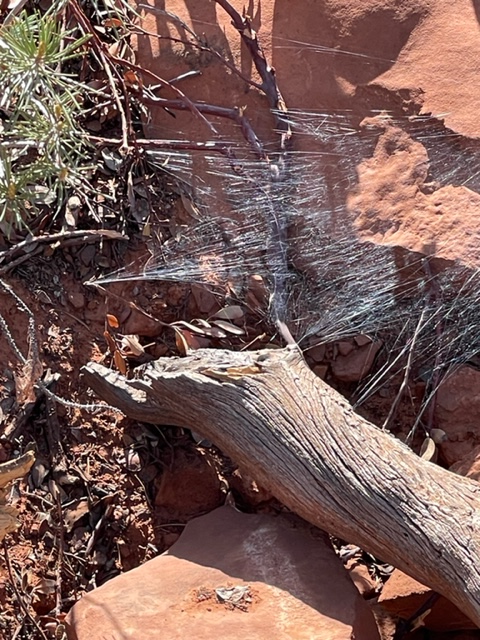
In a spider web, everything is connected. Everything you do is connected to others. No one can do everything alone. Celebrating holidays is best when celebrating in healthy ways with others!

Blackfoot scholar Dr. Leroy Little Bear looks at the big picture and captures everything: “Existence is a web of relationships. What you do to the land, to the animals, to the water, you do to yourself.”

Little Bear tells about dreaming that he was a bubble. His wife also was a bubble. He joined their bubbles. Half awake, he asked if his dream was real; the joined-bubble dream appeared a second time. When Little Bear shared his dream with his wife, she gave this interconnected interpretation: “I know what you are thinking…if we spread this among relatives, things will happen. Everybody is of one mind.”

As we roll through this holiday season, interconnected relationships are a key ingredient. In fact, relationships are key everywhere. According to Little Bear, the Western mind focuses on the social values of bigger and faster. To consider the social values in the Blackfoot mind, think about energy waves always in a state of flux. This is also scientific-minded territory. For an example of how this relational way of thinking might translate to the workforce, think team building, shared authority, and treating employees like a work family. As Little Bear suggests, this approach often results in team players producing better quality work.

Little Bear was instrumental in being part of creating Indigenous studies 50 years ago (in college at the University of Lethridge in Canada). Since many of us were not privy to Indigenous college courses, try on some Indigenous ways of relating:

  • Think holistically and relationally, rather than through the narrow lens of an individual paradigm;
  • Emphasize interconnectedness not just with your relatives and best friends, but also with land, spirit, and community for mental wellness and healing — understand life as energy, not just facts; 
  • Consider how language, story, dreams, and holiday rituals may shape pathways to healing.

Considering a lifetime of teaching, advocacy, and cultural stewardship, Little Bear challenges us to understand what thinking globally means as a rhythm of relational connections. He recalls his childhood when he heard both of his parents always singing! Yes, music is one of our best connectors. I go to many choral concerts and always feel a sense of renewal in the company of singers who harmonize with each other as if they are of one mind.   

What about the times when you are with relatives or friends and you do not sense any renewal of lifelong tuning in one-mind relating? There are good reasons, you say. Figure out where the disconnect story began. I have a “throw” pillow that says, “Home is where your story begins.” Start there.  

Pearls of Peace (PoP) Quiz

458. Do recall any dreams that hold special meaning for you?

459. How does telling your stories to a good listener bring lifelong tuning?  

Tender Gratitude

“Thankfulness finds its full measure in generosity of presence, both through participation and witness. We sit at the table as part of every other person’s world…this is the essence of gratefulness…Thanksgiving happens when our sense of presence meets all other presences. Being unappreciative might mean we are simply not paying attention” (Canadian American cultural writer David Brooks, How to Know a Person: The Art of Seeing Others Deeply and Being Deeply Seen).  

Another writer’s definition of gratitude also aligns with the importance of attention in the present moment: “Gratitude is not a passive response to something we have been given; gratitude arises from paying attention, from being awake in the presence of everything that lives within and without and beside us. Gratitude is not necessarily something that is shown after the event, it is the deep, a-priori state of attention that shows we understand and are equal to the gifted nature of life” (Irish poet David Whyte, Consolations: The Solace, Nourishment and Underlying Meaning of Everyday Words).  

Yes, “presence” is key to the experience of gratitude! As Thanksgiving emerges this week into present time, it is a reminder that we might consider being present to gratitude more of the year than on the annual Thursday holiday when many of us gather together to contemplate our blessings. I am reminded that not everyone in America celebrates this day. The distorted narrative of the Pilgrims feasting with indigenous people — who had long settled this land prior to the newcomers’ landing — is disturbing.

On our precious planet we need to be “tender narrators,” a phrase delivered by Polish psychologist-turned-novelist Olga Tokarczuk when she received the Nobel Prize in Literature for her entire writing in 2018. A tender narrator considers the big picture: “…a perspective from where everything can be seen. Seeing everything means recognizing the ultimate fact that all things that exist are mutually connected into a single whole, even if the connections between them are not yet known to us…[it] also means a completely different kind of responsibility for the world, because it becomes obvious that every gesture ‘here’ is connected to a gesture ‘there,’ that a decision taken in one part of the world will have an effect in another part of it, and that differentiating between ‘mine’ and ‘yours’ starts to be debatable.” Is American soil “mine” or “ours?”

In gratitude for her genetic roots, Tokarczuk recalls curiosity about everything. Her wide-eyed life view enables her to make connections that may not be obvious initially. While she invents stories for her novels, she sums up what I endorse as a writer of nonfiction and blogs: “…I made it into a general belief…that our task is to synthesize and consolidate the world, looking for connections, both overt and hidden, and building an image of the world as a complex whole full of mutual relations.” Let’s be grateful for mutual relations.

Pearls of Peace (PoP) Quiz

448. What prompts gratitude in you?

449. How often do you express gratitude out loud?   

Giving-Thanks

Let’s put Giving before Thanks in Thanksgiving.

 To set the record straight, Native Wampanoag people gave a successful corn crop to the immigrants who then declared a successful harvest in their first settler year. The two groups had a harvest gathering of the wary; at least 90 Native men and 50 Englishmen attended according to Plimouth Plantation colonial food expert, Kathleen Wall. Where were the women? Reportedly, Native givers dined on the ground according to their custom; the English sat at a table according to their custom. Why didn’t the thankful English join their benefactors by sitting with them?

Wampanoag leader Massasoit negotiated a treaty between his tribe and Plymouth settlers in 1620. They agreed that no individual of their respective groups would harm anyone from the other group. But tragedy was not averted; there was bloodshed. Complicating the fragile relationship between Native land dwellers and their nemesis neighbors, about 25,000 European colonizers crossed borders between 1630-1642. Including violent conflicts with settlers, the Native population lost more than half of their tribes as smallpox, measles, typhus and cholera decimated the indigenous people who had no immunity to newcomer diseases.

The holiday “Thanksgiving” became a U.S. national celebration after writer and magazine editor Sarah Josepha Hale petitioned four prior Presidents before President Lincoln agreed, issuing a gratitude proclamation in 1863. Nearly a hundred years later (in 1970) Native people gathered in Plymouth for a National Day of Mourning, not gratitude. Who tells the true story to school children?

Massachusetts celebrated the 350th Anniversary of the first landing of the Mayflower in 1970. Wampanopag leader Wamsutta Frank James was invited to speak at the banquet. Organizers requested a copy of his prepared remarks and then rescinded the invitation when James refused to read a redacted speech prepared by the PR team. The National Day of Mourning was initiated; 500 indigenous people (from 25 tribes) attended in Plymouth. As a commemoration of the suffering of Native people and a protest against racism, this gathering continues each year on the fourth Thursday of November. Listening to the granddaughter, Kisha James, of Wamsutta Frank James at a recent National Day of Mourning is a sobering experience: https://www.umassp.edu/deia/resources/supporting-indigenous-people/national-day-mourning

November was dubbed Native American Heritage Month by President George H.W. Bush in 1990. It also is called American Indian and Alaska Native Heritage Month. The Department of Defense reports that American Indians and Alaska Natives have one of the highest representations in the U.S. Armed Forces. When does America give thanks to indigenous people?  

Perhaps our country can introduce a nonprofit program meant for school children to all individuals. GiveThx defines the school behaviors expected for belonging and mental health in a given schools’ culture. At Lanai High and Elementary School in Hawaii these TORCH values were locally defined: Tenacious, Observant, Respectful, Compassionate, and Honorable. I am grateful that my children exercise these values.

Pearls of Peace (PoP) Quiz

345. What are your beliefs about Thanksgiving? 

346. Who might benefit from your gifting on this holiday?