Democracy Pearls

Sitka spruce tree, 1000 years old (191 ft. tall, 55 ft in circumference), Quinault Rain Forest, WA

Just as the “world’s largest spruce tree” appears to have a tilted top, democracy seems tilted these days. Let’s imagine that like the massive and strong roots of this magnificent Sitka spruce tree, the massive and strong roots of democracy can hold steady.

Stanford University is sponsoring a webinar series called “Reimaging Democracy.” When I first received the email invite, my unspoken question was to ponder why we have to “reimagine” something that we were taught –  from childhood onward – was an American birthright.

Professors of Law at Standford, Jud Campbell and Fred Smith, opined about whether our country is experiencing a “constitutional crisis.” This is unsettling territory. Neither of the professors believe that we have “crossed the Rubicon,” but each used phrases like these: “…a moment of transformation…a moment of uncertainty…there are increasing signs that we are at greater risk…people use politics to solve problems.” Interviewer Bernadette Meyler asked a burning question of each speaker: “What keeps you up at night?” Smith answered with his own question: “Are we going to have fair and free elections?” Campbell added, “I share that fear as well. To say something different, we have come out of differences before, but the information system today of divided opinion may not come together.”   

In an earlier webinar of this series, American political scientist Francis Fukuyama was featured. His book, The End of History and the Last Man combined philosophical notions from earlier centuries. A strong influence upon Fukuyama was Plato (428-347 B.C.) who is attributed with this idea of democracy: “…dealing with all alike on a footing of equality, whether they be really equal or not.” Add another 1000+ years, and a German philosopher, George Wilhelm Friedrich Hegel (1770-1831), was another influence with his vision that each period of history is an improvement on prior eras. Does such “old guard” thinking prevail today? Equality is challenged on many fronts. Can current history be considered an “improvement” from prior times?  

Is democracy up for grabs? If so, whose hands are going to catch a democracy that seems off-kilter, as if it were tossed into thin air?

I watched a kite flyer trying to maneuver strong headwinds and determined rain along the Pacific Ocean this weekend. The kite dipped and swerved with jagged and jerky motions as if it might plunge from the sky at any moment. However, despite kite trauma, I did not see the kite fall. I do not see democracy falling either. There are checks and balances in a democracy. It is up to each citizen to call for checks and balances in times of questionable circumstances.

Lyrics from Canadian singer-songwriter Leonard Cohen’s “Democracy” seem pertinent:

“Sail on, sail on

O mighty Ship of State!

To the Shores of Need

Past the Reefs of Greed

Through the Squalls of Hate

Sail on, sail on, sail on, sail on.

Pearls of Peace (PoP) Quiz

438. How do you define equality?

439. What does democracy mean to you?    

Women’s Herstory Month 

“Women are like teabags. We don’t know our true strength until we are in hot water.” Whether First Lady Eleanor Roosevelt actually said this is unknown, but women’s true strengths often go unrecognized, even by women themselves. Let’s reflect on a mostly unknown woman’s story and her accomplishments.

Austrian-American Gerda Hedwig Lerner taught American history and initiated the first college course on women’s history in 1963 while an undergraduate in New York’s New School for Social Research. Subsequently, she created the first known master’s degree program in women’s history at Sarah Lawrence College and first doctoral woman’s history program at University of Wisconsin-Madison. Her mission was simple: she wanted to offer studies in “people who did not have a voice in telling their own stories.”

Lerner’s early history included anti-Nazi resistance in Austria as a Jewish woman. She volunteered for “Red Aid” to help those who were arrested. Along with her mother, Lerner was jailed for 6 scary weeks, spending her 18th birthday imprisoned. She lived in a cell with two Christian women who were detained for political reasons. Her cell mates shared food with her as Jews received restricted meals. Lerner was able to immigrate to America with the aid of a sponsor – the family of her resistance fiancé. There are many poignant immigrant stories of individuals who escape dire circumstances to later enrich our collective history.

With her second husband, Lerner co-authored the screenplay of Black Like Me based on white journalist John Howard Griffin’s epic 6 weeks of traveling in the South disguised as a black man. Her doctoral dissertation told the story of resistance sisters from a slaveholding family who left their Southern home to become abolitionists in the North.

Learner became a founding member of the National Organization for Women (NOW) and began publishing books on women’s history with such titles as Black Women in White America (1972), and The Female Experience: An American Documentary (1976). She organized the first Women’s History Week in 1979, modeling it after a weeklong celebration of women’s contributions to culture and community by the Sonoma, California school district.

President Carter followed up with the first presidential proclamation to assign the week of March 8 as National Women’s History Week in 1980. Congress passed a resolution declaring a national celebration the following year. With the support of the National Women’s History Project, in 1987 Congress extended this recognition of women to our current month-long event every March. The United Kingdom and Australia followed to celebrate every March. Canada chose October for their women’s history recognition to correspond with their Persons Day on October 18th.

The 2025 theme of Women’s History Month, “Moving Forward Together,” celebrates equality and women’s collective strength. Equality includes children and men. Equality includes immigrant families. My equality ancestors were immigrants. How about your equality ancestors?

Pearls of Peace (PoP) Quiz

375.  How many women do you know who accomplish great things but are mostly unknown?

376. What women’s stories can you tell in Women’s Herstory Month?       

Creativity and Well-being

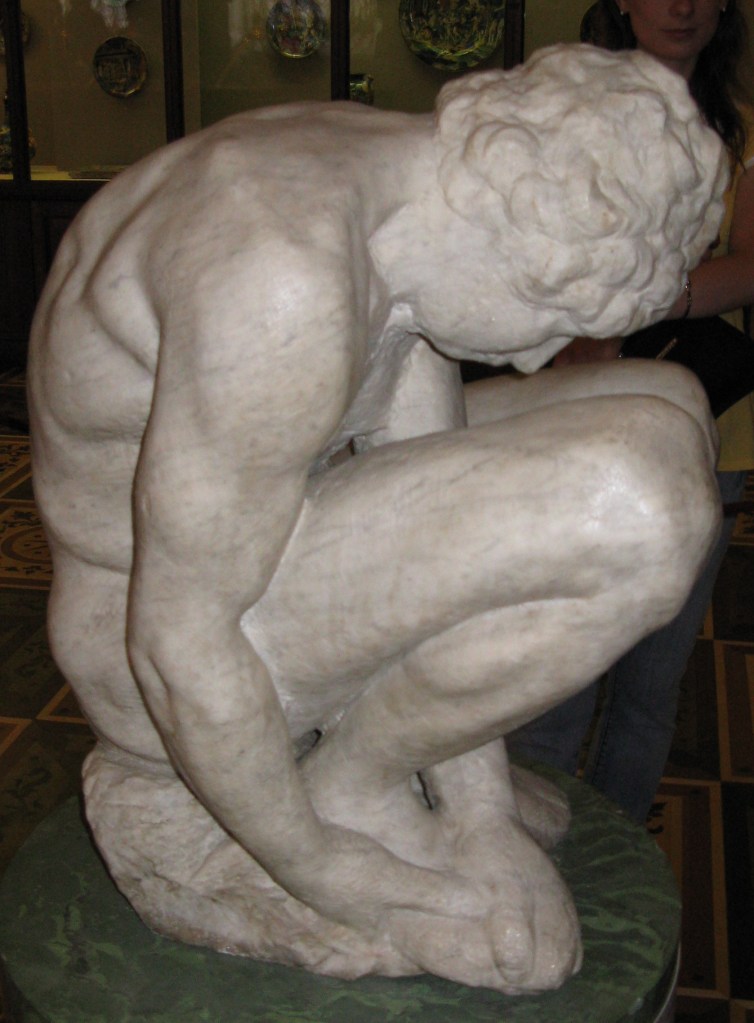
Michelangelo, Crouching Boy, 1530, The State Hermitage Museum, Saint Petersburg, Russia

Michelangelo created 42 sculptures. His Crouching Boy initially belonged to Italian banking and political dynasty Medici’s of Florence. In preliminary drawings for a double wall tomb for Lorenzo de’ Medici and his assassinated brother, Giuliano, Michaelangelo drew two crouching figures; only one was sketched in a final design. About 250 years later Crouching Boy was purchased by Russia’s Catherine the Great through a banker who did not know it was sculpted by Michelangelo. Its current home is the Hermitage Museum. If only sculptures could speak!

One interpretation is that ambiguous Crouching Boy is removing a thorn from his foot. There was a tumultuous political climate in Florence and Michelangelo was taking shelter in the monastery of San Lorenzo. Is Crouching Boy making a political statement? According to some scholars, Crouching Boy is considered an allegory of mourning – a grieving soul depicted in an unfinished marble statue in an oddly-seated position. A second opinion is that Crouching Boy is a representation of eternal youth. Take your pick.

Michelangelo led a solitary life and worked until dying at age 89. Aside from his renown as a sculptor, he was a poet. His poetry suggests that a younger man was his love interest. Whether or not he was a gay man who had to hide this fact, people in the 1500’s noticed that mostly nude men were his art form. As artist and activist Richard Kamler suggests, “Art is our one true global language…it speaks to our need to reveal, heal, and transform. It transcends our ordinary lives and lets us imagine what is possible.”

What meaning does “removing a thorn” have in today’s world? Wars are notorious for demonizing the other and for name-calling others who are not known personally. One might ask what constitutes a “thorn” today. We live in ambiguous times. Different interpretations for our global future abound.

Perhaps all of us would do well to turn to the arts. As authors Susan Magsamen (Founder/Director of the International Arts + Mind Lab at Johns Hopkins University School of Medicine) and Ivy Ross (VP of Design for hardware products at Google) eloquently write in their 2023 book, Your Brain on Art: How the Arts Transform Us, “…[the] alchemy of art and science is transforming our biology in ways that are both measurable and effective…artistic endeavors…effect beneficial outcomes for our physical and mental health…begin to create personalized arts practices. Like exercise and good nutrition, the arts on a routine basis will support your health.”    

The World Health Organization (WHO) defines mental health as a state of well-being whereby an individual realizes their own abilities, copes with normal life stresses, works productively, and is capable of making contributions to their community.

It took 35+ years to paint the ceiling of the Sistine Chapel. Perhaps you select a slightly smaller project? 

 Pearls of Peace (PoP) Quiz

 347. When have you turned to the arts for transformational time?

348. What do you notice when you are in creative mode?                              

A Bully-pulpit vs. Bullying

President Theodore Roosevelt coined the term bully-pulpit. His puzzling meaning included the fact that he knew he had a powerful leadership pulpit for advocating his agenda to a wide audience. Roosevelt wielded enthusiasm and selling power as he accomplished justice. Understanding both business and labor viewpoints, he intervened in the Pennsylvania coal strike of 1902. Promoting conservation, he expanded national parks/national forests and used executive orders to protect natural resources. His Emergency Banking Act held economic pieces together to prevent a run on banks. He held the line on monopolies. He helped establish the Food and Drug Administration to regulate food safety. His pulpit extended across the globe to make a more stable world. He fostered the building of the Panama Canal. He won the Nobel Peace Prize for his mediation skills in ending the Russo-Japanese War.

Today we have two candidates running for the U.S. Presidency who wield their bully-pulpit promises in opposite directions. Supporters sometimes are actual bullies. Name-calling in this election cycle will go down in U.S. history as winning a Most Vile Prize. A 47-year-old man said the following about his T-shirt: “I understand it’s derogatory…we can joke. We can wear crude shirts. Everybody here is having a good time.” A female vendor who sells vile T-shirts also equivocated: “I think it’s tacky but that’s what my customers want to buy, so that’s what I have.” Free speech was not intended to create laughter for some at the expense of trauma for others. How can bullying elevate a justice pulpit?

It is time for a justice reset.

A day away from Election Day, pollsters continuously arrange states’ puzzle pieces in favor of one candidate over the other. News outlets continuously question whether this group or that group will even show up to cast their sacred vote in the world’s most watched democracy.

It is time for a participance reset.

According to WBEZ’s Dan Tucker, Executive Producer of Reset, Australia handles their national elections in a far different manner from the U.S. method. Voting is mandatory in Australia. Their results seem to lead to more moderate political discussions, less voter disenfranchisement and overall, more voter trust. One only wins if one earns majority support. Wait, isn’t that what winning means? Isn’t that justice? A child understood the importance of justice in characterizing the interlocking pieces of the U.S. government.

With Australia’s voting system, no gerrymandering or voter suppression occur. To read more about the collaborative effort among WBEZ, the Chicago Sun-Times, and the University of Chicago’s Center for Effective Government, check out Democracy Solutions Project  (https://chicago.suntimes.com/democracy).

Another American Theodore, poet Theodore Roethke, penned these words: “In a dark time, the eye begins to see….” Let’s open our eyes to justice and seek higher ground in future elections. Let’s agree on one thing: “…pledge our allegiance…with liberty and justice for all.”

Pearls of Peace (PoP) Quiz 

339. Where do you see justice at the forefront in the U.S. today?

340. What ideas encourage a participatory democracy?