Creativity and Well-being

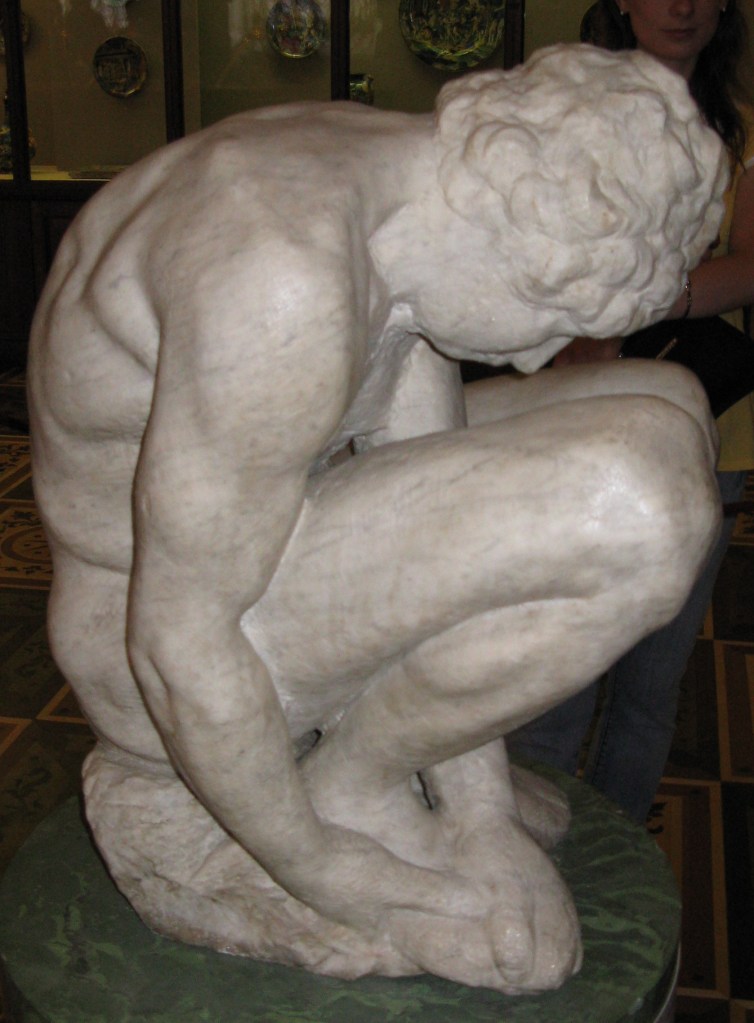
Michelangelo, Crouching Boy, 1530, The State Hermitage Museum, Saint Petersburg, Russia

Michelangelo created 42 sculptures. His Crouching Boy initially belonged to Italian banking and political dynasty Medici’s of Florence. In preliminary drawings for a double wall tomb for Lorenzo de’ Medici and his assassinated brother, Giuliano, Michaelangelo drew two crouching figures; only one was sketched in a final design. About 250 years later Crouching Boy was purchased by Russia’s Catherine the Great through a banker who did not know it was sculpted by Michelangelo. Its current home is the Hermitage Museum. If only sculptures could speak!

One interpretation is that ambiguous Crouching Boy is removing a thorn from his foot. There was a tumultuous political climate in Florence and Michelangelo was taking shelter in the monastery of San Lorenzo. Is Crouching Boy making a political statement? According to some scholars, Crouching Boy is considered an allegory of mourning – a grieving soul depicted in an unfinished marble statue in an oddly-seated position. A second opinion is that Crouching Boy is a representation of eternal youth. Take your pick.

Michelangelo led a solitary life and worked until dying at age 89. Aside from his renown as a sculptor, he was a poet. His poetry suggests that a younger man was his love interest. Whether or not he was a gay man who had to hide this fact, people in the 1500’s noticed that mostly nude men were his art form. As artist and activist Richard Kamler suggests, “Art is our one true global language…it speaks to our need to reveal, heal, and transform. It transcends our ordinary lives and lets us imagine what is possible.”

What meaning does “removing a thorn” have in today’s world? Wars are notorious for demonizing the other and for name-calling others who are not known personally. One might ask what constitutes a “thorn” today. We live in ambiguous times. Different interpretations for our global future abound.

Perhaps all of us would do well to turn to the arts. As authors Susan Magsamen (Founder/Director of the International Arts + Mind Lab at Johns Hopkins University School of Medicine) and Ivy Ross (VP of Design for hardware products at Google) eloquently write in their 2023 book, Your Brain on Art: How the Arts Transform Us, “…[the] alchemy of art and science is transforming our biology in ways that are both measurable and effective…artistic endeavors…effect beneficial outcomes for our physical and mental health…begin to create personalized arts practices. Like exercise and good nutrition, the arts on a routine basis will support your health.”    

The World Health Organization (WHO) defines mental health as a state of well-being whereby an individual realizes their own abilities, copes with normal life stresses, works productively, and is capable of making contributions to their community.

It took 35+ years to paint the ceiling of the Sistine Chapel. Perhaps you select a slightly smaller project? 

 Pearls of Peace (PoP) Quiz

 347. When have you turned to the arts for transformational time?

348. What do you notice when you are in creative mode?                              

ANGER: The Trauma Within

Le Penseur (The Poet), Auguste Rodin, 1904, Musee Rodin, Paris

Do you have anger about the Presidential election results? Perhaps your anger has other targets, but anger is rampant these days. Drivers on the expressway seem impatient and angry, cutting off their partner drivers as if broadcasting, “Watch out! Get out of my way! I’m changing lanes — whether it’s good for you or not.” This Presidential election reminds me of such drivers; voters chose a candidate with a me-first mentality, only they cannot see that they may be next to be cut off in some future way.

It’s hard to remember that anger is only a part of your personality when it feels like a dangerous drone inside your bodymind is prepped for a destructive lift-off. Whoever is in the path of anger demolition, innocent or not, watch out!

Anger is not about “the enemy within,” but the trauma within. Anger is a protective emotion. It protects our own trauma within — our fears, our grieving, our insecurities, our prejudices and other vulnerabilities we disown in our personalities. All of us have fears, grieving, insecurities, prejudices and other vulnerabilities. “Who me?” you ask. Yes, all of us.

It takes introspective reckoning to admit to all parts of one’s personality.

French Auguste Rodin created The Poet sculpture (also known as The Thinker) as one part of a large commission – Gates of Hell –– for a doorway surround in 1880. His inspiration was Dante’s 14,233-line Divine Comedy. How can it be that Dante’s opening lines in 1300 seem relevant to 2024? Well, he wrote at a time of intense political disagreement in Florence, Italy:

“Midway upon the journey of our life I found myself within a forest dark, / For the straightforward pathway had been lost. /  Ah me! how hard a thing it is to say /  What was this forest savage, rough, and stern,  /  Which in the very thought renews the fear….”

Despite its name invoking entertainment, Divine Comedy (La Commedia) is a fire-and-brimstone allegory. It depicts three layers of an afterlife – Inferno (Hell), Purgatoria, and Paradiso – for the human traveler whose life journey is one of passionate anger, resentment, love, justice and faith. There is a moral in this Early Renaissance epic poem: redemption is possible if one repents sins. Dante distinguished between a weakness-of-will sin and sins characterized by deliberate will.

If visuals interest you more than a 6-hour read, see National Gallery of Art depictions: https://www.nga.gov/stories/dante-divine-comedy-in-art.html   

Whether or not your anger feels passionate on this Veterans’ Day of painful remembrances, anger always requires our attention. I cut off weedy stalks in my garden as one way of dissipating my anger last week. Then I listened to beautiful music. Like other emotional parts of our personalities, a current anger brings up previous times we felt angry. I greeted numerous memories of anger last week. I own them and I can heal them.

Pearls of Peace (PoP) Quiz 

341. What role does anger play in your everyday life?

342. How do you greet and heal your anger in a safe manner?           

Poetry Pearls

I Dreamed I Could Fly (Porcelain), Nicholas Galanin

April is National Poetry Month. I have written a few poems over the years, but it is seldom that I take time to engage in poetry-writing classes. This weekend I immersed myself in an insight-filled and inspiring one-day poetry workshop with poet Terry Cahill. Prior to attending, I reread several of my previous poems. To my surprise, the first two poems I picked had the word “pearl” in them! One poem I wrote in 1986; the other was penned 30 years later. This latter poem’s final line holds the title of my blog, a detail only my subconscious brain retained!

Yes, I’ve admired pearls and enjoy wearing a pearl ring. A clue to my pearl attachment is my naming this blog, Pearls of Peace. I place tremendous value on the promise of peace, especially everyday peace. Final words from my first blog entry still inform me: Pearls represent a fresh start. Peace in the family, post-grief peace, and retirement peace all benefit from a fresh outlook. In these blog posts, we will explore how to string pearls of peace wherever you find yourself on your life’s odyssey.”

Word peace might even take flight to reach world peace. Here is my poem from 2016 (prior to blog initiation in 2021):

A Seashell, Tree and Me

A seashell knows how to live deep… 
A tree understands how to stretch its wings.  What about me?

A seashell gives birth to pearls… A tree harbors diverse creatures.  What about me?

A seashell lets go when the time is ripe…  A tree releases in the right season. What about me?

What shall we three release… Pearls of peace, safe harbors, And the strength of All of us — together.

Poetry is a power-filled connector; poems connect past traumas with dreamed-up futures. Poems may reflect distant memories, create a tribute to a poignant person or concept, explore fragile emotions in metaphors with incisive clarity, unleash subconscious ideation, elicit spiritual responses, serve as a bridge to creative problem-solving, or represent a cause to mobilize others. Indian poet Rabindranath Tagore inspired Indian independence through powerful poetry.

Irish poet David Whyte suggests a “good poem” is revelatory; it surprises us with new perceptions, like juxtapositioned “well-felt sadness” and “robust vulnerability.” Modern poetry loosens requirements for spacing or length or scoring the music of lines. Here are soundbites of Cahill’s wisdom: “Poetry does not need a lot of fancy words…the more concrete, the abstract comes through… the more surprised the poet is in writing a poem, the more surprised the reader will be.”  

I love how one creative high school teacher took her surprised 9th graders to a nursing home. The students and older adult residents wrote group poems. They also read their individual poetry to each other. You already might guess that I’m endorsing poetry writing as good for your brain!

Pearls of Peace (PoP) Quiz

281. When was the last time that you wrote a poem?

282. If you never attempted poetry-writing, what holds you back?    

Justice January

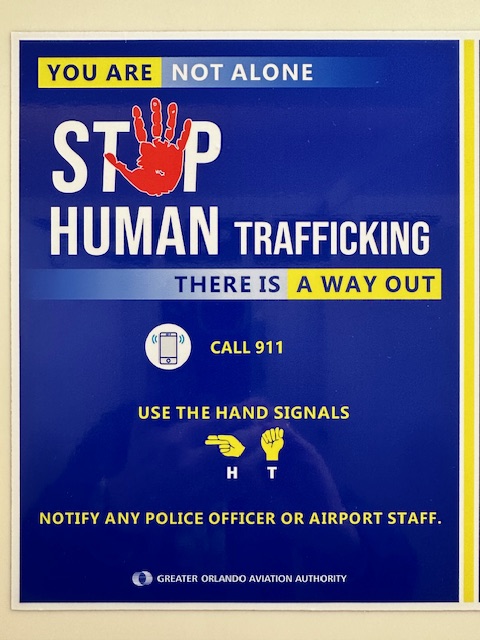
On Martin Luther King, Jr. Day, we address the dire consequences of injustice. January is Human Trafficking Prevention Month. While impossible to believe, reportedly there are 50 million modern slaves due to human trafficking today. It is estimated that 20% of trafficking victims are children. A group called Love Justice International is making a difference. With their installation of transit monitors at railway stations, bus stations, and border crossings, Love Justice looks for red flags of trafficking. The group’s efforts have intervened with 50,000 individuals before they were physically and/or psychologically exploited for their bodies or their labor. Human trafficking is a hidden and hideous crime. A language barrier and/or fear for one’s life prevents victims from asking for help.

I found signs (in English and Spanish) for victims to seek help in ladies’ bathroom stalls in airports. In Chicago there were many details about various kinds of trafficking. While many think of sex trafficking (street prostitution, massage parlor prostitution, internet pornography or “escort services”), the bathroom list of other trafficking activities is long: private home housekeepers or nannies, servile marriages, farm work, factory work (meat-packing plants), construction work, begging rings, and hotel or restaurant work. The bathroom sign also detailed having passports or identification taken away and being threatened with deportation if one refuses the work.   

The Federal Motor Carrier Safely Administration (of the Department of Transportation) requests that drivers keep their eyes open at transit sites, highway rest stops or gas stations. There are Indicator Cards to aid one in detecting human trafficking. While not all indicators would be present in every situation, these indicators could help detect a suspected trafficker and calling 9-1-1 could save a person from victimhood:

  • A vehicle dropping off/picking up individual(s) at other vehicles/trucks;
  • Flashing headlights at people in the parking lot;
  • Talk about a “commercial company” or “sale” on citizens band (CB) radio;
  • A suspicious vehicle parked in an unusual location;
  • A person told not to speak or appearing coached on what to say;
  • A person exhibiting signs of physical or emotional distress or abuse.

Human trafficking is prohibited in the 13th Amendment to the U.S. Constitution, yet justice often eludes victims. Many criminal situations are underreported, as recent migration, substance use, mental health issues, runaways or homelessness frequently accompany victimhood. And then there is the monetary factor — according to the National Human Trafficking Hotline, this is a multi-billion dollar “industry.”

While it seems that U.S. culture might rise above such sordid slavery of individuals, we have to acknowledge where we are at the present moment. I took the time to read the bathroom charts and hope that others will educate themselves about this important issue as well. Let’s follow our Constitution. Yes, Dr. King, we dream “…that one day this nation will rise up and live out the true meaning of its creed….”

Pearls of Peace (PoP) Quiz

255. How might you prevent the abuse of children in your community?

256. What steps can you take to recognize labor trafficking?