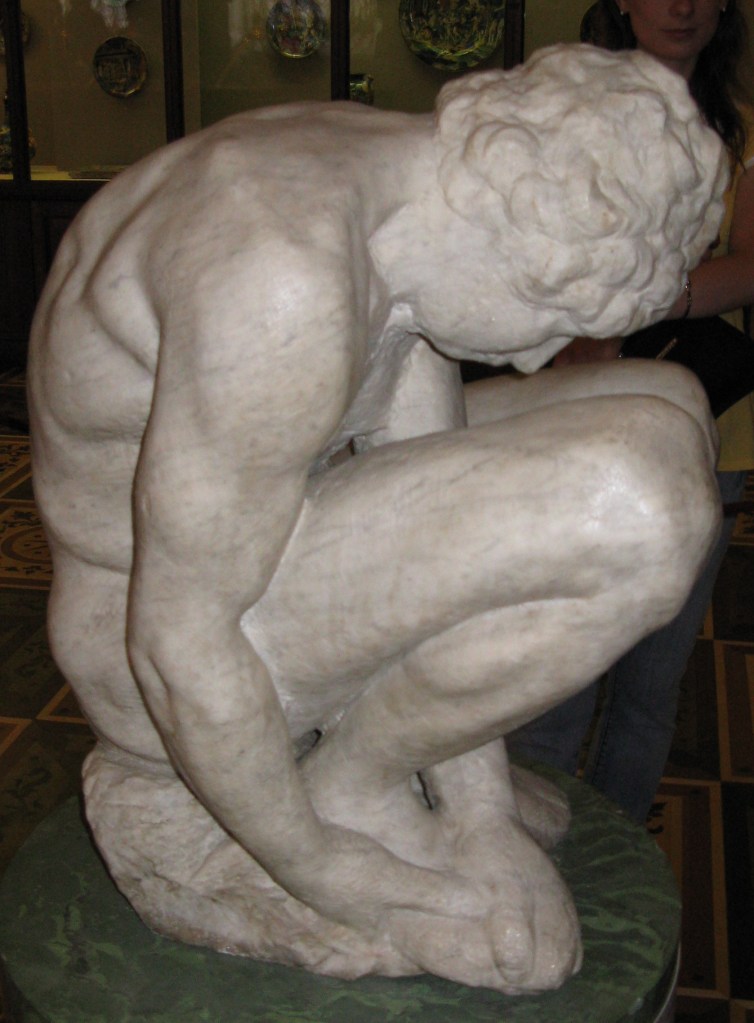
Michelangelo created 42 sculptures. His Crouching Boy initially belonged to Italian banking and political dynasty Medici’s of Florence. In preliminary drawings for a double wall tomb for Lorenzo de’ Medici and his assassinated brother, Giuliano, Michaelangelo drew two crouching figures; only one was sketched in a final design. About 250 years later Crouching Boy was purchased by Russia’s Catherine the Great through a banker who did not know it was sculpted by Michelangelo. Its current home is the Hermitage Museum. If only sculptures could speak!
One interpretation is that ambiguous Crouching Boy is removing a thorn from his foot. There was a tumultuous political climate in Florence and Michelangelo was taking shelter in the monastery of San Lorenzo. Is Crouching Boy making a political statement? According to some scholars, Crouching Boy is considered an allegory of mourning – a grieving soul depicted in an unfinished marble statue in an oddly-seated position. A second opinion is that Crouching Boy is a representation of eternal youth. Take your pick.
Michelangelo led a solitary life and worked until dying at age 89. Aside from his renown as a sculptor, he was a poet. His poetry suggests that a younger man was his love interest. Whether or not he was a gay man who had to hide this fact, people in the 1500’s noticed that mostly nude men were his art form. As artist and activist Richard Kamler suggests, “Art is our one true global language…it speaks to our need to reveal, heal, and transform. It transcends our ordinary lives and lets us imagine what is possible.”
What meaning does “removing a thorn” have in today’s world? Wars are notorious for demonizing the other and for name-calling others who are not known personally. One might ask what constitutes a “thorn” today. We live in ambiguous times. Different interpretations for our global future abound.
Perhaps all of us would do well to turn to the arts. As authors Susan Magsamen (Founder/Director of the International Arts + Mind Lab at Johns Hopkins University School of Medicine) and Ivy Ross (VP of Design for hardware products at Google) eloquently write in their 2023 book, Your Brain on Art: How the Arts Transform Us, “…[the] alchemy of art and science is transforming our biology in ways that are both measurable and effective…artistic endeavors…effect beneficial outcomes for our physical and mental health…begin to create personalized arts practices. Like exercise and good nutrition, the arts on a routine basis will support your health.”
The World Health Organization (WHO) defines mental health as a state of well-being whereby an individual realizes their own abilities, copes with normal life stresses, works productively, and is capable of making contributions to their community.
It took 35+ years to paint the ceiling of the Sistine Chapel. Perhaps you select a slightly smaller project?
Pearls of Peace (PoP) Quiz
347. When have you turned to the arts for transformational time?
348. What do you notice when you are in creative mode?


How timely, Jan! About 10 weeks ago I took my first drawing class. Although I was the only true beginner in a class of advanced students which was quite humbling, I learned a lot!
Most importantly, I learned that I love to draw. Drawing brings me so much joy, and now, I’m rarely without my sketch book. It has added a tremendous outlet for my racing brain and helps me slow down and appreciate peace and quiet! It’s funny how the universe speaks isn’t it?
Thanks for another great post!
Maribeth
Sent from my Verizon, Samsung Galaxy smartphone
Get Outlook for Androidhttps://aka.ms/AAb9ysg
LikeLike