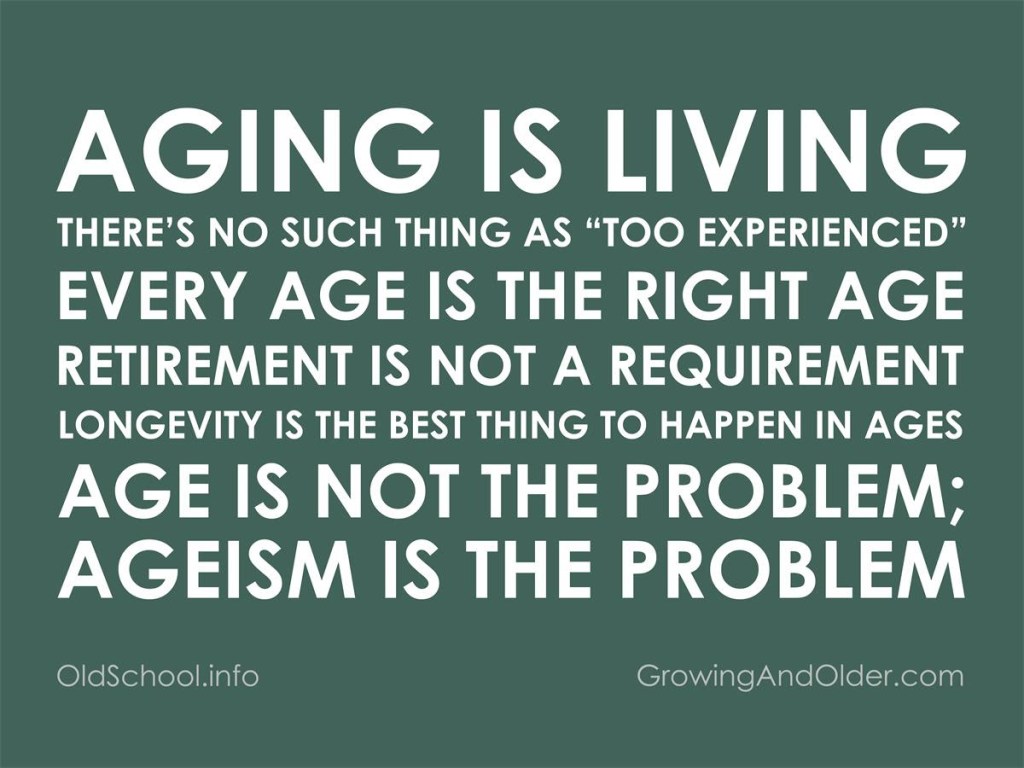
Ageism Awareness Day is October 9. The American Society on Aging (ASA) Ageism & Culture Advisory Council has a Fact Sheet for those who want more details on ageism: https://asaging.org/wp-content/uploads/2025/09/Ageism-Awareness-Day-Fact-Sheet-2025.pdf
Ageism is common and yet overlooked as one of the most socially accepted forms of prejudice. A poll reported that 82% of adults in ages 50-80 experience ageism words or actions daily. And to make matters worse, we often are ageist about ourselves! Other highlights from the ASA report include these issues:
- Ageism covers people of many ages, both as recipients of prejudice and offenders of prejudice.
- By age 3 children pick up age stereotypes.
- Ageism refers to stereotypes (how we think), prejudice (how we feel) and discrimination (how we act) toward others — or ourselves — based on age.
- Cultural ageism slips into our movies, literature, songs, news reporting, and especially our jokes.
- One research study found that a mere 1.5% of the characters on TV in the U.S. are older adults. If present, they tend to have minor roles and/or are portrayed in stereotypic ageist behavior.
- Ageism is even more prevalent when it intersects with racism, sexism and ableism.
- Those who experience multiple forms of ageism are reported to have more chronic health conditions and depression.
- Ageism has economic implications; AARP estimates that $850 billion in lost gains to the CDP results from involuntary retirement, underemployment, and unemployment in older adults.
- Older adults support the U.S. economy; ages 50+ support over 88 million jobs (through jobs they hold or create).
- More than half of small business owners are 50+ years old.
- Work contributions of older adults are overlooked: caregivers ages 65+ are often unpaid caregivers for their family, friends or neighbors.
- In 2022 data, 1.1 million grandparents ages 60+ were providing most of the basic care of grandchildren living with them.
- Older adults have longer periods of unemployment, face discrimination during the hiring process, and receive fewer professional development possibilities.
- 64% of older workers report age discrimination in their place of work.
- In one study 1 out of 5 adults over 50 experienced discriminations in their healthcare settings.
- There are few geriatricians treating the older adult population; the average salary for a geriatrician is half of the salary for an anesthesiologist, cardiologist, or radiologist.
- Medication-related problems are estimated to be one of the top 5 causes of death in older adults.
I have experienced ageism and while I know about the unconscious bias that exists in the U.S., it is still unsettling as I feel useful, not over-the-hill. I like author and poet Gertrude Stein’s approach: “We are always the same age inside.” Her statement can be taken in many ways, but there is a timeless quality to believing in a core self with an ability to have consciousness to each present moment. There are positive possibilities when we embrace age-inclusion.
Pearls of Peace (PoP) Quiz
434. Have you experienced ageism lately?
435. What do you say when you hear ageism bias tossed into conversations?

 Pearls of Peace: A Family Psychologist’s Circle-of-Life Blog