
Time for a Personality Lift?

“Active Aging Week” (October 5-11 this year) was initiated by the International Council on Active Aging to promote free wellness activities in organizations for those 50+ with a goal of reaching as many older adults as possible. Suggestions include group walks, group exercise classes such as yoga, and health-related classes like prevention of falling. Sponsors for programming include Humana, Abbot, and LeadingAge, a national advocacy group of 5300 nonprofit service providers serving older adults. “Active aging” includes recognizing that many older adults are active contributors to society.

Ageism Awareness Day (October 9) is sponsored by the American Society on Aging to reinforce a realistic view of aging. For many, there is a bias against rising numbers of older adults. Perhaps Americans are in need of a “personality lift.”

Ageism often misrepresents the facts. Ageism has 3 components:

  • Stereotypes (how we think),
  • Prejudice (how we feel), and
  • Discrimination (how we act) toward others or ourselves, often based on one’s numerical age. 

Psychotherapist and spiritual writer Thomas Moore writes in Ageless Soul, “When people think of keeping their youth as they age, they often think too physically, materially, and literally. They get face-lifts but not personality lifts.”

Yes, youth is prized in American culture. And yes, facelifts are a “thing;” according to the American Society of Plastic Surgeons; as many as 230,000 full and partial facelifts happen each year in the U.S., as well as increasing numbers of facial fat grafting and neck lifts.

We need to break ageist, sexist, racist, and gender bias stereotypes in America. There is backlash from younger workers about Social Security payments provided for seasoned citizens (my label). It is not well known how much older adults support our economy and are key caregivers. Nearly 69% of U.S. grandparents (estimated at 65 million) provide some kind of childcare or support for their grandchildren. Approximately 2.07 million grandparents are the mainstay for raising their resident grandchildren. Almost a third of older adults identifying as LGBTQIA+ are providing care to a friend.

The number of people older than 75 in the labor force is estimated to be 10.1% in 2026. Recent AARP data indicate that adults 50+ produce $12.5 trillion in economic activity. However, most white-haired adults are not wealthy. In 2022, nearly 1 in 10 individuals ages 65 and older (approximately 5.9 million) lived below the poverty level. Many grandparent caregivers (60%) are in the workforce to make ends meet. It is a sad truth that the poverty rates are higher for African American, Asian and Hispanic older adults than non-Hispanic white older adults.

Let’s ask ourselves to notice when we are in discrimination territory. Stereotypes are so prevalent today in America that I am afraid we mostly do not notice. Your critical personality part often is a misguided protective attempt. Is your critic operating in overdrive? Personalities need tune-ups more frequently than cars.

Pearls of Peace (PoP) Quiz

540. When do you catch yourself being ageist/sexist/racist/gender-biased?

541. What are your own needs for a personality lift?                      
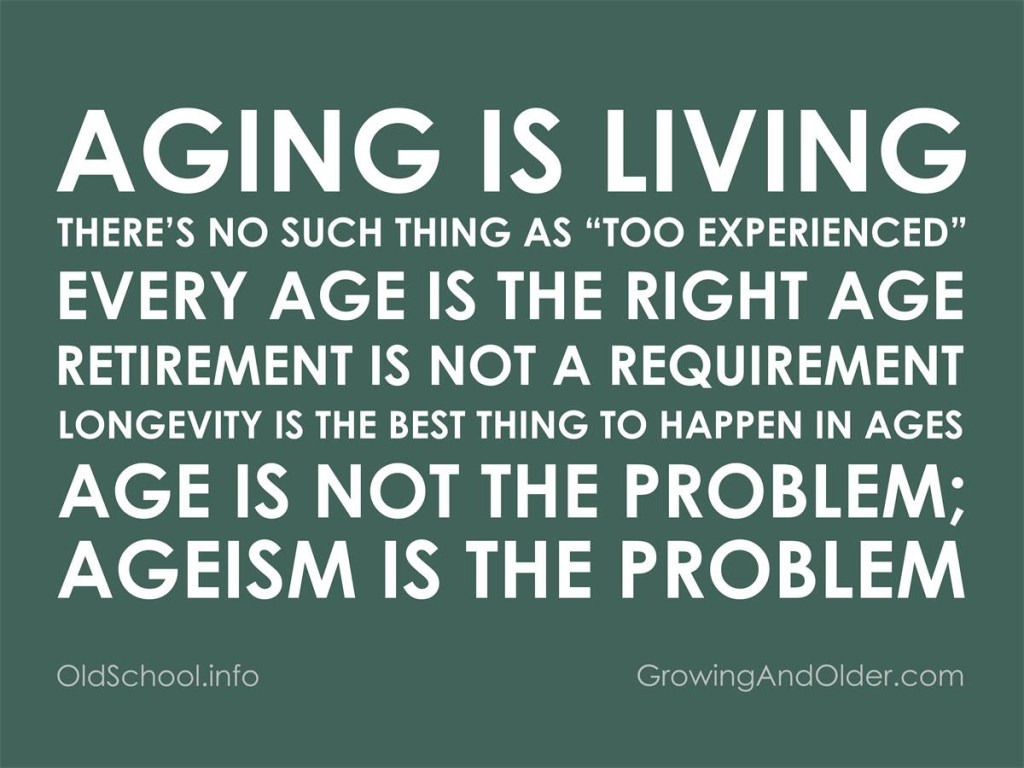
Age-inclusion Please

Ageism Awareness Day is October 9. The American Society on Aging (ASA) Ageism & Culture Advisory Council has a  Fact Sheet for those who want more details on ageism: https://asaging.org/wp-content/uploads/2025/09/Ageism-Awareness-Day-Fact-Sheet-2025.pdf

Ageism is common and yet overlooked as one of the most socially accepted forms of prejudice. A poll reported that 82% of adults in ages 50-80 experience ageism words or actions daily. And to make matters worse, we often are ageist about ourselves! Other highlights from the ASA report include these issues:

  • Ageism covers people of many ages, both as recipients of prejudice and offenders of prejudice.
  • By age 3 children pick up age stereotypes.
  • Ageism refers to stereotypes (how we think), prejudice (how we feel) and discrimination (how we act) toward others — or ourselves — based on age.
  • Cultural ageism slips into our movies, literature, songs, news reporting, and especially our jokes.
  • One research study found that a mere 1.5% of the characters on TV in the U.S. are older adults. If present, they tend to have minor roles and/or are portrayed in stereotypic ageist behavior.
  • Ageism is even more prevalent when it intersects with racism, sexism and ableism.
  • Those who experience multiple forms of ageism are reported to have more chronic health conditions and depression.
  • Ageism has economic implications; AARP estimates that $850 billion in lost gains to the CDP results from involuntary retirement, underemployment, and unemployment in older adults.
  • Older adults support the U.S. economy; ages 50+ support over 88 million jobs (through jobs they hold or create).
  • More than half of small business owners are 50+ years old.
  • Work contributions of older adults are overlooked: caregivers ages 65+ are often unpaid caregivers for their family, friends or neighbors.
  • In 2022 data, 1.1 million grandparents ages 60+ were providing most of the basic care of grandchildren living with them.
  • Older adults have longer periods of unemployment, face discrimination during the hiring process, and receive fewer professional development possibilities.
  • 64% of older workers report age discrimination in their place of work.
  • In one study 1 out of 5 adults over 50 experienced discriminations in their healthcare settings.
  • There are few geriatricians treating the older adult population; the average salary for a geriatrician is half of the salary for an anesthesiologist, cardiologist, or radiologist.
  • Medication-related problems are estimated to be one of the top 5 causes of death in older adults.

I have experienced ageism and while I know about the unconscious bias that exists in the U.S., it is still unsettling as I feel useful, not over-the-hill. I like author and poet Gertrude Stein’s approach: “We are always the same age inside.” Her statement can be taken in many ways, but there is a timeless quality to believing in a core self with an ability to have consciousness to each present moment. There are positive possibilities when we embrace age-inclusion.

Pearls of Peace (PoP) Quiz

434. Have you experienced ageism lately?

435. What do you say when you hear ageism bias tossed into conversations?