Pearls of Pride

The definition of “pride” today is “a feeling that you respect yourself and deserve to be respected by other people.” This has a different connotation from an older definition which meant “inordinate self-esteem.” Likewise, our definitions of personhood are evolving.

The first Pride march in New York City took place 6-28-1970, one year after Stonewall Inn, a Greenwich Village gay bar, was raided by NYPD. Violent demonstrations followed. Stonewall became a rallying call, creating a turning point for gay rights. Pride Month was recognized nationally by President Clinton in 1999 and later endorsed by President Obama. Month-long activities highlight the courage and contributions of lesbian, gay, bisexual, transgender, queer, intersex, and asexual (LGBTQIA+) individuals.

Everyone’s story is unique. Here is one story.

Gender Magic (2023) is the book that Mx. Rae McDaniel wished they might have had as a guide when they were young. Growing up with missionary parents was challenging for this adopted child. The following words convey McDaniel’s extreme discomfort: “The journey to my nonbinary identity was like discovering I’d been walking around in shoes a half size too small. Until I was almost 30, I didn’t notice how uncomfortable and constricted I felt in my assigned gender as a woman, but after decades limping around with blisters, my cramped toes screaming for relief, something had to give.”

According to the National Library of Medicine, it is impossible to know the population size of transgender individuals in the U.S. The Census Bureau has a don’t-ask-don’t tell approach to gender- identity differences. A study searched the Cumulative Index to Nursing and Allied Health literature and estimated 1 million adults nationally are transgendered individuals.

Further study results are frightening. According to a 2008 national survey, transgender individuals were 4 times more likely to live in poverty with twice the rate of unemployment and homelessness: 28% postponed medical care due to discrimination. More traumatic, 41% attempted suicide.    

Research (June, 2022) by the Pew Research Center reports that 1.6% of U.S. adults are transgender or nonbinary; their current gender identity and assigned-at-birth sex differ. Younger adults (under age 30) are more likely to report being trans or nonbinary: 2.0% under 30 are a trans man or trans woman, while 3% identity as nonbinary which means they are neither man nor woman (or are not strictly one or the other). The American Psychological Association explains: “Transgender people, like cisgender people, may be sexually oriented toward men, women, both sexes, or neither sex.”

Those of us who do not question our gender and/or sexual identity are not as accepting of differences as we might be.  Physician and poet Jeremy Nobel (Project UnLonely: Healing our Crisis of Disconnection) has pertinent advice: let’s accept each other as “who we are and welcome hearing their story.”   

Pearls of Peace (PoP) Quiz

299. What is your experience in fostering inclusiveness for those who identify differently from you?                       

300. How might you foster cultural connotations that are inclusive of all people?    

Wear Orange: Hunt for Peace

Hostility is a trainload of energy that can go off-track. Wear Orange Weekend (June 7-9) commemorated victims and families of gun violence, which can derail entire communities. One estimate is that 120 individuals are shot and killed every day in America (with twice as many suffering wounds from gunfire).

The U.S. movement of Wear Orange began in 2013 after the tragic killing of 15-year-old Hadiya Pendleton, a student at King College Prep High School. She was shot in the back while standing with friends on a Chicago playground only one week after marching in President Obama’s inaugural parade. The 18-year-old gunman was sentenced to 84 years in prison, admitting that Hadiya was not the intended “target.”

Hadiya’s friends began honoring her life by wearing orange, the vibrant color worn by hunters to alert other hunters that they share space in the woods. It seems unbelievable but guns lead as the cause of death among American children and teens.

Prominent psychologist Abraham Maslow was asked a question in a 1968 magazine interview for Psychology Today: “If a …young psychologist came to you today and said, ‘What’s the most important thing I can do in this time of crisis?’ what advice would you give?”  Maslow replied: “I’d say: Get to work on aggression and hostility. And we need it now…time is running out. A key to understanding the evil which can destroy our society lies in this understanding.” 50+ years later we still are not addressing aggression and hostility with enough urgency.

While June 7th, Hadiya’s birth date, was the 10th National Gun Violence Awareness Day, June 8th was named National Best Friends Day by the U.S. Congress in 1935. Enthusiasm for the day has waned, but we need affirming friendships more than ever. I wonder if those who take another’s life have any best friends.

According to National Today’s survey of 1000 adults (https://nationaltoday.com/national-best-friends-day/), 19% named their dog as their best friend and 9% named their cat. When asked if they had a best friend, 15% answered no. Happily, many reported that they do not have only one best friend!

Primary-care physician and poet Jeremy Nobel authored Project UnLonely: Healing our Crisis of Disconnection (2023). His words might apply to individuals who shoot people: “When we are too lonely for too long, the way we make sense of the world changes, leaving us increasingly at risk for even greater loneliness. We fail to thrive and flourish, we get sick, we spread the affliction to others, and we die before our time.”

What signals violence ahead? There are many tracks that can lead to gun violence, but the most powerful predictor of future violence is a history of violent behavior according to the American Psychological Association. We must “get to work” on prevention.  Let’s address the needs of young children and their parents. Let’s hunt for peace.    

Pearls of Peace (PoP) Quiz

297. Is your best friend an animal?

298. Do you know anyone who seems disconnected and needs friendship?  

Writing Pearls

Illinois Women’s Press Association (IWPA) hosts a contest for writers, both professional writers and beginning writers in high school. I became a member after re-reading Natalie Goldberg’s wonderful book, Writing Down the Bones, and realizing that I too might call myself a writer even though I had only “morning pages” under my writing belt. Goldberg received sage advice from a Zen master: “Why do you come to sit meditation? Why don’t you make writing your practice? If you go deep enough in writing, it will take you everyplace.”

Yes, writing takes one everyplace. In 1995 I fell down steep stairs in Chicago on the eve of taking my firstborn to college. Unable to hobble much in my cast, I slowed down. I began writing “morning pages” according to journalist and film/TV writer Julia Cameron’s inspiring book, The Artist’s Way: A Spiritual Path to Higher Creativity. I did not imagine that later I would publish three developmental psychology books and create a weekly blog, Pearls of Peace. The word “blog” was not invented until Jorn Barger coined “weblog” in 1997; Peter Merholz reduced the concept to “blog” in 1999.  

Goldberg is strictly a pen-and-notebook (of a special kind) writer. She prefers writing in a café. I can take notes and write poems with a pen, but I prefer the keyboard at my desktop computer for books and blogs. Classical music is my companion when I write, not extraneous conversation. Reportedly, Ernest Hemingway wrote naked at a lectern. He used a pencil but switched to typing for dialogue. Each writer develops their own writing style.

Cameron wrote her “morning pages” for decades; in a lecture she commented that writing is a way to “zip up a concern.” She believed she was writing her 1992 Artist’s Way for “about 5 people.” She was shocked when 5 million copies sold! I do not have this following, but the people who do read my writing give me compassionate feedback. However, we writers are most in need of saying something when we take our pen or keyboard to hand. Among others, Cameron believes that we teach what we need to learn ourselves.

I feel lucky to discover the stimulation of writing in an encore career. I feel lucky to receive awards from my two submissions to the 2024 IWPA Mate E. Palmer Communications Contest:

  • First Place in Web & Social Media Blog, Nonprofit (Government or Educational), IWPA 2024 – “Banned Pearls” (online 10-2-23) 
  • First Place in Non-Fiction Books for Adult Readers, IWPA 2024 – Transforming Retirement: Rewire and Grow Your Legacy (published 2023)

The best part of the Award luncheon was hearing high school writers’ enthusiasm for their craft! I recommend writing at every age. Take Hemingway’s advice: All you have to do is write one true sentence. Write the truest sentence that you know.” My advice? Write a second sentence. Keep writing.

Pearls of Peace (PoP) Quiz

295. What kind of writing engages you?

296. Is there a type of writing you would like to begin?   

Seasonal Pearls

What color are your pearls? Hint: my interest is in your figurative pearls.

Perhaps Sister Joan Sauro’s words will explain: “There is a pearl in every season. Find it. Then give all you have to claim it” (Whole Earth Meditation: Ecology for the Spirit).

May is a busy month for addressing important populations within the U.S. In addition to May’s Asian American, Native American, Native Hawaiian, and Pacific Islanders Heritage Month (see “Hula Pearls,” 5-6-24) and America Mental Health Awareness Month (see “Synergy for Mental Health,” 5-13-24), May also is Older Americans Month. Some individuals relate to all 3 of these populations.

Numbers of older adults coping with depression range from 7.7% (adults 50+) to an estimated 31% in some groups (ages 65+). Older adults’ symptoms of depression may not be recognized by their physicians. Compounding caretaking, older adults may view mental health help as a stigma, especially in non-English speaking individuals.

A population bumper crop of older adults is ripening: it is estimated that 4.1 million Americans will reach age 65 every year from 2024-2027. Reportedly, more than 11,200 Americans turn 65 every day (The Alliance for Lifetime Income). Regardless of exact numbers, depression, anxiety and loneliness plague too many older adults.

An exciting program to address this looming population, created 20 years ago at the University of Washington in Seattle, Program to Encourage Active, Rewarding Lives (PEARLS) coaches older adults to be proactive about their wellbeing. Depression is defined in everyday examples by coaches for participants (identified in community organizations); problem-solving skills are taught to enable self-sufficiency for more active lives. The free program takes place in homes or preferred community settings. Online PEARLS began during the pandemic. One-hour sessions for 6-8 weeks (over 4-5 months) start with each person’s daily routines of “where they are.” Coaches have supervision with mental health practitioners. PEARLS coaching has reached adults across 26 states, including our Memorial Day veterans, people of all ages with disabilities, and especially those 65+.

American education is not forward-thinking regarding older adults. My doctoral program in counseling psychology had courses on childhood, adolescent development, and psychology of young adults, but no specific coursework on midlife (since identified as ages 35-64) or gerontology.  Relatively few colleges and universities offer a gerontology major, despite a growing need. Of the 5 institutions graduating the most students in gerontology, 89.9% are females. We need more compassion and creativity in our thinking about seasoned citizens.

Recently I was asked to talk about creativity enhancing aging on a podcast, “Older Women and Friends” (interviewed by host Jane Leder). Check it out:  https://www.buzzsprout.com/2054889/15102414  

Seasonal growth is important at every age, but retirement age is a reminder that our true wealth consists of time, how positively we spend it, and bodymind health. Let’s meet aging with colorful pearls of creativity!

Pearls of Peace (PoP) Quiz

293. What season of your life has been your most creative time?

294. What about now?          

Unmet Needs

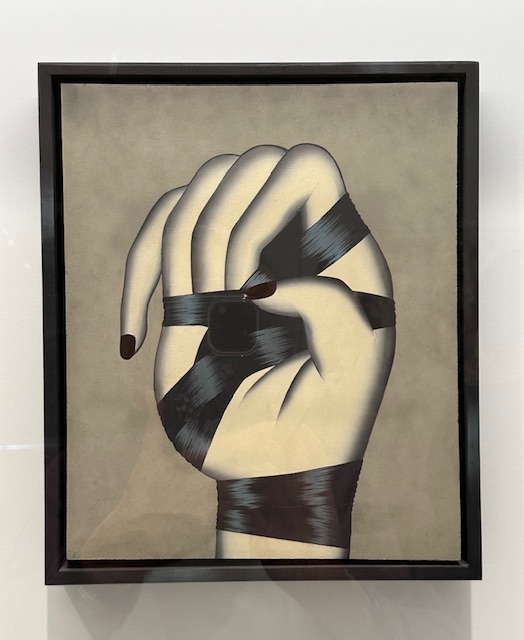
Bound Hand, 1973, Christina Ramberg

If you can visit The Art Institute of Chicago before August 11th, do not miss the exhibit, “Christina Ramberg: A Retrospective.” In 2025 the Ramberg exhibit travels to art museums in L.A. and Philadelphia.

Ramberg was a devoted artist; she drew, painted, sewed, quilted, and compiled scrapbooks. Her sometimes-edgy art without faces (and only parts of a body represented in each production) leaves much open to interpretation. Everyone flies their own perceptions into any piece of art, but with unsettling cut-offs there is a provocative quality to Ramberg’s work. What was she thinking as she cropped her art? She once answered this question about a corseted headless-legless woman. The curvy mid-section was bent over; Ramberg recalled watching her mother wriggle into tight undergarments to cinch her waist, popular in women’s fashion in the 50’s. The restraints suggested in cut-off torsos were further emphasized with subdued colors.

Here is what grabbed me when I first saw Ramberg’s Bound Hand. I use my hand to teach people about 5 basic needs. Partly as a mnemonic, and partly as a visual representation of what is at hand for us daily, my 5 EDCBA basic needs (as illustrated on a hand or drawn on a handprint) provide a handy chart. Consider how you meet this handful: Energy (thumb), Discipline (index finger), Creativity (middle finger), Belonging (ring finger) and Ability (little finger).    

These needs are not hierarchical, but ideally are interdependent and flow into one another, grounded in a core self. Your met needs are a collaborative effort for your wellbeing. However, the daily-needs story gets complicated when needs are unmet; it is challenging when you are confronted by others trying to meet different needs (or disagreeing with how you meet needs). Bound-up needs stifle one’s equality and growth.

As insightful writer Ann Patchett writes in These Precious Days: Essays, “People want you to want what they want. If you want the same things they want, then their want is validated. If you don’t want the same things, your lack of wanting can, to certain people, come across as judgment.”

Despite critiques, Ramberg (1946-1995) kept evolving her creativity, although her life was cut short by Pick’s disease (frontotemporal dementia). Her creativity is contemporary in its cropped views of both femininity and masculinity. The headless-legless male and female torsos are riveting.

Ramberg frequently visited garage sales and flea markets where she collected the 155 dolls mounted on one wall of the exhibit. The dolls (some headless) represent ethnic, racial, and gender stereotypes. Ramberg said this about Doll Wall: “I was only interested in the dolls that had been owned by someone. The ones where the face was worn off and redrawn in, or where something very strange had transpired…I’m interested in what is implied. And the simple fact that they had a life.”

Let’s embrace life. Who needs wars?

Pearls of Peace (PoP) Quiz

291. What (if any) are your unmet needs?

292. How do you meet your need for creativity?

Synergy for Mental Health

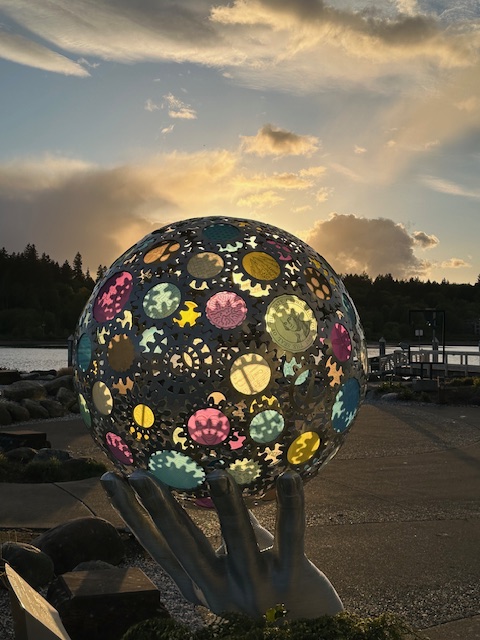
“Cognitive Synergy” by Bill Frymire, Olympic, WA

The word synergy comes from Attic Greek sunergos meaning “working together.”

May is America’s Mental Health Awareness Month. In the UK Mental Health Awareness Week is May 13-19 with this year’s theme of “Movement: Moving More for our Mental Health.” I like this emphasis on the whole body working together in movement.

I watch flowers in my spring garden moving together in a constant tableau. It was just yesterday that Virginia Bluebells were a flowing drift of dainty blue flower blooms swaying in the breeze. We also are equipped to bloom and thankfully, most of us have a longer bloom time than spring ephemerals. Today the bluebells are wilting; soon their greenery will disappear and go dormant after flowering and dispersing seeds. Moving into bloom where my bluebells reigned are False Solomon’s Seal perennials with their tiny white stars at the top of flagpole stems.

People wilt for a variety of reasons. It is not easy to be physically and mentally healthy every season. Children especially struggle with conditions that go unnamed for years, often not finding helpful ways to cope until adulthood.                                                             

American songwriter, mixed-media artist and writer Morgan Harper Nichols only received her diagnosis of autism, ADHD, and sensory processing disorder at age 31. She began creating art and poetry as responses to social media messages. Nichols bloomed with her art creating “room to breathe.” She moved her talent in the direction of sharing what she believes is helpful to others:

“Inhale, exhale. Never forget the green lights, stop signs and highways that brought you here. Every single step accounted for, even though you can’t see where the road leads, what matters is that you travel not in pursuit of knowing it all, but in pursuit of boundless peace” (How Far You Have Come).

Nichols initiated a project of sending personalized letters to strangers, making a lifetime goal to compose a million poems to strangers! She invites individuals to share their story with her on her website. She replies to them sending visual art with a letter of encouragement. There are no fees. She keeps names anonymous. Her daily practice of synergistic generosity is a powerful example of her blooming and dispersing seeds of hope. Nichols is completing her MFA (in Interdisciplinary Media Arts) as she works on an online conversational-focused game.

“Art is made in hindsight,” claims Virgil Abloh, fashion designer. Or as Nichols penned, “One day, you will look back and see that all along, you were blooming.”

To keep blooming go to https://www.samhsa.gov/mental-health-awareness-month/toolkit and https://www.nami.org/get-involved/awareness-events/mental-health-awareness-month/ for activities in mental health synergy.

Synergy is “the interaction or cooperation of two or more organizations, substances, or other agents to produce a combined effect greater than the sum of their separate effects.” Springtime is an excellent time for all of us to move together in the growing of mental health for all.

Pearls of Peace (PoP) Quiz

289. When is a time in your life when you were wilting?

290. What did you do to re-bloom?    

Hula Pearls

On 4-30-24 President Biden named May as Asian American, Native American, Native Hawaiian, and Pacific Islanders Heritage Month. This year marks the 25th year of the White House Initiative and President’s Advisory Commission on Asian Americans (AA), Native Hawaiians, and Pacific Islanders (NHPI) recognizing government workers in these communities who further equity, opportunity, and justice for their people. Biden’s current actions include creating a memorial to honor 10,000 Japanese Americans who received unjust treatment in internment camps during World War II, providing $22 billion in loans to AA and NHPI entrepreneurs, as well as backing Maui after horrific wildfires devastated a town on this Hawaiian Island.

It is tragic that hate crimes are on the rise against those of AA and NHPI ancestry post-pandemic. Thankfully, there was bipartisan support for the 2021 COVID-19 Hate Crimes Act sponsored by Senator Mazie K. Hirono of Hawaii. In addition to respecting people in the U.S., we also need more respect for the sacred lands, cultures, and traditions of our diverse population. America is a country built on the backs of immigrants and subscribing to the noble notion that all are created equal.

I was privileged to learn about Pacific Islander cultures at Polynesian Cultural Center on O’ahu in April. Each tropical island has special traditions. I learned that hula dancing may have origins in Tahiti (Ori), but Hawaii possesses a major hula claim. The Big Island, O’ahu, Kauai, and Molokai all proclaim having the first hula dancers. Some argue that Navigator Goddess Laka first danced hula on Molokai. Others give Goddess Hi’iaka credit (creating hula for her sister, Pele). Still others say Kapo’ulakina’u, Goddess of Fertility, was the first dancer. Notice that these stories have a goddess theme. Hula hand movements tell a story, often honoring deities, chiefs, and/or ancestors. Today there are few grass skirts, but colorful costumes and flower crowns for one’s hair are still a traditional nod.

Prior to the 1820’s Hawaii had no written language, but male and female hula dancers handed down cultural stories. Originally a sacred dance, hula dancers might celebrate deities for certain moon times, perform at ceremonies, or announce a child’s birth. When Christian missionaries arrived in 1820, church folks were so distressed by what they did not understand that they convinced Christian convert Queen Ka’ahumanu to outlaw hula dancing; however, the tradition survived with dancers performing traditional rites in private. Upon the Queen’s death, hula resurfaced.

When King David Kalakaua (aka Merrie Monarch) was crowned in1883, he brought hula into the open by making it part of his two-week coronation celebration. Unfortunately, hula was banned again after the next ruler, Queen Lili’uokalani, was overthrown by American businessmen in 1893. It was almost 100 years before hula dancing returned in government celebrations.                                

What does it mean to a people when their traditions are deemed unacceptable?

Pearls of Peace (PoP) Quiz

287. What cultural traditions do you maintain in your family?

288. When has a tradition from your ancestors been dropped from usage?  

Pearls of Purpose

“Another world is not only possible, she is on her way. On a quiet day, I can hear her breathing.” Writer Arundhati Roy

It is easier to believe this hopeful thought when one is surrounded by Mother Nature’s beauty — especially in a fertile atmosphere like Hawaii where my nephew and fiancée live and married this weekend. The wedding took place on a working ranch under a canopy of banana trees with a rocky mountain peak for a chapel steeple. As part of the ceremony, a tree sapling was placed between the couple as they held a pot of soil with a trowel. They jointly scooped soil into the tree. They will plant it at one of their ecological volunteer sites.

Earlier in Wedding Week the bridal party of 14 attendants joined family members for a volunteer activity at a non-profit 405-acre farm near the Ko’olau Mountains. Forming a long line across a trough of watery planting area, we stomped in thick mud to even the planting bed for the next taro crop. With mud halfway up to our knees, we encountered a few rocks underfoot. It was a literal slippery slope when leaning over to pull weeds growing in rich mud. Taro grows on a rotating basis to produce a constant food source. Much  produce from this farm goes to the local community living outside of tourist areas. If one does not visit rural Hawaii with its dirt roads, an opportunity for cultural understanding is lost. However, most tourists may taste taro at any luau or buffet meal as taro (karo) is a staple food in O’ahu.

The newlyweds are regular volunteers at Kako’o Oiwi, along with some of their friends who were wedding guests. These young adults feel a strong commitment to both helping sustainable food efforts and partnering with Hawaiian people preserving their culture. They find a dedicated purpose in volunteerism alongside their careers. Psychologist William Damon, professor at Stanford, defines the power of purpose (The Path to Purpose). When one’s skills meet the needs of the world, purpose becomes like a chemical reaction. In identifying something in one’s environment where improvement is necessary, the volunteer also identifies aspects of their skillset that make a contribution, such as leadership or creativity. A synergy develops as a win-win opportunity for both recipient and volunteer.

Damon finds that individuals begin their pursuit of purpose in their 20’s and 30’s. While career and family often are at the center, he adds volunteerism as bringing purpose to many individuals. Making a difference in the world is good for people! However, in one survey only 30% of individuals ages 50-92 reported feeling purposeful. Older adults may feel a loss of identity when they leave their careers without cultivating other purposes in life.

In an earlier book, Greater Expectations: Overcoming the Culture of Indulgence in Our Homes and Schools, Damon suggests that child-rearing that is predominantly focused on a child-centered philosophy does not prepare youth for moral maturity and competence: “Less is expected of the young, and in turn less is received.” I find that the same thing might be said of older adults. When we do not expect that seasoned citizens have skills and new purposes to be further developed, we all miss out.

Taking care of the environment is critical. It takes many feet in muddy and rocky places. What if we start to live with Roy’s quote in our own backyards?

Pearls of Peace (PoP) Quiz

285. Where do you find purpose in your life?

286. How many of your friends might join you in some common purpose?

Earth Day Climate Caretakers

Earth Day Climate Caretakers 4-22-24

Today is Earth Day! While we still celebrate the wonders of seeing the total eclipse of our precious Sun, the relationship-to-Earth details of this magnificent star are even more dazzling. According to astronomers, Earth is situated in Sun’s “goldilocks zone” — not too hot, not too cold, but just the “right” temperature to nurture plants which produce oxygen and sustenance to keep our planet alive. One creative step evolves into the next creative action.

How have we earthlings shown gratitude for the planetary gifts we receive? Today we might pause to take stock of our planetary caretaking abilities. A young woman, a 21-one-year-old Swedish activist, is a surprise leader in how to parent the planet. Her comment is revealing: “It falls on children to be the adults.” I heartily endorse this often-true statement in my first book, It Takes a Child to Raise a Parent: Stories of Evolving Child and Parent Development.

Greta Thunberg took on planetary caretaking in her childhood, finding out about climate problems at 8 years of age. She could not comprehend why there was so little environmental interest among adults, including her own parents. Her sadness over this dilemma led to dire mindbody signals of her distress: she stopped eating and talking as an 11-year-old, leading to the diagnosis of selective mutism, obsessive-compulsive disorder (OCD) and Asperger syndrome.

Thunberg evolved to combat climate change at home by insisting that her parents make lifestyle changes. Her mother, an opera singer, made sacrifices in her career when she stopped flying. Her father, an actor and author, became a vegetarian. Greta began a skip-school-on-Fridays protest movement which she labeled, “School Strike for Climate.” Alone initially, she sat for the entire school day outside the Swedish parliament building at age 15 with a hand-made sign. Other students stopped bullying and joined her.

Thunberg evolved from Friday peaceful protests. Regularly, she meets with both politicians and billionaires. Her mutism aside, she overcomes a previously shy demeanor as she steps into assertiveness when she speaks with fortitude: “I don’t want you to be hopeful. I want you to panic. I want you to feel the fear I feel every day. And then I want you to act.”

Illinois Governor J. B. Pritzker took action in training individuals in prisons (within 36 months of their release) to be capable of employment post-prison in clean-energy jobs. The Returning Residents Program is one aspect of a larger initiative in evolving Illinois’ participation in the Climate and Equitable Jobs Act (CEJA, an Illinois law since 2021). CEJA establishes rebates for using electric vehicles and charging stations among other projects. Other states focus on solar installation as a training component in their prison population. The Minnesota Department of Corrections runs a boot camp in the wilderness to prepare returning citizens in solar installation.

We just need more proactive climate caretakers.

Pearls of Peace (PoP) Quiz

283. What are your views on climate change?

284. How might you take an action step in caretaking our planet?

Poetry Pearls

I Dreamed I Could Fly (Porcelain), Nicholas Galanin

April is National Poetry Month. I have written a few poems over the years, but it is seldom that I take time to engage in poetry-writing classes. This weekend I immersed myself in an insight-filled and inspiring one-day poetry workshop with poet Terry Cahill. Prior to attending, I reread several of my previous poems. To my surprise, the first two poems I picked had the word “pearl” in them! One poem I wrote in 1986; the other was penned 30 years later. This latter poem’s final line holds the title of my blog, a detail only my subconscious brain retained!

Yes, I’ve admired pearls and enjoy wearing a pearl ring. A clue to my pearl attachment is my naming this blog, Pearls of Peace. I place tremendous value on the promise of peace, especially everyday peace. Final words from my first blog entry still inform me: Pearls represent a fresh start. Peace in the family, post-grief peace, and retirement peace all benefit from a fresh outlook. In these blog posts, we will explore how to string pearls of peace wherever you find yourself on your life’s odyssey.”

Word peace might even take flight to reach world peace. Here is my poem from 2016 (prior to blog initiation in 2021):

A Seashell, Tree and Me

A seashell knows how to live deep… 
A tree understands how to stretch its wings.  What about me?

A seashell gives birth to pearls… A tree harbors diverse creatures.  What about me?

A seashell lets go when the time is ripe…  A tree releases in the right season. What about me?

What shall we three release… Pearls of peace, safe harbors, And the strength of All of us — together.

Poetry is a power-filled connector; poems connect past traumas with dreamed-up futures. Poems may reflect distant memories, create a tribute to a poignant person or concept, explore fragile emotions in metaphors with incisive clarity, unleash subconscious ideation, elicit spiritual responses, serve as a bridge to creative problem-solving, or represent a cause to mobilize others. Indian poet Rabindranath Tagore inspired Indian independence through powerful poetry.

Irish poet David Whyte suggests a “good poem” is revelatory; it surprises us with new perceptions, like juxtapositioned “well-felt sadness” and “robust vulnerability.” Modern poetry loosens requirements for spacing or length or scoring the music of lines. Here are soundbites of Cahill’s wisdom: “Poetry does not need a lot of fancy words…the more concrete, the abstract comes through… the more surprised the poet is in writing a poem, the more surprised the reader will be.”  

I love how one creative high school teacher took her surprised 9th graders to a nursing home. The students and older adult residents wrote group poems. They also read their individual poetry to each other. You already might guess that I’m endorsing poetry writing as good for your brain!

Pearls of Peace (PoP) Quiz

281. When was the last time that you wrote a poem?

282. If you never attempted poetry-writing, what holds you back?