Possessed Versus Letting Go

Vicky Silverthorn is a professional organizer. She can clean up any mess in your home or study. Let’s backtrack. Why did we hang onto items that now clutter our space in the first place? Are we possessed by possessions?

According to a study cited in the Journal of Consumer Psychology, researchers find that folks link certain items to their self-worth. When they no longer have said items, they grieve for lost possessions in terms of their tie to them as part of their self-identity. There are extreme “hoarders” (2.6% of the population, according to the American Psychiatric Association) and more common “packrats” who suffer from a difficulty categorizing “an array of items with minimal value into groups.” 

My personal packrat-itis has roots. Both of my parents fit the description. They had an excuse. The nation’s depression was a major event in their early years. As the oldest of 10 children, my mother recalled not having much food to eat; she recalled having “coffee soup” (coffee over a piece of bread) as a meal. She sometimes was asked to take a skillet containing leftover gravy (over bread) down the alley to a family with less to eat than her own family. How could there be leftovers from a dozen people at their table? Such experiences were vivid for my mother many years later. She was a saver of tin foil and plastic bags for reuse, as well as much larger items that became clutter build-up. Dad had saver parents who knew they might “need” an item “someday.”  

Silverthorne advises that “Clutter can affect our mood, productivity, ability to think clearly, and overall mental processing. It can contribute to stress, impact our well-being, and really alter our focus…for a free-flowing house and a free-flowing mind, reducing clutter really helps.”

Words of wisdom may not be enough to make the letting-go process possible. In moving from a larger home to a smaller one, I encountered clutter closets that I could escape from for years with merely closing the doors. The day of reckoning came with moving: I had to face the fact that there were simply too many items to take with me…and many of them did have minimal value…to other people.  

Each “minimal value” item was attached to some memory. It was memories and the relationships attached to those memories that I did not want to let go. With practice, I am learning to give up keeping “everything,” although my learning curve is a bumpy ride. I do not find Silverthorne’s advice to ask, “What’s the worst thing that could happen?” very useful. More appropriate to my situation, I recall the person who gifted me an item, thank them silently, and then send the item into give-away land. Admittedly, this takes time. It is not as easy as it may sound.

Pearls of Peace (PoP) Quiz

409. How do you handle keeping versus giving-away decisions in your home?

410. What is your method for letting go of items of “minimal value”?
Ancestor Pearls

Ever curious, I traveled to the UK to find my English ancestors in the Yorkshire dales (Viking word for valleys). On my plane ride over the ocean I read the history of Yorkshire’s people – industrious and opinionated – check and check. I also found a new understanding about my 9-times-great grandfather. Gathering Yorkshire lore, there is a line-up of possible gene diversity in early times. My Lonely Planet travel guide gives a history of a variety of people occupying Yorkshire. Originally there was a local tribe called “Brigantes” who were linked to the Celtic goddess Brigantia. But many adventurers desired claim to the lovely rolling hills and dales of Yorkshire. A revolving door of conquering warriors settled there:

  • AD 71 — Romans fought off Brigantes, building roads and fortifications.
  •  AD 122 — Roman emperor Hadrian, born in Italica, used the fort at York for “campaigns.”
  • AD 325 — Roman priest Paulinus converted Yorkshire people to Christianity.
  • AD 410 – Roman Empire rule ended in Britain with Anglo-Saxons taking charge.
  • AD 866 — Vikings arrived, making York a successful trading post.
  • AD 954 — King Eadred of Wessex took command, ousting the Vikings.
  • AD 1066 — King Harold II held off a Norwegian invasion, only to die at the Battle of Hastings.
  • AD  1066 – Vikings rebuilt York, including the beginning of the large cathedral…
  • AD 1644 – “Civil” War nearly destroyed the city of York.

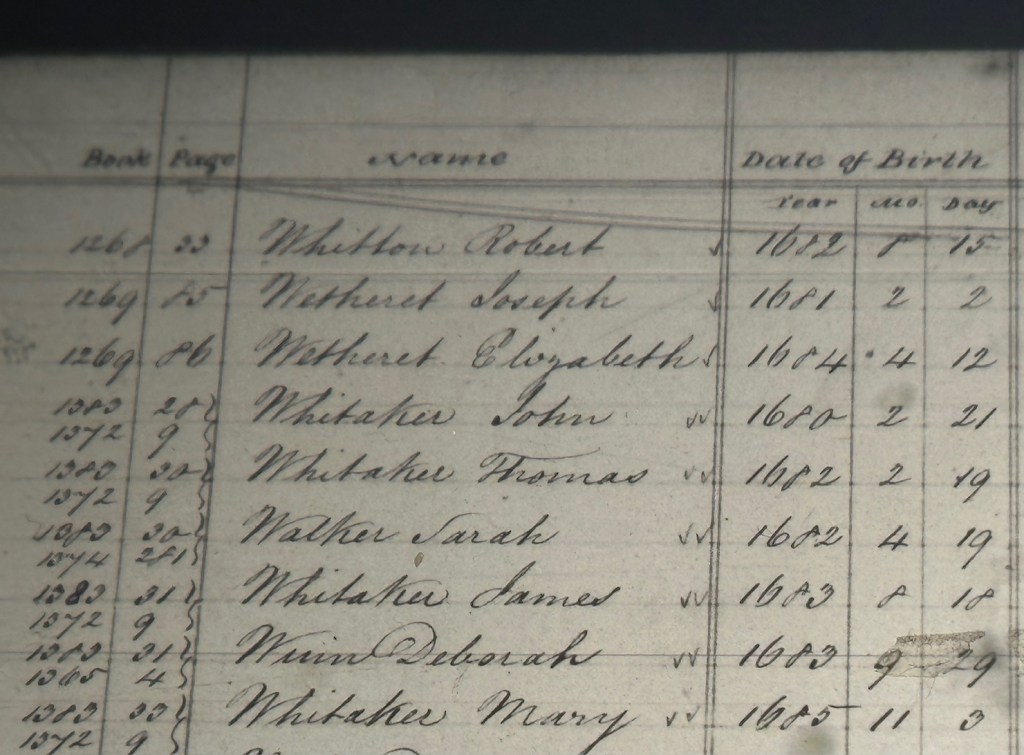
My ancestor, Joseph Whitacre (also spelled Whitaker), was born in Yorkshire in 1680. Was he part-Viking? Was he Norwegian? I already knew that he was a Quaker who set sail from Liverpool to Philadelphia on the ship Britannia in 1699. The pacifist Quakers were persecuted for their religious beliefs. They rejected the Church of England’s rituals containing elaborate ceremonies and set ways of worship. Quakers held a different understanding of divinity, believing in the “Inner Light,” or the presence of divinity within each person.

In the University of Leeds Brotherton Library basement, my daughter and I viewed microfilm records of the Quakers in Yorkshire in the 1600’s. There were so many names beginning with the letter W and my relative was not at the beginning of the W names (not listed alphabetically). The last name of Wilson might be next to Wood. When I finally saw Whitaker, John, whose father was also John, it was amazing!

Unfortunately, there was no occupation listed for his father, or his mother’s name, but I found what I was really interested in – his identity confirmed, his hometown named, and his siblings’ names. I was able to visit the site of his Quaker Meeting House, and his family’s town of Halifax, important in the wool industry at the time. Halifax was delightful, nestled in the dales of Yorkshire…one immigrant family line traced to their hometown, three lines to go.

Pearls of Peace (PoP) Quiz

395. Where did your precious ancestors live?

396. How many diverse groups of people might make up your family tree?  

Broaden-and-build Purls and Pearls

I cannot give away my grandmother’s crochet hook…yes, this is a scarcity mindset at work (see Pearls of Peace, 1-13-25). I am hooked on warm memories of my childhood hours in my grandparents’ home. I recall many hours that Grandma sat in her rocker, wearing her hand-sewn apron and dress, making one doily after another to gift the many females in her family and friend network. I never learned knit-and-purl stitches, but I watched with fascination as Grandma created with her crochet hook, building one stitch upon the next to broaden her handiwork. Handmade gift-giving was on her unofficial resume.  

Psychologist Barbara Frederickson created her broaden-and-build theory when she realized that there was a greater amount of research on negative emotions than positive emotions. For every positive emotion, there appear to be 3 negative ones! The reason for this disparity is that negative emotions are linked to our survival in big and small ways.

The broaden-and-build theory emphasizes that the expression of positive emotions can expand one’s repertoire of psychological, social, cognitive, and physical resources. Positiveness improves one’s resilience. It may help one’s coping skills. This approach is not meant to erase negative emotions but instead allows for the co-existence of both kinds of emotions.

A negative emotion is a protective signal that something does not “feel right.” When such emotions are brushed off, sometimes there could be dire consequences. The bodymind is a listening machine, always on lookout to protect one from physical and/or psychological harm. The idea with broaden-and-build theory is to make space for ALL emotions.

Expressing frustration in a trusted relationship is often necessary before gaining access to a more centered space where one can choose a positive action. The key is having an awareness of your positive emotions so that you can repair touchy situations. Building upon a growth mindset reminds one that others roll with negative emotions also.    

Here is a list of positive emotions that you can broaden-and-build for more resiliency. You probably do not need a list of negative emotions, as they seem ever-ready for action. However, you may miss out on positivity time if you do not have these positives tucked in your pocket for ready use:  

  • Admiration  
  • Affection
  • Altruism
  • Amusement
  • Anticipation
  • Awe
  • Cheerfulness
  • Confidence
  • Enjoyment
  • Enthusiasm
  • Euphoria
  • Gratitude
  • Happiness
  • Hope
  • Inspiration
  • Interest
  • Joy
  • Love
  • Optimism
  • Pride
  • Relief
  • Serenity
  • Surprise

Best of all, positive emotions are keep-on-giving gifts. I took interest in “crewel” (Welsh word for wool) embroidery when I was in graduate school dealing with a dissertation committee at odds with one another. I needed to broaden my outlook to create something that was positive, one stitch after another, for my own well-being. I realized that one situation is not destiny. Looking back on Grandma’s knit-and-purl self-therapy, I wonder what she was working through in her mind.  

Pearls of Peace (PoP) Quiz

361. When have you used an art form to increase your positive coping skills?  

362. How often do you catch yourself with an initial negative emotion in situations?

Legacy of True Thanks

Great-grandmother, Oakland, Maryland

A legacy has 3 ingredients: learning the truth about the past, living in the present, and building for the future, although people frequently substitute learning truths for embellished myths and then live in that past delusion, not in present moments.

This week of Thanksgiving, I keep gathering a long list of things that I am truly thankful for in this moment of time. I am especially thankful for my family, including ancestors with their legacy of strong values. While none are famous in the popular sense of fame, they possessed hero and heroine status in their own everyday ways.

The Wampanoag people who established sophisticated communities for 13,000 years — prior to the 1620 English immigration to “Plymouth” in “Massachusetts” — were everyday heroes and heroines too. (The new settlers named “Plymouth” for the port of Plymouth in England where they had set sail; “Massachusetts” was the first of many U. S. states to be given a Native American name.) 

Truthfully, it was due to the Wampanoag sharing of hunting and planting strategies that kept the Pilgrims from starvation. In October, 1621, 90 Wampanoag Native Americans and 52 Mayflower survivors gathered for a three-day feast. It was the Wampanoag’s daily legacy of giving thanks for nature’s bounty that predates the Pilgrim version of Thanksgiving.

The true Thanksgiving story contains tragedy for both the Pilgrims and Native Americans, but this is rarely the story told to school children. The reason for the Puritan passage was a desire for religious freedom, however an anticipated legacy of future freedom was short-lived for many. Out of 102 passengers (and 30-40 crew members) of the Mayflower’s December arrival, some died enroute and nearly half of the Pilgrims could not survive their first winter of religious freedom in America.

As told by Stephen C. O’Neill (The Life of Peregrine White), one young family’s plight seems poignant. William and Susanna White were Mayflower passengers with their 5-year-old son. Suzanna was pregnant and brought a wicker cradle onboard for baby Peregrine who was the first Pilgrim birth in the “new” land. Dad William died in February.   

The Pilgrims docked at an abandoned village where corn had been planted. Thankful for perceived good fortune, they had no idea that their “discovered” land was abandoned by Native Americans due to a rampaging illness (believed to be leptospirosis spread by rat urine contaminating standing fresh water).

Later, yellow fever was lethal to many English settlers but was especially devastating to the Native Americans. One estimation is that 45,000 Wampanoag, or two-thirds of these heroic people, succumbed to this epidemic.

The legacy of our ancestor stories is a cornerstone in our personalities, yet no one wants to talk about legacies of ancestor illness. For those of us truly fortunate to survive the COVID pandemic, let’s give thanks for health, a wealth far greater than any other.

Pearls of Peace (PoP) Quiz

239. What are you thankful for this Thanksgiving week?

240. How might you search for true stories of your ancestors?