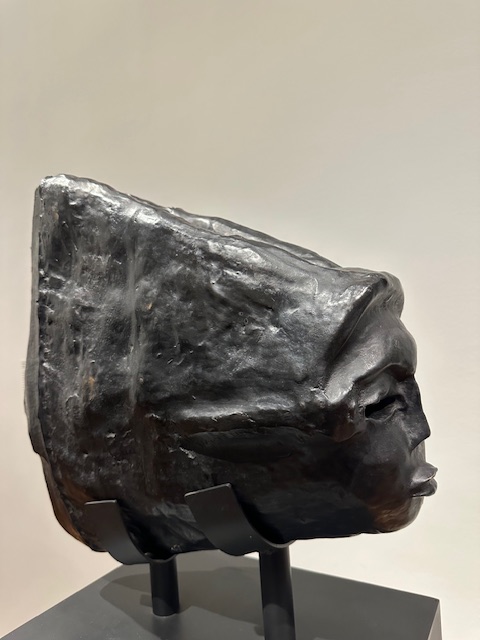
Black History & Herstory Month

To Craft a Double Consciousness or Two-faced, Theaster Gates, 2018, Art Institute of Chicago

Black History month has a predominant focus on men who championed racial equality — with some exceptions.

On Rosa Parks’ birthday (2-4-25), Congresswoman Joyce Beatty (Ohio) spoke passionately about Parks’ enduring legacy in U.S. voting-rights progress. The Rosa Parks Commemorative Coin Act was initiated to honor the lifelong peaceful equal-rights activist.

In 1996 Parks was honored with the Presidential Medal of Freedom and the Congressional Gold Medal in 1999. A department store seamstress, Parks received a nearly 100% affirmation vote with only Representative Ron Paul (Texas) in dissent for her Gold Medal. Parks observed the voting from her Detroit home where she had moved due to the firing from her seamstress job and her family enduring threats.

Upon her death in 2005, Parks was honored to lie in state in the U.S. Capitol Rotunda. In 2013 the Postal Service recognized Parks’ “soft” power with a Forever Stamp on her 100th birthday and Congress approved Parks’ statue in Statuary Hall for her importance in “forming a more perfect union” and “establishing Justice.” Her seated granite statue, dressed similarly to that momentous day on the Montgomery, Alabama bus, was the first full-length statue of an African American individual in the Hall. Her statue joined busts of Martin Luther King, Jr. (1986 placement) and Sojourner Truth (2009 placement).

Rosa Parks was a member of the NAACP and was elected secretary. She had knowledge of many injustices in mandated racial segregation in public places. When she was ordered to give up her bus seat to a white passenger, she merely sat still. Arrested, she was pronounced guilty of “disorderly conduct and violating a local ordinance.”

As Joyce Beatty took the Congressional podium, she elaborated on the iconic memory of Parks refusing to give up her bus seat: “Rosa Parks was more than one moment… as America nears its 250th birthday, we must honor not only our founding fathers but also the mothers of our democracy.”

Let’s honor more mothers of democracy as “first” Black women to crack ceilings: Barbara Jordan – Black Southern woman elected to Congress, Rebecca Lee Crumpler – Black woman graduate in U.S. medical school, Ida Lewis – editor-in-chief of Essence magazine, Ruth Batson – Black woman on Democratic National Committee, Ketanji Brown Jackson – Black woman on Supreme Court, and Kamala Harris among others.

A first National Youth Poet Laureate, youth role model Amanda Gorman took another Washington, DC podium. Invited by Jill Biden to address the nation at President Biden’s inauguration, Gorman’s words from “The Hill We Climb” are especially poignant at this time in U.S. history/herstory:

“…We lay down our arms
so we can reach out our arms
to one another
We seek harm to none and harmony for all
Let the globe, if nothing else, say this is true:
That even as we grieved, we grew
That even as we hurt, we hoped
That even as we tired, we tried”

Pearls of Peace (PoP) Quiz

371. What story do you tell for “a more perfect union?”

372. How are you growing from grief?                     

Disability Pride Pearls

July is Disability Pride Month. We commemorate the Americans with Disabilities Act (ADA) anniversary (becoming law July 26, 1990). The ADA civil-rights goal is to prohibit discrimination against individuals with disabilities. One might ask how often the law is working for the 1 in 4 adults in the U.S. who live with a disability. Individuals with intellectual and developmental disabilities are especially challenged in finding jobs — 85% are unemployed.

Self-acceptance and pride are themes every year, but the 2024 theme for the month-long celebration is “We Want a Life Like Yours.” Being inclusive and supporting everyone is part of our Declaration of Independence: We hold these truths to be self-evident, that all men [people] are created equal, that they are endowed by their Creator with certain unalienable Rights, that among these are Life, Liberty and the pursuit of Happiness…we mutually pledge to each other our Lives, our Fortunes and our sacred Honor.” Yes, dear weekly readers, I included these words in my blog about July 4th — on the topic of immigrants who were granted citizenship over that holiday week. There seems to be a need for shoring up our memories about what our country stands for.

Boston has the distinction of being first to celebrate Disability Pride in 1990, while Chicago is first in sponsoring a Disability Pride Parade (beginning in 2004). A Disability Pride flag was created with various colors to represent different types of disabilities: green for sensory disabilities, blue for mental illnesses, white for invisible or undiagnosed disabilities, yellow for neurodivergence, and red to represent physical disabilities. One wheel-chair-bound participant looks forward to the annual parade, calling it “a family reunion.”

The idea of any parade is to celebrate something, to take notice of something important, and to pause our busy lives for a period of focus. Too often, those with disabilities are not noticed — or are noticed but then overlooked when it comes to inclusive actions. Some individuals with disabilities have to cope with ableism issues every day.

July also is National Minority Mental Health Awareness Month or BIPOC (Black, Indigenous, People of Color) Mental Health Month. We need more open dialogues about mental health in America.  

Happily, in my hometown community I watched our local high school’s summer musical with pride. The cast was extensive with a chorus line that was three-deep for many songs! Among the singer/dancer chorus were high schools students with disabilities. When I realized this, I had goose bumps. Someone at the high school notices these students. I was on the faculty of this school as a school psychologist in the 1980’s, working with troubled students who were referred to as “Behavior Disordered,” a label that I reject. Acceptance from non-special-education staff was withering.

Perhaps times are changing in a good direction. Let’s speed up progress in acceptance for everyone and their particular needs. 

Pearls of Peace (PoP) Quiz 

309. Do you personally know someone with a disability?

310. If so, how does their disability affect you?