Broaden-and-build Purls and Pearls

I cannot give away my grandmother’s crochet hook…yes, this is a scarcity mindset at work (see Pearls of Peace, 1-13-25). I am hooked on warm memories of my childhood hours in my grandparents’ home. I recall many hours that Grandma sat in her rocker, wearing her hand-sewn apron and dress, making one doily after another to gift the many females in her family and friend network. I never learned knit-and-purl stitches, but I watched with fascination as Grandma created with her crochet hook, building one stitch upon the next to broaden her handiwork. Handmade gift-giving was on her unofficial resume.  

Psychologist Barbara Frederickson created her broaden-and-build theory when she realized that there was a greater amount of research on negative emotions than positive emotions. For every positive emotion, there appear to be 3 negative ones! The reason for this disparity is that negative emotions are linked to our survival in big and small ways.

The broaden-and-build theory emphasizes that the expression of positive emotions can expand one’s repertoire of psychological, social, cognitive, and physical resources. Positiveness improves one’s resilience. It may help one’s coping skills. This approach is not meant to erase negative emotions but instead allows for the co-existence of both kinds of emotions.

A negative emotion is a protective signal that something does not “feel right.” When such emotions are brushed off, sometimes there could be dire consequences. The bodymind is a listening machine, always on lookout to protect one from physical and/or psychological harm. The idea with broaden-and-build theory is to make space for ALL emotions.

Expressing frustration in a trusted relationship is often necessary before gaining access to a more centered space where one can choose a positive action. The key is having an awareness of your positive emotions so that you can repair touchy situations. Building upon a growth mindset reminds one that others roll with negative emotions also.    

Here is a list of positive emotions that you can broaden-and-build for more resiliency. You probably do not need a list of negative emotions, as they seem ever-ready for action. However, you may miss out on positivity time if you do not have these positives tucked in your pocket for ready use:  

  • Admiration  
  • Affection
  • Altruism
  • Amusement
  • Anticipation
  • Awe
  • Cheerfulness
  • Confidence
  • Enjoyment
  • Enthusiasm
  • Euphoria
  • Gratitude
  • Happiness
  • Hope
  • Inspiration
  • Interest
  • Joy
  • Love
  • Optimism
  • Pride
  • Relief
  • Serenity
  • Surprise

Best of all, positive emotions are keep-on-giving gifts. I took interest in “crewel” (Welsh word for wool) embroidery when I was in graduate school dealing with a dissertation committee at odds with one another. I needed to broaden my outlook to create something that was positive, one stitch after another, for my own well-being. I realized that one situation is not destiny. Looking back on Grandma’s knit-and-purl self-therapy, I wonder what she was working through in her mind.  

Pearls of Peace (PoP) Quiz

361. When have you used an art form to increase your positive coping skills?  

362. How often do you catch yourself with an initial negative emotion in situations?

Big-picture Peace

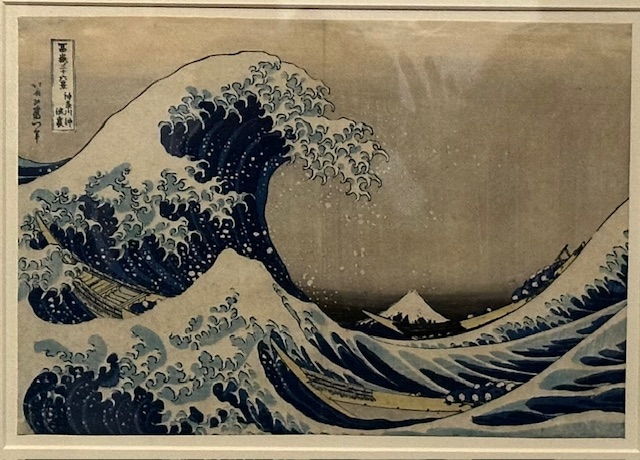
Under the Wave off Kanagawa, Katsushika Hokusai (1769-1849)

The United Nations International Day of Peace, annually set for September 21st, has a request: a 24-hour ceasefire of all hostilities on the planet. This year’s theme, “Cultivating a Culture of Peace,” calls for teaching the values of dialogue (see blog, “Mend Differences through Dialogue,” 8-19-24) and mutual respect to the 1.2 billion youth worldwide. Have we given up on adults knowing how to use dialogue and mutual respect in resolving conflicts?

It seems that adult problem-solving efforts to create peace on earth are like the tiny boats facing the looming giant wave in Katsushika Hokusai’s color woodblock print, Under the Wave off  Kanagawa. I must admit that the first time I saw this captivating image in Chicago’s Art Institute years ago, I was so focused on the wave action that initially I did not see the boats! Due to being on paper, the print is only on view for 3-4 months every 5 years. This original gem has re-surfaced from protective storage and again is on display (September 5, 2024–January 6, 2025) in the Art Institute’s Ando Gallery, my favorite room in the entire museum. This time, I knew to look for the boats. What if we are looking for world peace in all the wrong places?

Most museum visitors never see the Tadao Ando Gallery, or Gallery 109, as it sits in an innermost corner of the Art Institute’s Japanese collections. It is a compact space compared to many roomy galleries in other sections of the museum. Also, it is one of the few darkened spaces.

Ando was a self-taught architect. His haunting 16 free-standing wood columns in the womb-like environment compel one to slow down, take deeper breaths, and realize that this is a bodymind immersion into a different sense of time and space. Walking through the “forest” of oak pillars creates an atmosphere of peaceful reverence; the message is to refocus your gaze and get ready to look for what is beyond this “forest” grove.

We have English writer John Heywood to thank for his catchy proverb from 1546: “Can’t see the forest for the trees.” It seems to apply to many situations today, but especially to country leaders who lack the capacity to grasp the disastrous consequences of continuing wars. While dwelling solely on certain details, the big picture is often far from sightlines. Combating inequality, advocating for human rights, and championing climate actions for our planet are factors that lie beyond the immediate details of our international conflicts.

Re-look at Hokusai’s masterpiece. Mount Fuji holds still beyond the crashing wave. Again, we almost miss seeing beyond first details. This mountain is considered a spiritual place. How might we look for big-picture peace and create an interfaith spiritual culture for world dialogues? Isn’t peace first within a baby’s heart?

Pearls of Peace (PoP) Quiz 

327. When have you caught yourself missing some big-picture viewpoint?

328. How often do you refocus your gaze in looking for solutions to your personal sense of peace? 

Mend Differences through Dialogue

Egyptian Stela, Middle Kingdom, about 1870-1770 BCE

Interpretations of ancient Egyptian art are fascinating. According to the hieroglyphs on the above stela (a commemorative monument), scholars find that a son and his mother (Amenemhat and Yatu) are depicted with objects they might use in the afterlife. Along with clothing and food supplies (bread and beer), there is a cosmetic container under Yatu’s chair (a red and white container of “ointment”). One scholar refers to a blue jar under Amenemhat’s chair as eye paint (kohl); a second opinion labels this a “beer jar with a drinking straw.” Take your pick.   

Four horizontal lines of hieroglyph text offer a prayer: “A royal offering of Osiris, Lord of ‘Life of the Two Lands.’ May he give a mortuary offering of bread and beer, oxen and geese, linen, clothing, every good and pure thing whereon [the god] lives, for the ka [soul] of the guardsman Amenemhat, deceased, born of Yatu, deceased, and for the ka [soul] of his mother, his beloved, Yatu, deceased, born of Tita, deceased.”

Ever curious, I offer questions: Why is guardsman Amenemhat depicted with his mother, Yatu? What did he guard? Why is no father named in the stela story? Did the mother/son duo die at the same time? Was there a plague or war? Or was this gravestone initiated when a mother was dying and the two family members shared a final dialogue?

The definition of “dialogue” is a conversation between two or more individuals where discussion leads to resolving an issue or problem.

Too many families do not dialogue about important stuff. As psychiatrist Murray Bowen points out, “The person who runs away from his family of origin is as emotionally dependent as the one who never leaves home. They both need emotional closeness, but they are allergic to it.”

Too many countries do not dialogue about their differences and subsequently devolve into war. Are people allergic to problem-solving dialogues? Or do they lack the training to have dialogues?

It takes compassion to have a dialogue. I wrote about this in Transforming Retirement: Rewire and Grow Your Legacy: “Relating well with compassion for others takes the consciousness of the fittest. The most useful compassion description I have found is from Austrian Jewish philosopher Martin Buber. He differentiated I-Thou relating, or accepting the other person as sacred, from I-It relating where people treat others more as objects useful for one’s benefit. In I-Thou relationships there is a genuine dialogue where you discuss issues with another with your whole being. Such conscious relating can remove arbitrary boundaries between individuals. If both partners in a relationship believe in I-Thou dialoguing, they stop themselves from projecting their own painful stories onto the other.”

We might use Buber’s dialogue messaging to mend differences and negotiate an end to stuff — like barbaric wars.

Pearls of Peace (PoP) Quiz 

317. When have you dialogued successfully to resolve some tricky issue?

318. When in your life has dialogue broken down so that it seemed impossible to have individuals listen to one another?