Invest in Togetherness

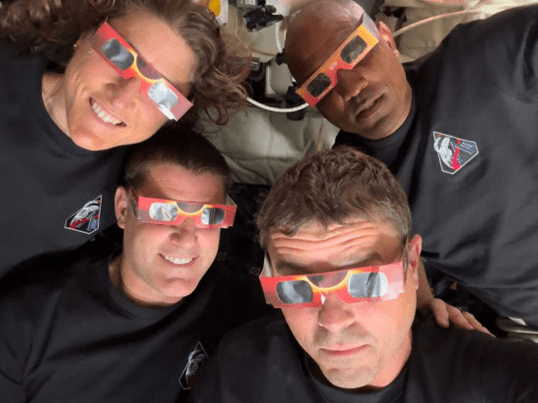
Artemis II crew in eclipse viewers to protect eyes in observing a solar eclipse during their lunar flyby

Artemis II Misson commander Reid Wiseman, pilot Victor Glover, and 2 mission specialists, Jeremy Hansen and Christina Koch, circled the far side of the moon. They traveled further in outer space than any other humans, unless unknown alien travelers might qualify as “human!” The utter joy of the astronauts in seeing first-time sights was contagious. I watched the splashdown with family and was spellbound by the sheer complexity of NASA predictions that the astronauts would return to Earth at 8:07 ET. A correction was made when first announced that it was 8:07 and 47 seconds, only to be updated to 8:07 and 27 seconds. This was one of countless NASA precision details that dazzled us.

The three Americans and one Canadian experienced Earth views that showed the entire planet in just one windowpane out of their spacecraft windows. “Trust us, you look amazing,” exclaimed pilot Victor Glover to those of us at home plate. The team of astronauts did not see wars. They did not see nation boundaries. They saw one colorful planet holding togetherness in the infinite cosmic darkness.

As the astronauts were heading home, Glover communicated with a fellow astronaut on the ground: “Tell the world to keep this energy going. Let’s invest in togetherness.”

Some readers will recall their goose bumps when watching another team of moon pioneers in 1969. Communication from that moon voyage sticks like velcro in your memory if you watched the epic moments: “That’s one small step for man, one giant leap for mankind,” exclaimed Neil Armstrong. Along with Buzz Aldrin, Armstrong walked in awe on the moon’s surface while lesser-known command module pilot Michael Collins orbited alone. During his solo sojourn he was cut off from radio communication for 21+ hours, but Collins calmly collected his teammates for a safe return home.

What effective communication are we humans cut off from today? With strife on many parts of our precious planet, our communication to resolve differences is key. Perhaps we are forgetting about the plaque that was left on the moon by Apollo astronauts with the following words: “Here men from the planet Earth first set foot upon the moon. July 1969 A.D. We came in peace for all mankind.”  The plaque held the signatures from the Apollo 11 crew and President Nixon.

Let’s applaud NASA on another successful space mission but let’s also take care of our planetary cousins. Too often we endorse peace for some, not all.

Civil Rights activist James Baldwin wrote in Nothing Personal, “…it is not fixed; the earth is always changing. The light is always changing; the sea does not cease to grind down rock. Generations do not cease to be born, and we are responsible to them.”

Yes, we owe it to future generations to invest in peace for togetherness on planet Earth.

Pearls of Peace (PoP) Quiz

488. What meaning do you take away from space exploration?

489. How might you engage in peaceful dialogues with someone who has different views from your own?

Inter-being Connections

Ugo Rondinone, Soul, Galerie Eva Presenhuber, Zurich, 2013

I read the book that my graduate school, Boston University, asked students to read as they began this new academic year. The choice was British novelist Samantha Harvey’s Orbital (2024 Booker Prize winner), about 6 astronauts on the International Space Station (actually 4 astronauts — American, Japanese, British, Italian — and 2 Russian cosmonauts). The novel was a fascinating blend of out-of-this-world details of living/working without benefit of gravity and the daydream/nightdream lives of the intrepid souls onboard.

Purposedly, I had not read the reviews before my own reading. I find that a reviewer’s comments often tell more about the reviewer than about a book. In any case, reviews were mixed. On the plus side, reviewers found Harvey’s writing “beautiful…contemplative.” She describes Earth as having fragility. Through the eyes of astronauts there were worries about personal fragility, like fending off nausea, while zooming around Earth 16 times a day in mind-dizzying circles.

Negative reviewers commented on “minimal plot,” a “lack of traditional character development” and finding “philosophical musings…lacking in substance.”

What caught my attention was how similar the international astronauts were in terms of their emotions. This should not be a surprise. The author places readers into a spacey, weightless interconnection with Planet Earth alongside the sacred space of weighty troubles of everyday people – a mother’s death, another’s unhappy marriage, and a third astronauts’ sick relative.

I agree with the reviewer who noted that the reader feels as if they “were up there with them” for the one day, a Tuesday, that the story unfurls in captivating description: “Over its right shoulder the planet whispers morning – a slender molten breach of light…they have each at some point been shot into the sky on a kerosene bomb, and then through the atmosphere in a burning capsule with the equivalent weight of two black bears upon them.” 

I appreciated a review from James Wood (in New York Times) commenting on earlier literary figures who longed to know what it would be like to travel in an airplane, but they were never afforded the opportunity: “…the poets and novelists who moved naturally from the mundane to the massive, who saw God and knew death and narrated time, who sensed that, beyond this ‘mundane egg’ (Blake) ‘This World is not Conclusion’ (Dickinson).”

Harvey’s haunting narrative can border on the poetic: “Some alien civilization might look on and ask: what are they doing here? Why do they go nowhere but round and round?”

Swiss sculpturer Ugo Rondinone also offers stark commentary on human nature in his Soul figures. While his primitive blocks of bluestone are not chiseled into perfection, as quarry trauma in the form of drill-holes and splits are visible, his overall repetition of forms makes a statement. Each individual sculpture is titled an emotional state – “The “Affectionate,” “The Surprised,” The Frisky,” “The Concerned.” We can identify. It’s called inter-being.

Pearls of Peace (PoP) Quiz

440. What are your views of space travel?

441. How do you interpret your own round-and-round days?