Invest in Togetherness

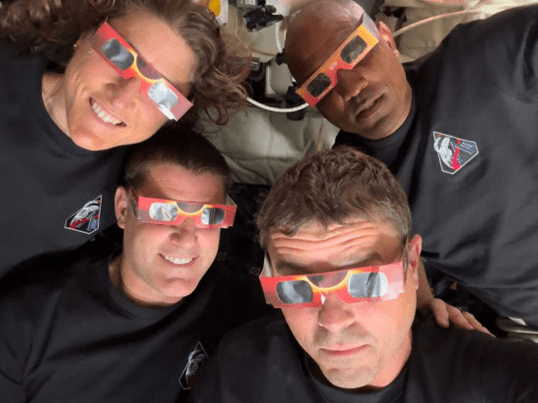
Artemis II crew in eclipse viewers to protect eyes in observing a solar eclipse during their lunar flyby

Artemis II Misson commander Reid Wiseman, pilot Victor Glover, and 2 mission specialists, Jeremy Hansen and Christina Koch, circled the far side of the moon. They traveled further in outer space than any other humans, unless unknown alien travelers might qualify as “human!” The utter joy of the astronauts in seeing first-time sights was contagious. I watched the splashdown with family and was spellbound by the sheer complexity of NASA predictions that the astronauts would return to Earth at 8:07 ET. A correction was made when first announced that it was 8:07 and 47 seconds, only to be updated to 8:07 and 27 seconds. This was one of countless NASA precision details that dazzled us.

The three Americans and one Canadian experienced Earth views that showed the entire planet in just one windowpane out of their spacecraft windows. “Trust us, you look amazing,” exclaimed pilot Victor Glover to those of us at home plate. The team of astronauts did not see wars. They did not see nation boundaries. They saw one colorful planet holding togetherness in the infinite cosmic darkness.

As the astronauts were heading home, Glover communicated with a fellow astronaut on the ground: “Tell the world to keep this energy going. Let’s invest in togetherness.”

Some readers will recall their goose bumps when watching another team of moon pioneers in 1969. Communication from that moon voyage sticks like velcro in your memory if you watched the epic moments: “That’s one small step for man, one giant leap for mankind,” exclaimed Neil Armstrong. Along with Buzz Aldrin, Armstrong walked in awe on the moon’s surface while lesser-known command module pilot Michael Collins orbited alone. During his solo sojourn he was cut off from radio communication for 21+ hours, but Collins calmly collected his teammates for a safe return home.

What effective communication are we humans cut off from today? With strife on many parts of our precious planet, our communication to resolve differences is key. Perhaps we are forgetting about the plaque that was left on the moon by Apollo astronauts with the following words: “Here men from the planet Earth first set foot upon the moon. July 1969 A.D. We came in peace for all mankind.”  The plaque held the signatures from the Apollo 11 crew and President Nixon.

Let’s applaud NASA on another successful space mission but let’s also take care of our planetary cousins. Too often we endorse peace for some, not all.

Civil Rights activist James Baldwin wrote in Nothing Personal, “…it is not fixed; the earth is always changing. The light is always changing; the sea does not cease to grind down rock. Generations do not cease to be born, and we are responsible to them.”

Yes, we owe it to future generations to invest in peace for togetherness on planet Earth.

Pearls of Peace (PoP) Quiz

488. What meaning do you take away from space exploration?

489. How might you engage in peaceful dialogues with someone who has different views from your own?

Everyone Needs SEL

Francesco Carta fotografo/Getty Images

March 2nd is SEL (Social Emotional Learning) Day 2026. This annual celebration highlights the many positive benefits of SEL immersion in all aspects of life. SEL Day is an international event that takes place during the first week of March each year with 88 countries onboard. The U.S. Senate introduced SEL Week in 2023 with a bipartisan resolution by Senators Susan Collins and Dick Durbin. The 2026 theme posts as “Skills for Community, Skills for Career.”

Social and emotional learning (SEL) is a proactive set of skills for children (and adults) to focus on mental health and well-being. The skills incorporate developing self-awareness, coping with emotions, setting and achieving positive goals, understanding and practicing empathy for others, building relationship competence, and making responsible decisions. An increasing need is for families, educators, business leaders, and whole communities to work together to promote SEL among students, our future leaders. A boost in academic learning is only one of the winners with such a systemic effort. SEL encompasses restorative justice, workforce readiness, and cultivating a lifelong growth mindset.

Russian psychologist Lev Vygotsky (1896-1934) set the stage for understanding one’s historical-cultural influence in their learning. He stressed the importance of one’s social environment – the attitudes and interactions – that each child is exposed to from their earliest years. His zone of proximal development espoused guiding children through a task rather than expecting them to work in isolation. He was a proponent of social negotiation as an essential step in a student’s mastery of concepts. Rather than traditional memorization methods, Vygotsky advocated a model of teacher-student questioning, clarifying, and predicting in a collaborative process.

The theory of scaffolding was applied to psychological arenas by cognitive psychologist Jerome Bruner in the late 1950’s. He used the construction term to outline young children’s oral language acquisition. Bruner’s principles also spotlighted social interactional support for students in learning new concepts; he believed that the temporary scaffolding could be removed, similar to construction scaffolding, when the support is no longer needed.

Building upon Vygotsky’s and Bruner’s thinking, school scaffolding in social and emotional learning (SEL) incorporates modeling, prompting and coaching by school staff. Emotional and social skills are introduced in a stepwise progression with the goal of gradually removing support as students exhibit competence and independence. This approach also applies to academics and athletics. 

It is a good idea to focus on scaffolding of children’s development of SEL. How might such scaffolding apply to adults who missed out on SEL in their schooling? This seems like our biggest challenge. In President Barack Obama’s words, “Learning to stand in somebody else’s shoes, to see through their eyes, that’s how peace begins. And it’s up to you to make that happen. Empathy is a quality of character that can change the world.”

SEL peer modeling, prompting and coaching for adults needs to be part of National SEL Week.

Pearls of Peace (PoP) Quiz

476. When do you use empathy?

477. What will you do to incorporate SEL for yourself this week?   

Mothers with Soft Power

Wellesley Centers for Women (WCW) held a colloquium (October, 2025) for 120 participants, “Mothers Without Borders: The Phenomenology of Mothers’ Soft Power in Peace Building.” The event was coordinated by Senior International Scholar-in-Residence Hauwa Ibrahim, J.D., S.J.D., M.L. In a keynote address former WCW executive director Susan McGee Bailey, Ph.D., explained the importance of this initiative: “Mothers understand that shaping a better world starts with each of us…We can’t change everything quickly, but we can change everything…By believing in ourselves and our vision, we can initiate major changes, not only in our own homes, but throughout the world.”

In her keynote address, Her Royal Highness, Nahla Al-Qassimi, Ph.D., associate professor and chair of Women Empowerment Council at Ajman University, United Arab Emirates, echoed mother-power: “A mother’s love is the most borderless thing on Earth…when mothers connect, the world becomes kinder, brighter, and stronger.”

Nigerian lawyer Ibrahim outlined mothers’ soft power (using persuasion, not coercion) with a poignant story. In Nigeria 337 girls were kidnapped in 2014 by Boko Haram, an insurgency opposing Western culture influences in their country. One captured kidnapper was tortured for 3 years because he refused to speak with authorities about his actions. However, when his mother was allowed to talk with him, she needed only 3 words before her son broke his silence. Ibrahim outlined women’s quiet resistance and soft power in influencing decision-making in men in power, especially regarding governing without use of force.

Women Without Borders has big plans for the world’s big problems. Her Royal Highness Dr. Al-Qassimi introduced soft-power initiatives in Beijing at the Global Engineering Congress. Lt. Gen. Fernando Giancotti of the Italian Air Force took the concept home with him to Rome after attending the colloquium. Assistant Inspector General Aishatu Abubakar Baju, Nigeria’s senior female police officer, carried mothers’ soft-power thinking to Johannesburg where she spoke at the African Women in Law Enforcement Conference.

On a sunny afternoon at San Diego Zoo and Safari Park, I saw 2 lions communicating; the male lion roared first. The female roared back. Back and forth for a few loud moments, there were clear signs of some relationship. Then the tour guide said the lions were brother and sister. But what was the message? Here are possibilities:

  • Bro: “Can you believe that breakfast this morning?”   
  • Sis: “We can’t really complain because we did not have to hunt all night for today’s food.”  
  • Bro: “You always stick up for the Government of Zoo.
  • Sis: “I am living in the present moment.”                                                                                               

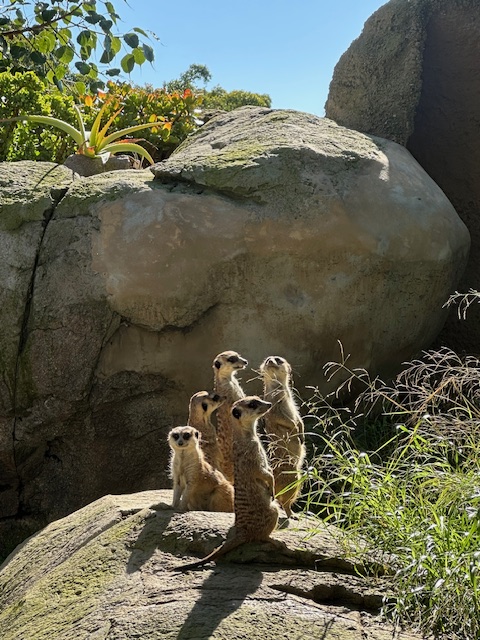
Consider some soft-power behaviors within meerkat packs. They take turns watching out for their pack while most are digging 5-8 hours above ground for food. If a predator threatens, the patrol-kat whistles a high-pitched alert. Young pups have many helpers in their pack. We will make progress on our precious planet when human mothers and fathers understand and use soft power.

Pearls of Peace (PoP) Quiz

464. When have you used soft power?

465. Have you ever regretted using aggressive/coercive power?