Wellesley Centers for Women (WCW) held a colloquium (October, 2025) for 120 participants, “Mothers Without Borders: The Phenomenology of Mothers’ Soft Power in Peace Building.” The event was coordinated by Senior International Scholar-in-Residence Hauwa Ibrahim, J.D., S.J.D., M.L. In a keynote address former WCW executive director Susan McGee Bailey, Ph.D., explained the importance of this initiative: “Mothers understand that shaping a better world starts with each of us…We can’t change everything quickly, but we can change everything…By believing in ourselves and our vision, we can initiate major changes, not only in our own homes, but throughout the world.”
In her keynote address, Her Royal Highness, Nahla Al-Qassimi, Ph.D., associate professor and chair of Women Empowerment Council at Ajman University, United Arab Emirates, echoed mother-power: “A mother’s love is the most borderless thing on Earth…when mothers connect, the world becomes kinder, brighter, and stronger.”
Nigerian lawyer Ibrahim outlined mothers’ soft power (using persuasion, not coercion) with a poignant story. In Nigeria 337 girls were kidnapped in 2014 by Boko Haram, an insurgency opposing Western culture influences in their country. One captured kidnapper was tortured for 3 years because he refused to speak with authorities about his actions. However, when his mother was allowed to talk with him, she needed only 3 words before her son broke his silence. Ibrahim outlined women’s quiet resistance and soft power in influencing decision-making in men in power, especially regarding governing without use of force.
Women Without Borders has big plans for the world’s big problems. Her Royal Highness Dr. Al-Qassimi introduced soft-power initiatives in Beijing at the Global Engineering Congress. Lt. Gen. Fernando Giancotti of the Italian Air Force took the concept home with him to Rome after attending the colloquium. Assistant Inspector General Aishatu Abubakar Baju, Nigeria’s senior female police officer, carried mothers’ soft-power thinking to Johannesburg where she spoke at the African Women in Law Enforcement Conference.
On a sunny afternoon at San Diego Zoo and Safari Park, I saw 2 lions communicating; the male lion roared first. The female roared back. Back and forth for a few loud moments, there were clear signs of some relationship. Then the tour guide said the lions were brother and sister. But what was the message? Here are possibilities:
- Bro: “Can you believe that breakfast this morning?”
- Sis: “We can’t really complain because we did not have to hunt all night for today’s food.”
- Bro: “You always stick up for the Government of Zoo.
- Sis: “I am living in the present moment.”
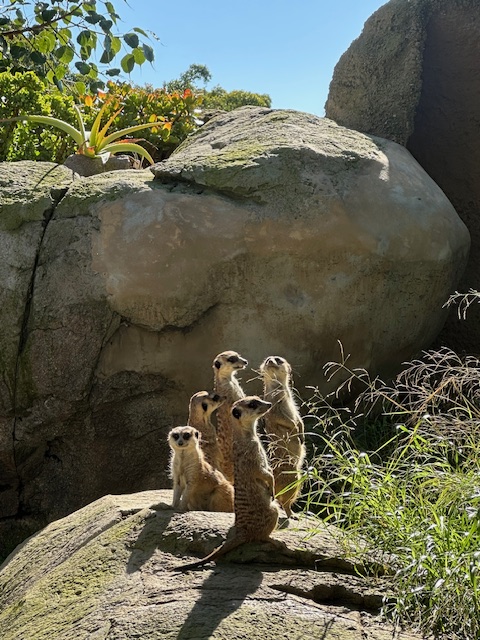
Consider some soft-power behaviors within meerkat packs. They take turns watching out for their pack while most are digging 5-8 hours above ground for food. If a predator threatens, the patrol-kat whistles a high-pitched alert. Young pups have many helpers in their pack. We will make progress on our precious planet when human mothers and fathers understand and use soft power.
Pearls of Peace (PoP) Quiz
464. When have you used soft power?
465. Have you ever regretted using aggressive/coercive power?
 Pearls of Peace: A Family Psychologist’s Circle-of-Life Blog