Winter Solstice Pearls

The Winter Solstice is an ancient holiday to recognize the importance of Sun’s energy. The pre-Christian Yule (jól) festival had its origins in Scandinavia but was later entwined (with other pagan celebrations) with the Christian holiday of Christmas. In the first century BC Roman calendar, Marcus Terentius Varro wrote that December 25 was the date for the Winter Solstice.

Yule (symbolizing renewal) in more “modern” times has a focus on reflection as well as celebration. To participate in solstice rituals today, one might consider the early symbolism of seasonal plants such as evergreen pine branches (healing), holly (God), and mistletoe (Goddess).  Rituals also include singing and sharing food.

Having a bonfire or lighting a Yule log in the fireplace symbolizes the elongation of daily sunlight as days become “longer” in terms of noticeable sunshine. Those who honor this ritual annually hold small pieces of last year’s log as reminders of aspects they had desired for the coming year. Spiritually, the Winter Solstice honors the renewal of more light while acknowledging the darkness that we harbor within ourselves. Each individual releases their remnants of dark thoughts/deeds into this year’s fire before setting intentions for the coming year. Might this begin your New-Year-resolution setting?

The Yule spirit includes an appreciation of nature, a good daily practice whether in sunlight or not. This unappreciated holiday (literally, holy day) is one of unity. Those who hold differing spiritual traditions might come together on the Winter Solstice, as celebrating our precious Sun belongs to no one spiritual tradition. There are no Sun territorial boundaries to war over.

Helen Berger, visiting scholar at Harvard Divinity School, suggests that paganism may be supplanting some Americans’ search for a less organized religion. “There’s this outward joyousness about the light.”  Pagan rituals for the Winter Solstice include a sacred circle with a cleansing of the inner space with smoke: “…in that circle, part of what we say is that we are in a place that is no place, and time is no time, and we are between the worlds.”

Child-literature writer Susan Cooper writes in her picture book, The Shortest Day:

“…this Shortest Day,
As promise wakens in the sleeping land:
They carol, feast, give thanks,
And dearly love their friends,
And hope for peace.
And now so do we, here, now…
Welcome, Yule!

Let’s take a higher road and be gratitude-ready. Let’s awaken a peace presence as sunshine increases each day by seconds until mid-January when there is a 2-minute-per-day increase. Remember, we share one planet (at least until immigration can begin on Mars) and ONE SUN.

Are our actions “modern?” Singer/songwriter Jennifer Cutting leads a way forward: “We pray for peace…so let us sing to welcome in the turning year…we hold the pen that writes the tale…to know what to keep and what to let go….”

Pearls of Peace (PoP) Quiz

353. What thoughts from 2024 might you release to a symbolic fire?

354. How might you prepare for peaceful relationships for the coming year?

Women Missing Equality’s Pearl

1st Place: in Web & Social Media Blog, Nonprofit (Government or Educational) -Illinois Woman’s Press Association, 2025

Georgia O’Keeffe, Slightly Open Clam Shell, 1926)

Actress America Ferrera’s “Barbie” movie monologue could apply to Mileva Marić Einstein: “It is literally impossible to be a woman. You are so beautiful, and so smart, and it kills me that you don’t think you’re good enough. Like, we have to always be extraordinary, but somehow, we’re always doing it wrong.”

Einstein’s first wife, Mileva Marić, was extraordinary. Let’s celebrate her 149th birthday this week on December 19th. Mileva did not make it into U.S. history books. Born in 1875 to an affluent Serbian family, Mileva attended an all-boys’ school as an adolescent where she was a mathematics and physics whiz. She began studying medicine at the University of Zurich before switching to Zurich Polytechnic. It was there she met German-born Albert Einstein. Mileva was the only female in her group of 6 students. Her grade in physics was 5.5 (equal to Albert’s), although she scored 5 in applied physics while Albert scored 1. Classmates described her as brilliant, not talkative.

Mileva’s academic career closed when she became pregnant with Einstein’s child. She returned to Serbia where their daughter was born. Baby Liserl contracted scarlet fever which left her with medical issues. It is unclear if the love child died or was placed for adoption in Serbia. Her name became a closed issue.

Letters betweenthe two physicistsexchanged between 1899-1903convey a collaboration on the theory of relativity. Mileva was methodical and organized, helping her man “channel his energy.” Albert wrote, “How happy and proud I shall be when the two of us together will have brought our work on relative motion to a victorious conclusion!” and “I need my wife. She solves for me all my mathematical problems.” He called Mileva his Doxerl (“doll” in a German dialect). Einstein’s parents opposed the relationship, citing Mileva was too intellectual, had a limp, and there were different religious and cultural backgrounds, but a marriage occurred in 1903. Over 100 years later, little has changed.

Son Hans Albert (born 1904) recalled both parents working together at the same table in the evenings. Despite Mileva’s career closing for parenting responsibilities, some scholars argue that she must be credited for helping Einstein formulate the theories presented in his papers. The marriage lasted until 1914 when Einstein separated from Mileva; he had begun a relationship with his cousin, Elsa Lowenthal, in 1912. Mileva moved out with the couple’s two sons (Eduard was born in 1910). In the divorce settlement Einstein was to give Mileva any award money he might receive from a future Nobel Prize.

Mileva once confided to her father, with cousin Sofija in the room: “… we finished an important scientific work which will make my husband known around the world.”  Mileva confided in friend Helene Savić: “With all this fame, he has little time for his wife…What is there to say, with notoriety, one gets the pearl, the other the shell.”

Pearls of Peace (PoP) Quiz

351. How have you experienced gender inequality?

352.  When will we create gender equality?      

Music as Change Agent

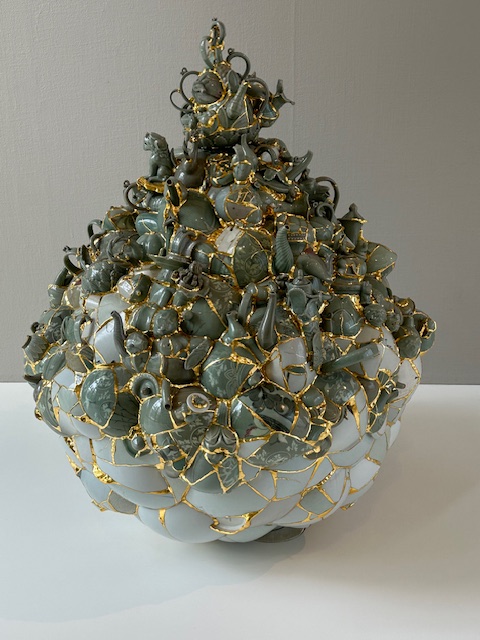
Translated Vase, Yeesookyung, 2015, Art Institute of Chicago

“We are going to change the world with music,” states one of Venezuelan Ron Davis Alvarez’s music students. Alvarez is a 2024 Top Five CNN Hero; he pieced together his free Dream Orchestra to give refugees, immigrants, and native Swedes an opportunity to learn an instrument. Beginning with 13 students, he characterizes his Dream Orchestra as music “family” with 405 current participants who speak 25 different languages in Gothenburg, Sweden. The 3-56 age-range participants rely on music as their common language. Alvarez’ dream is for Dream Orchestra to help people translate traumas through finding joy and compassionate connections in life.   

Native author Louise Erdrich captures the essence of both day/nighttime dreams: “What are dreams but an internal wilderness and what is desire but a wildness of the soul?” Alvarez could agree; he compares playing his violin to electricity. Music and art are energetic change agents; they can electrify both artists and their audiences.

Dreamer Alvarez grew up in a Caracas slum where drugs and violence were commonplace. His family moved frequently. His grandmother’s house was across the street from El Sistema, a free classical music training program for low-income communities. The young Alvarez heard wafting music from musicians practicing. He loved the sounds and learned to play violin at age 10; his zest for music led him to become a teacher at 14 and a conductor by age 16. He started Greenland’s first youth orchestra before settling in Sweden. Part of his Dream Orchestra is composed of refugee teenagers from Syria and Afghanistan who came to Sweden alone.  

Every Saturday his fledgling musicians gather in a church to make electricity. Alvarez defines music education: “It’s about giving you new opportunities [for] learning about life, about challenges, about dreaming, about…connecting you to your soul.”  

Conductor Alvarez bridges different cultures by having students learn a wide range of works from around the world, including many from their diverse homelands. He also teaches Swedish compositions, so students learn about their newfound home. Alvarez and some members of his orchestra help with housing, food, and connection to outside resources and support. This outgrowth from the music comes from the friendships formed. The Alvarez connection with his musicians runs deep: “When someone comes and says, ‘I have this problem,’ then we all have the problem.”

Hansson-Khorsand says he could not have adjusted to life in Sweden without the financial and emotional support he received from Dream Orchestra. Now married and a father to a young son, he has a job helping refugees find work. Alvarez is mentoring him in preparation for studying music at college.

Alvarez’ new dream is finding others to replicate his work. He has supported programs at refugee camps in the West Bank and Greece. Korean artist Yeesookyung also celebrates the beauty of imperfection and “second chances.” Connecting broken shards of pottery delivers a changed vessel.

      Pearls of Peace (PoP) Quiz

349. When has music helped you cope?

350. In what way has music changed you? 

Creativity and Well-being

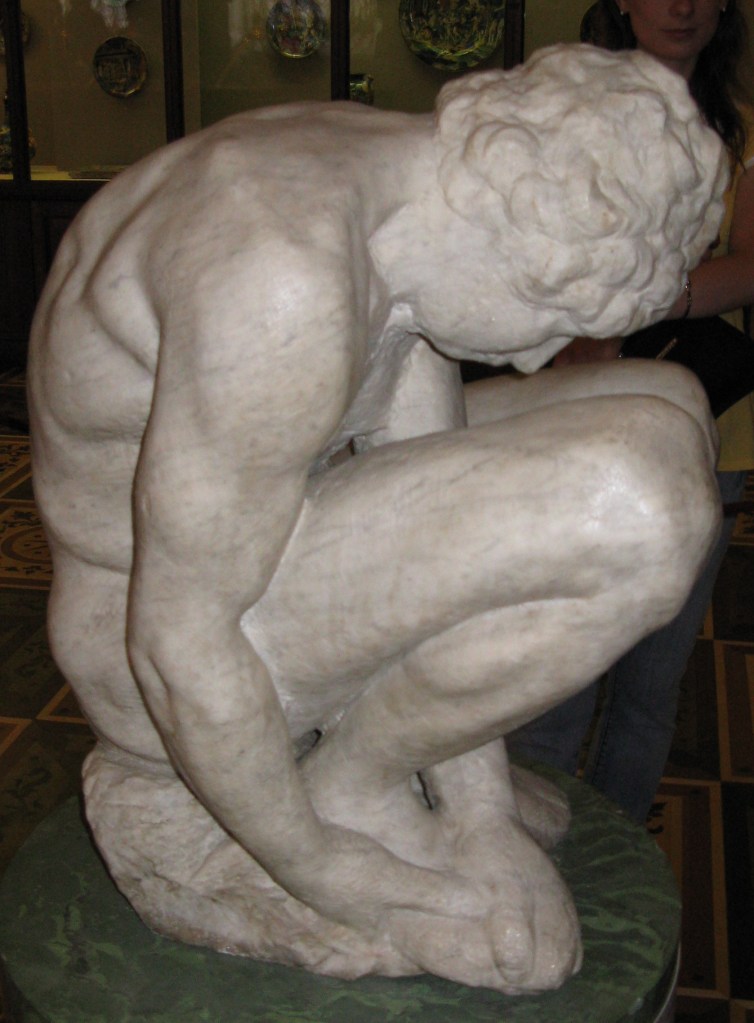
Michelangelo, Crouching Boy, 1530, The State Hermitage Museum, Saint Petersburg, Russia

Michelangelo created 42 sculptures. His Crouching Boy initially belonged to Italian banking and political dynasty Medici’s of Florence. In preliminary drawings for a double wall tomb for Lorenzo de’ Medici and his assassinated brother, Giuliano, Michaelangelo drew two crouching figures; only one was sketched in a final design. About 250 years later Crouching Boy was purchased by Russia’s Catherine the Great through a banker who did not know it was sculpted by Michelangelo. Its current home is the Hermitage Museum. If only sculptures could speak!

One interpretation is that ambiguous Crouching Boy is removing a thorn from his foot. There was a tumultuous political climate in Florence and Michelangelo was taking shelter in the monastery of San Lorenzo. Is Crouching Boy making a political statement? According to some scholars, Crouching Boy is considered an allegory of mourning – a grieving soul depicted in an unfinished marble statue in an oddly-seated position. A second opinion is that Crouching Boy is a representation of eternal youth. Take your pick.

Michelangelo led a solitary life and worked until dying at age 89. Aside from his renown as a sculptor, he was a poet. His poetry suggests that a younger man was his love interest. Whether or not he was a gay man who had to hide this fact, people in the 1500’s noticed that mostly nude men were his art form. As artist and activist Richard Kamler suggests, “Art is our one true global language…it speaks to our need to reveal, heal, and transform. It transcends our ordinary lives and lets us imagine what is possible.”

What meaning does “removing a thorn” have in today’s world? Wars are notorious for demonizing the other and for name-calling others who are not known personally. One might ask what constitutes a “thorn” today. We live in ambiguous times. Different interpretations for our global future abound.

Perhaps all of us would do well to turn to the arts. As authors Susan Magsamen (Founder/Director of the International Arts + Mind Lab at Johns Hopkins University School of Medicine) and Ivy Ross (VP of Design for hardware products at Google) eloquently write in their 2023 book, Your Brain on Art: How the Arts Transform Us, “…[the] alchemy of art and science is transforming our biology in ways that are both measurable and effective…artistic endeavors…effect beneficial outcomes for our physical and mental health…begin to create personalized arts practices. Like exercise and good nutrition, the arts on a routine basis will support your health.”    

The World Health Organization (WHO) defines mental health as a state of well-being whereby an individual realizes their own abilities, copes with normal life stresses, works productively, and is capable of making contributions to their community.

It took 35+ years to paint the ceiling of the Sistine Chapel. Perhaps you select a slightly smaller project? 

 Pearls of Peace (PoP) Quiz

 347. When have you turned to the arts for transformational time?

348. What do you notice when you are in creative mode?                              

Giving-Thanks

Let’s put Giving before Thanks in Thanksgiving.

 To set the record straight, Native Wampanoag people gave a successful corn crop to the immigrants who then declared a successful harvest in their first settler year. The two groups had a harvest gathering of the wary; at least 90 Native men and 50 Englishmen attended according to Plimouth Plantation colonial food expert, Kathleen Wall. Where were the women? Reportedly, Native givers dined on the ground according to their custom; the English sat at a table according to their custom. Why didn’t the thankful English join their benefactors by sitting with them?

Wampanoag leader Massasoit negotiated a treaty between his tribe and Plymouth settlers in 1620. They agreed that no individual of their respective groups would harm anyone from the other group. But tragedy was not averted; there was bloodshed. Complicating the fragile relationship between Native land dwellers and their nemesis neighbors, about 25,000 European colonizers crossed borders between 1630-1642. Including violent conflicts with settlers, the Native population lost more than half of their tribes as smallpox, measles, typhus and cholera decimated the indigenous people who had no immunity to newcomer diseases.

The holiday “Thanksgiving” became a U.S. national celebration after writer and magazine editor Sarah Josepha Hale petitioned four prior Presidents before President Lincoln agreed, issuing a gratitude proclamation in 1863. Nearly a hundred years later (in 1970) Native people gathered in Plymouth for a National Day of Mourning, not gratitude. Who tells the true story to school children?

Massachusetts celebrated the 350th Anniversary of the first landing of the Mayflower in 1970. Wampanopag leader Wamsutta Frank James was invited to speak at the banquet. Organizers requested a copy of his prepared remarks and then rescinded the invitation when James refused to read a redacted speech prepared by the PR team. The National Day of Mourning was initiated; 500 indigenous people (from 25 tribes) attended in Plymouth. As a commemoration of the suffering of Native people and a protest against racism, this gathering continues each year on the fourth Thursday of November. Listening to the granddaughter, Kisha James, of Wamsutta Frank James at a recent National Day of Mourning is a sobering experience: https://www.umassp.edu/deia/resources/supporting-indigenous-people/national-day-mourning

November was dubbed Native American Heritage Month by President George H.W. Bush in 1990. It also is called American Indian and Alaska Native Heritage Month. The Department of Defense reports that American Indians and Alaska Natives have one of the highest representations in the U.S. Armed Forces. When does America give thanks to indigenous people?  

Perhaps our country can introduce a nonprofit program meant for school children to all individuals. GiveThx defines the school behaviors expected for belonging and mental health in a given schools’ culture. At Lanai High and Elementary School in Hawaii these TORCH values were locally defined: Tenacious, Observant, Respectful, Compassionate, and Honorable. I am grateful that my children exercise these values.

Pearls of Peace (PoP) Quiz

345. What are your beliefs about Thanksgiving? 

346. Who might benefit from your gifting on this holiday?    

Compassion: The Peace Within

Inuit, Unknown carver, Art Institute of Chicago

Tania Israel, Professor of Counseling Psychology at University of California (Santa Barbara) is  author of the 2024 book, Facing the Fracture: How to Navigate the Challenges of Living in a Divided Nation. Rather than focusing on differences between voters, Israel takes a compassionate (and researched) approach: “We have more in common than we realize.”

  • There is a tendency to overestimate the distance between our viewpoints; two-thirds of Americans do not belong to either extreme of the political continuum. While voters may disagree on whether there is environmental climate change, many who voted for different candidates are exhausted by the divisiveness of today’s political climate.
  • Most Americans share core values, such as service, patriotism, and bipartisanship.
  • There are over 500 organizations that are working in earnest in the bridging movement to bring people together in the Listen First Project, a global nonpartisan nonprofit that was founded in 2013. The goal is to strengthen social cohesion and democratic principles.
  • Listen First conversations happen by following these 3 tips: 1) Listen with curiosity. 2) Speak from your own experience. 3) Connect with respect.
  • Our actions can change our beliefs. Look for unifying causes. Check out these brief You Tube clips: https://www.youtube.com/@ListenfirstprojectOrg/videos
  • Despite social media outlets that foster conflict, 53% of Americans across political lines report changing their social media diet in favor of more constructive choices.

Researchers are working on ways to reduce division. In a large study of online interventions, 23 of 25 reduced partisan animosity. Reducing support for undemocratic practices and partisan violence were intervention goals. Correcting misperceptions about “the other side” was one useful approach. Most individuals were found to value resilient and safe communities where healthy families can thrive.

Social psychologist Peter T. Coleman, Professor of Psychology and Education, Teachers College at Columbia University, initiated the Polarization Detox Challenge – a 20-day skill-building online experience designed to shape new habits for political tolerance and compassion. His ongoing research is one that you can join: https://startswith.us/pdc/exercises/

The Polarization Detox Challenge takes as little as 5 minutes a day. This is not an assignment! No one grades you. Dropping out is an option. Day One of The Detox Challenge is finding out (via a quick survey with results immediately) how much you believe in change. No surprise, I believe in people’s capacity for change!

“Research on more intractable conflicts has found that… when people believe that groups and situations are mutable and sometimes can change, they are much more likely to work to do so. Making this simple shift in mindset helps make it conceivable to see and realize possible solutions to problems where others see inevitable dead ends. The consequences of this simple difference have been shown by decades of research to be profound.”

Hanging on to a fixed mindset halts evolving problem-solving. Let’s correct any misperceptions with facts while embracing values that we hold in common. 

Pearls of Peace (PoP) Quiz

343. What are your thoughts about people who voted opposite from you?

344. How might you dialogue together?      

ANGER: The Trauma Within

Le Penseur (The Poet), Auguste Rodin, 1904, Musee Rodin, Paris

Do you have anger about the Presidential election results? Perhaps your anger has other targets, but anger is rampant these days. Drivers on the expressway seem impatient and angry, cutting off their partner drivers as if broadcasting, “Watch out! Get out of my way! I’m changing lanes — whether it’s good for you or not.” This Presidential election reminds me of such drivers; voters chose a candidate with a me-first mentality, only they cannot see that they may be next to be cut off in some future way.

It’s hard to remember that anger is only a part of your personality when it feels like a dangerous drone inside your bodymind is prepped for a destructive lift-off. Whoever is in the path of anger demolition, innocent or not, watch out!

Anger is not about “the enemy within,” but the trauma within. Anger is a protective emotion. It protects our own trauma within — our fears, our grieving, our insecurities, our prejudices and other vulnerabilities we disown in our personalities. All of us have fears, grieving, insecurities, prejudices and other vulnerabilities. “Who me?” you ask. Yes, all of us.

It takes introspective reckoning to admit to all parts of one’s personality.

French Auguste Rodin created The Poet sculpture (also known as The Thinker) as one part of a large commission – Gates of Hell –– for a doorway surround in 1880. His inspiration was Dante’s 14,233-line Divine Comedy. How can it be that Dante’s opening lines in 1300 seem relevant to 2024? Well, he wrote at a time of intense political disagreement in Florence, Italy:

“Midway upon the journey of our life I found myself within a forest dark, / For the straightforward pathway had been lost. /  Ah me! how hard a thing it is to say /  What was this forest savage, rough, and stern,  /  Which in the very thought renews the fear….”

Despite its name invoking entertainment, Divine Comedy (La Commedia) is a fire-and-brimstone allegory. It depicts three layers of an afterlife – Inferno (Hell), Purgatoria, and Paradiso – for the human traveler whose life journey is one of passionate anger, resentment, love, justice and faith. There is a moral in this Early Renaissance epic poem: redemption is possible if one repents sins. Dante distinguished between a weakness-of-will sin and sins characterized by deliberate will.

If visuals interest you more than a 6-hour read, see National Gallery of Art depictions: https://www.nga.gov/stories/dante-divine-comedy-in-art.html   

Whether or not your anger feels passionate on this Veterans’ Day of painful remembrances, anger always requires our attention. I cut off weedy stalks in my garden as one way of dissipating my anger last week. Then I listened to beautiful music. Like other emotional parts of our personalities, a current anger brings up previous times we felt angry. I greeted numerous memories of anger last week. I own them and I can heal them.

Pearls of Peace (PoP) Quiz 

341. What role does anger play in your everyday life?

342. How do you greet and heal your anger in a safe manner?           

A Bully-pulpit vs. Bullying

President Theodore Roosevelt coined the term bully-pulpit. His puzzling meaning included the fact that he knew he had a powerful leadership pulpit for advocating his agenda to a wide audience. Roosevelt wielded enthusiasm and selling power as he accomplished justice. Understanding both business and labor viewpoints, he intervened in the Pennsylvania coal strike of 1902. Promoting conservation, he expanded national parks/national forests and used executive orders to protect natural resources. His Emergency Banking Act held economic pieces together to prevent a run on banks. He held the line on monopolies. He helped establish the Food and Drug Administration to regulate food safety. His pulpit extended across the globe to make a more stable world. He fostered the building of the Panama Canal. He won the Nobel Peace Prize for his mediation skills in ending the Russo-Japanese War.

Today we have two candidates running for the U.S. Presidency who wield their bully-pulpit promises in opposite directions. Supporters sometimes are actual bullies. Name-calling in this election cycle will go down in U.S. history as winning a Most Vile Prize. A 47-year-old man said the following about his T-shirt: “I understand it’s derogatory…we can joke. We can wear crude shirts. Everybody here is having a good time.” A female vendor who sells vile T-shirts also equivocated: “I think it’s tacky but that’s what my customers want to buy, so that’s what I have.” Free speech was not intended to create laughter for some at the expense of trauma for others. How can bullying elevate a justice pulpit?

It is time for a justice reset.

A day away from Election Day, pollsters continuously arrange states’ puzzle pieces in favor of one candidate over the other. News outlets continuously question whether this group or that group will even show up to cast their sacred vote in the world’s most watched democracy.

It is time for a participance reset.

According to WBEZ’s Dan Tucker, Executive Producer of Reset, Australia handles their national elections in a far different manner from the U.S. method. Voting is mandatory in Australia. Their results seem to lead to more moderate political discussions, less voter disenfranchisement and overall, more voter trust. One only wins if one earns majority support. Wait, isn’t that what winning means? Isn’t that justice? A child understood the importance of justice in characterizing the interlocking pieces of the U.S. government.

With Australia’s voting system, no gerrymandering or voter suppression occur. To read more about the collaborative effort among WBEZ, the Chicago Sun-Times, and the University of Chicago’s Center for Effective Government, check out Democracy Solutions Project  (https://chicago.suntimes.com/democracy).

Another American Theodore, poet Theodore Roethke, penned these words: “In a dark time, the eye begins to see….” Let’s open our eyes to justice and seek higher ground in future elections. Let’s agree on one thing: “…pledge our allegiance…with liberty and justice for all.”

Pearls of Peace (PoP) Quiz 

339. Where do you see justice at the forefront in the U.S. today?

340. What ideas encourage a participatory democracy?        

Micro-aggression Stitches

Family Life, Susan Else, 2010, San Jose Museum of Quilts & Textiles

It is difficult to listen to the evening news in this pre-election season when one is bombarded with microaggressions, or outright aggressive threats, aimed at certain populations. Sexism that affects half of humanity, racism, ableism, ageism, and LGBTQ+ stereotyping cause everyday harm for many individuals. Targeted victims often incur deep wounds. It is easy to blame a few people when the real issues are buried within cultural caskets of prejudice layered with new soiling every century.

Psychology researcher Derald Wing Sue grew up in Portland, Oregon. He was not accepted in childhood as a Chinese American and often received cutting rude and crude discrimination. His later education led him to study institutional racism by way of Martin Luther King, Jr’s leadership. As coping siblings, two of Dr. Sue’s brothers also found their way to the field of psychology. Derald Wing Sue and his brother Stanley co-founded the Asian American Psychological Association.

With his brother David, Sue co-authored Counseling the Culturally Diverse: Theory and Practice. The adaptive approach to microaggression is what Sue terms “microintervention” — making the invisible visible, educating the perpetrator, disarming the microaggression, and seeking outside support. These goals need to be sewn into country-wide New Year’s Resolutions.

According to a 2023 survey by the Boys & Girls Club, 40% of school students (ages 9-18 across the U.S.) reported being bullied on school property; this represents a higher number than previous years. Of those bullied students, 55% said that they never told an adult about what happened. Cyberbullying is even more prominent with 82% of adolescents reporting offenses. These aggressive attacks can result in a student’s poor school attendance and performance, as well as an increased substance abuse risk and/or other mental health issues –  including suicide.

Violinist Tyler Clementi committed suicide in 2010 after cyberbullying. His Rutgers University roommate live-streamed Tyler and another male student in a sexual encounter shortly after Tyler’s freshman year began. No one deserves such treatment.

Bullying includes:

  • An aggressor with a sense of power (either real or perceived) and a targeted individual (who may be a victim in circumstances where no one even views the bullying behavior).

Bullying often includes:

  • Bystanders who either witness or hear about abusive behaviors but do not intervene or Upstanders who intervene (through interruption and reporting bullying) as well as offer support to targeted individuals.

Today we often hear the admonishment to “tone down the rhetoric.” This is like putting a butterfly band-aid on a large gaping wound. We need psychological stitches for those wounded by bullying.

Schools at every level must approach micro-and-macro aggression with ongoing system-wide approaches. Some teachers bully other teachers; they also require bullying prevention training. An anti-bullying program is available for free downloading through the Tyler Clementi Foundation’s #Day1 Campaign (to be administered on the first day of school or any time during the school year). https://tylerclementi.org/about/

Pearls of Peace (PoP) Quiz 

337. What microaggressions do you encounter as an adult?

338. When have you acted as an Upstander?             

Change: A Pearl-in-the-Making

Autumn is a good time to consider something that needs changing in your life. As more leaves change colors and eventually give way to their new legacy of providing mulch, envision a change or two for yourself. As R. Buckminster Fuller said, “You never change things by fighting the existing reality. To change something, build a new model that makes the existing model obsolete.”

Architect Buckminster Fuller was an intuitive systems thinker and futurist. His penchant for creating not just the amazing geodesic dome structure, but also new words, gives us a blueprint for our personal changes. Fuller both coined and initiated the field of Synergistics. His interdisciplinary approach encourages lateral thinking and incorporating nature: “I am confident that humanity’s survival depends on all of our willingness to comprehend feelingly the way nature works.” It is the feelingly comprehension of ALL of us that sent my mind on a search for a further explanation of Fuller’s ideas.

Professor of Leadership at Harvard Business School, Amy C. Edmondson worked as Chief Engineer for Fuller during the last three years of his 87-year life. Edmondson wrote Fuller a letter as an undergraduate student, asking him what people might do to make our planet work for everyone. What a wonderful question for each of us!

Edmonson’s easier-to-comprehend description of Synergistics is ALL about changing our mindset, something that I fully endorse as a psychologist (Fuller Explanation: The Synergistic Geometry of R. Buckminister Fuller). Ready for some mindset change? I have found a few beginner pearls in Synergistics (and life):

  • Let curiosity guide you. Say “image-ination” like Fuller (instead of imagination), because we are the architects of our images.
  • Self-directed examination of patterns and structure in nature will educate you.
  • Stop lying to children by saying, “Watch the sun going down.” This made me wonder why I say, “sunset.”
  • Fuller reminded audiences that we are accustomed to believing that reality is comprised of what one sees, smells, touches and hears, while we actually “live in a world of invisibles.”
  • “…there are no solids; matter consists exclusively of energy.” This is deep.

Most of us will not be known for BIG-C creativity as in Fuller’s producing 28 U.S. patents that gathered recognition in multiple honorary doctorates, but we exhibit little-c creativity whenever we change our mindsets.

Take a peak at Fuller’s childhood. Born to successful leather and tea merchant parents and grand-nephew of Margaret Fuller, the ardent women’s rights advocate, Fuller attended a Froebelian Kindergarten where he was influenced by the same geometric building blocks as Frank Lloyd Wright. This suggests to me that we need to wean school-age children off their gadget dependence to encourage more self-directed mindsets as in creative play, especially in nature.

As British primatologist and anthropologist Jane Goodall reminds us, “Every individual matters. Every individual has a role to play. Every individual makes a difference.”

Pearls of Peace (PoP) Quiz 

335. What difference are you making?

336. What is your current change or pearl-in-the-making?